
M&A and Fundraising Analysis for August 23, 2026
Retail media, defense, AI infrastructure, and nuclear fusion: a day where capital repositions itself on what controls flows—of audience, data, energy, or territory.
· Proplace
🌐 Translated from the French original by AI — the French version is authoritative.
🌡️ Sectors on the move — hover a sector to see its deals, click to open it
Filter, open a company, evaluate it against your own criteria — everything stays on this page.
🤝Signed-deals stream · 11 evaluable in the cockpit
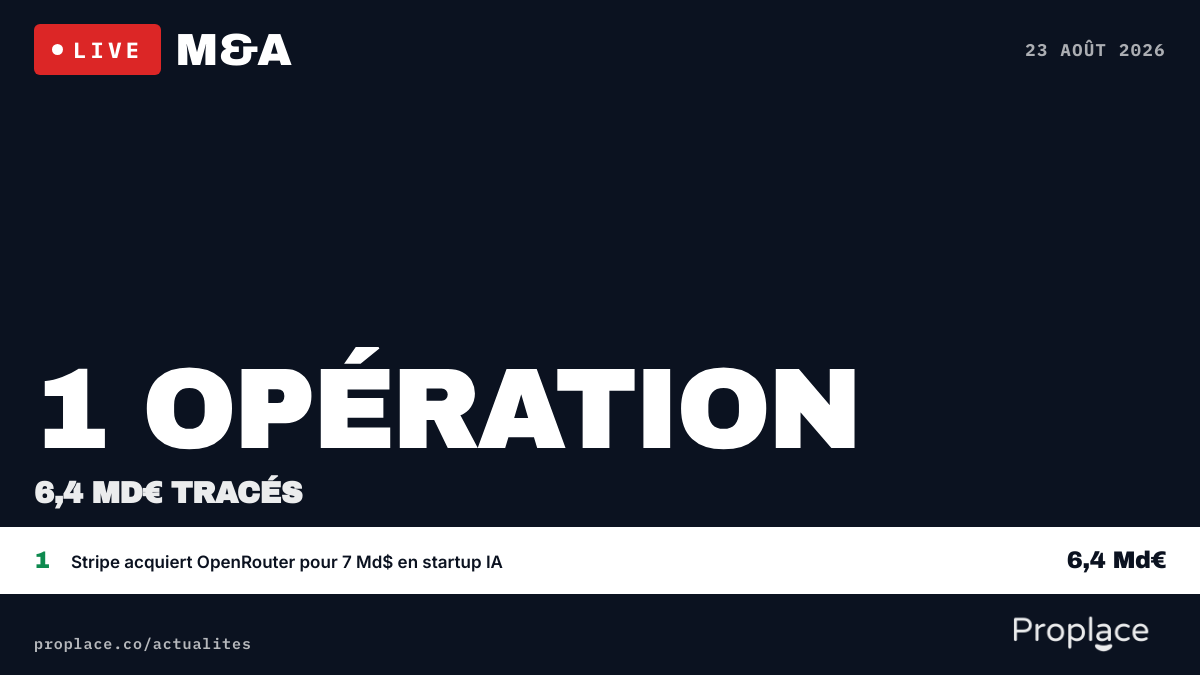
- OpenRouter — Stripe acquiert OpenRouter pour 7 Md$ en startup IA
Stripe acquires OpenRouter for €6.4 billion: AI agent infrastructure comes at a price
LIVE6,4 Md€StripeBuyerPlateforme de paiements et fintechOpenRouterTargetPlateforme d'agrégation de modèles IAPendingOpenRouterPlateforme d'agrégation de modèles IAStripePrétendantAnnoncéStatutproplace.co/actualites
Stripe is set to acquire OpenRouter for approximately $7 billion (or €6.4 billion). OpenRouter is an API router that allows developers to access dozens of AI models—GPT, Claude, Gemini, Mistral—via a unified interface, with a usage-based billing logic.
The obvious reading: Stripe is extending its empire of digital flow monetization to AI flows. But the mechanism is more precise. OpenRouter is not an AI model—it's a tollbooth. Every call to a model passes through it, is measured, billed, and routed. Stripe, which built its value on monetizing payment transactions, is acquiring the same type of asset on the AI layer: a metering and billing infrastructure that no one sees but everyone uses.
The valuation—$7 billion for a routing infrastructure—says something about what the market anticipates: that the volume of tokens consumed by AI agents will grow at such a rate that the toll itself becomes a strategic asset. For a software publisher or an IT department deploying AI agents, the acquisition means that usage-based billing will rapidly become more sophisticated—and that Stripe will likely be in the middle of the flow.
Walmart acquires Vibe: when a retailer understands that attention is worth more than margin
Walmart is set to acquire French advertising agency Vibe.co for approximately €1.2 billion. On the surface: a retail giant acquiring a tool to monetize its digital audience against Amazon.
The deeper reading lies elsewhere. Amazon understood before anyone else that selling products is a means, not an end. Its advertising division now generates more revenue than Prime and subscriptions combined—because it sells something rare: access to buyers at the exact moment they intend to purchase. Walmart watched Amazon build this machine for ten years. Today, it is paying €1.2 billion not to start from scratch.
Vibe is not a traditional media agency. It is an advertising targeting infrastructure for connected TV—the segment that captures budgets fleeing linear TV without going to social networks. By acquiring Vibe, Walmart is not buying an agency: it is buying technology that allows it to cross-reference its transactional data (what you buy in-store and online) with advertising inventories on a European scale.
For an advertiser or a French retail media player, the lesson is brutal: purchase data is becoming the most valuable advertising raw material, and the distributors who hold it will monetize it—either alone or by acquiring the tools to do so.
Qonto buries Regate and acquires Acasi: accounting as a conquest ground
Qonto is simultaneously making two moves: the discreet closure of Regate (its accounting management solution for chartered accountants) and the acquisition of Acasi, a direct competitor in the accounting firm segment, from the Paris Commercial Court. The amount was not disclosed.
The combination says it all. Regate did not work as expected—probably because chartered accountants did not adopt a tool imposed by their banking client. Acasi, acquired from the court, comes at a discounted price with an already established user base. Qonto abandons organic growth for opportunistic consolidation.
The dissatisfaction of chartered accountants is real, but it is also structurally predictable: whenever a financial platform integrates an accounting layer, it reduces the perceived added value of the firm. Qonto is building a financial operating system for SMEs—and in this model, the chartered accountant is either an integrated partner or a bypassed intermediary.
Airtable sold to Bending Spoons: anatomy of an 81% discount
Airtable is acquired by Italian company Bending Spoons for $2.25 billion (€2.1 billion). The company had reached a valuation of $11.7 billion at the end of 2021 after raising nearly $1.4 billion.
The 81% discount is spectacular, but it doesn't say who loses what. The mechanism is as follows: early-stage investors (Series A, B) have preferred shares with liquidation clauses—they recover their investment before others. Employees with stock options issued at exercise prices based on 2021 valuations see their options become worthless. Late-stage investors (Series F at $11.7 billion) absorb most of the loss in value.
Bending Spoons, a specialist in acquiring mature applications to optimize them operationally (Evernote, Meetup, WeTransfer), follows its usual logic: buy established user bases at a discounted price, reduce costs, monetize existing assets. For the teams in place, the Bending Spoons experience is documented—rapid restructuring and a focus on short-term profitability—which makes the operation predictable in its human as well as financial effects.
Datadog acquires Adaptive ML: observability extends to self-improving models
Datadog acquires Adaptive ML, a specialist in Reinforcement Learning Operations (RLOps), for an undisclosed amount.
Datadog built its position by monitoring what applications do in production. The acquisition of Adaptive ML extends this scope to AI models that improve through reinforcement—a category that escapes classic monitoring tools because the model's behavior changes over time, without explicit code updates. This is a defensive as well as offensive move: if Datadog does not monitor self-modifying models, a new layer of observability will emerge elsewhere and overtake it from above.
Schneider Electric pays €2.9 billion for Cognite: a multiple that raises questions, a logic that holds
Schneider Electric acquires Cognite, a Norwegian industrial software publisher, for $3.1 billion (€2.9 billion). Cognite generates just over $170 million in annual revenue—a revenue multiple of over 18x, which immediately sparked a skeptical reaction from the markets.
The multiple is high, but that's not the point. Cognite is an industrial data layer: it connects sensors, SCADA systems, digital twins of factories and energy platforms to make physical data readable by AI models. Without this layer, industrial AI remains a concept—it does not have access to field data.
Schneider Electric already sells physical infrastructure (electrical panels, energy management systems) to thousands of industrial companies. By adding Cognite, it controls both the hardware and the software layer that adds value to the data generated by that hardware. This is the same logic as a machine tool manufacturer acquiring the publisher of the control software: value is shifting from metal to software, and Schneider prefers to pay 18x revenue today rather than become dependent on a third party tomorrow.
💰Fresh-funding radar · 33 evaluable in the cockpit
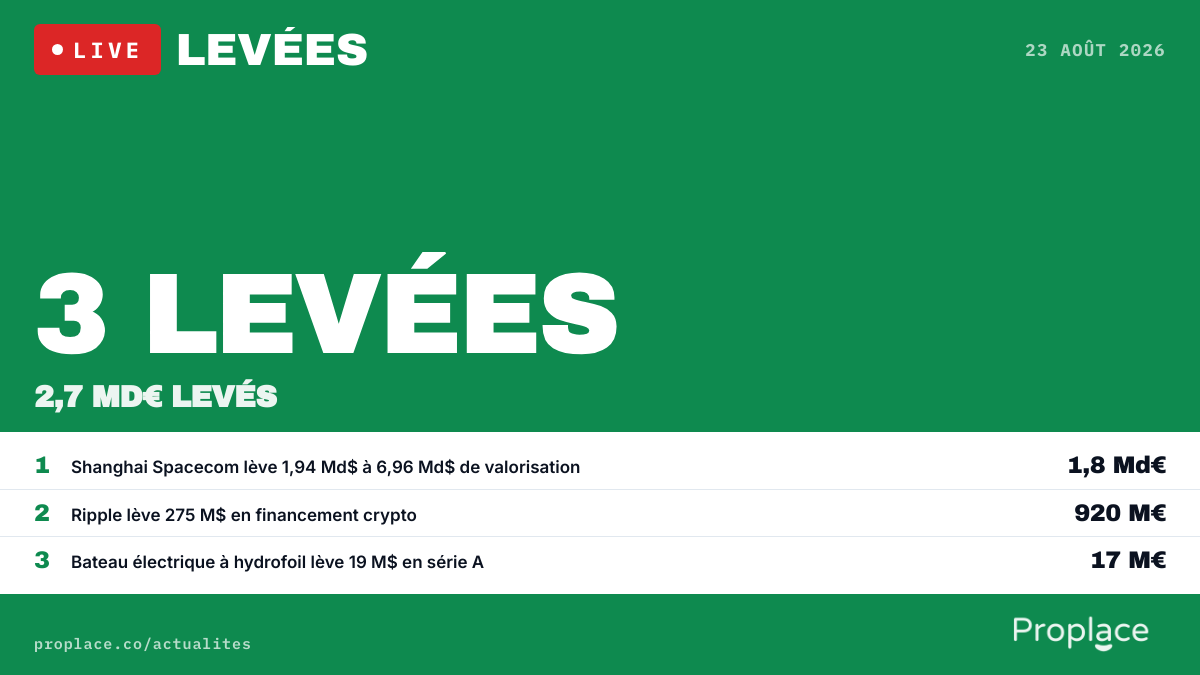
- Electric Hydrofoil Boat Maker — Bateau électrique à hydrofoil lève 19 M$ en série A
- Ripple — Ripple lève 275 M$ en financement crypto
ZeroStack and Ripple: a billion in crypto infrastructure
LIVE920 M€RippleProtocole de paiement blockchainRaiseRippleProtocole de paiement blockchainSeries DStadeÉtats-UnisPaysproplace.co/actualitesZeroStack raises $1 billion and Ripple raises $275 million in the crypto segment, for a reported total of €920 million for the week. Limited details available.
The return of mega-rounds in crypto infrastructure—after two years of post-FTX freeze—signals that institutional capital is once again considering the segment investable. The distinction between protocol infrastructure (what Ripple funds) and decentralized computing infrastructure (ZeroStack) remains crucial for evaluating the sustainability of these models.
- Shanghai Spacecom — Shanghai Spacecom lève 1,94 Md$ à 6,96 Md$ de valorisation
Shanghai Spacecom raises $1.94 billion: China builds its own constellation
LIVE1,8 Md€Shanghai SpacecomTechnologies et services spatiauxRaiseShanghai SpacecomTechnologies et services spatiauxSeries BStadeChinePaysproplace.co/actualitesShanghai Spacecom raises $1.94 billion in Series B at a valuation of $6.96 billion to deploy its communications satellite constellation.
China is building its equivalent of Starlink—not by imitation but by strategic necessity. A sovereign satellite communications infrastructure is now considered a national security asset on par with foreign exchange reserves. For European telecommunications operators and space agencies, the proliferation of constellations creates two simultaneous pressures: managing available frequencies and orbits, and tariff competition for global connectivity.
Alan at €5.5 billion: Prosus bets on health as infrastructure
Alan raises €480 million from Prosus, three months after a €100 million round, bringing its valuation to €5.5 billion and exceeding €1 billion raised cumulatively.
Prosus is one of the few funds in the world operating at this scale on long-growth technology assets—it has funded Tencent, OLX, Delivery Hero. Its entry into Alan's capital is not a signal of speculation on an upcoming IPO: Prosus typically invests for decades, in assets that become de facto infrastructure in their market.
The Alan thesis is simple to state, difficult to execute: replace fragmented health insurance with an integrated system where the insurer, doctor, and record are in the same application. The real asset is not the interface—it is the longitudinal health data accumulated on millions of members, which allows for anticipating costs, personalizing coverage, and, ultimately, influencing health behaviors. For a social protection group or a traditional mutual insurance company, Alan is no longer a health fintech to observe—it is a competitor building the asset you don't have: the behavioral data of your policyholders.
Skello raises €200 million: from HR SaaS to market consolidator
Skello raises €200 million led by Bridgepoint, based on over €50 million in ARR.
Bridgepoint is a private equity fund, not a venture fund. Its entry into a round of this size signals that Skello is no longer in an organic growth phase: it is in an acquisition phase. The management of schedules and working hours in hourly-intensive sectors (restaurants, retail, healthcare) is a fragmented market in Europe, with dozens of medium-sized local players. Skello has the recurring revenue, technology, and now the capital to consolidate them.
For a mid-sized European competitor in this segment, the signal is clear: the window to remain independent is closing, and the most likely acquirer has just raised enough to finance several acquisitions.
Elixir Aircraft raises €45 million: the trainer aircraft as a Trojan horse
Elixir Aircraft raises €45 million led by Bpifrance's SPI fund, with Odyssée Venture and Innovacom via Turenne Groupe.
The La Rochelle-based company manufactures light composite training aircraft. The segment seems modest—but it is strategic for a specific reason: the trainer aircraft is the first aircraft a pilot touches, and the global aviation training market is structurally under-equipped to meet the demand for commercial pilots in the coming decades. Mastering this segment means entering the supply chains and certifications of major airlines before addressing broader markets. The fundraising finances an industrial ramp-up—the real test will be the ability to meet certification and delivery deadlines in an industry where delays are the norm.
Sapiom raises €32 million: financial control for AI agents
Sapiom raises $35 million (€32 million) to build a financial management layer for AI agents.
The problem it addresses is real and underestimated. An AI agent can make dozens of calls to external models, use third-party tools, trigger transactions—without the company knowing precisely what each mission cost. When AI budgets were marginal, no one measured. Now that they represent significant lines in P&Ls, CFOs are asking for accountability. Sapiom aims to be the dashboard that answers this question.
This is a sign that enterprise AI is maturing: we are moving from the "deploy at all costs" phase to the "understand what we spend and why" phase. Governance tools always arrive after production tools—but they do arrive.
Comand AI raises €32 million: from command software to defense platform
Comand AI raises €32 million in Series A, led by Blossom Capital, with the entry of Swedish group Saab into its capital.
Eighteen months after an initial round of €8.5 million, the French startup specializing in military command software crosses a qualitative threshold. Saab's entry is not a financial signal—it is a signal of operational legitimacy. An established defense industrialist does not take a stake in a command startup without having validated that the technology works in real-world conditions.
For European armed forces seeking to modernize their C2 (command and control), Comand AI with Saab as a shareholder is now a credible interlocutor—which fundamentally changes its ability to access public defense markets.
Tsuga raises €30 million: monitoring AI agents costs money
Tsuga raises €30 million to reduce the monitoring costs of AI agents in production.
The paradox Tsuga addresses is counter-intuitive: AI is sold as a cost-reduction technology, but deploying AI agents in production generates a monitoring bill—logs, traces, anomaly detection, decision auditing—that can represent a significant fraction of the total budget. Tsuga offers a more efficient monitoring infrastructure so that the economic balance of agents remains positive.
With Sapiom (management control) and Tsuga (monitoring), two fundraisings on the same day address the same problem from two angles: industrial AI creates an overhead economy that now needs to be financed and controlled.
Flease raises €13 million: long-term leasing for used cars
Flease raises €13 million to offer long-term leasing of reconditioned company vehicles.
The long-term leasing market was built on new vehicles. Flease bets that pressure on corporate mobility budgets, combined with the growing maturity of the premium used car market, creates a window for an intermediate offering: the contractual advantages of long-term leasing (fixed rent, included maintenance, no capital immobilization) on quality second-hand vehicles. The model holds if the residual value of vehicles remains predictable—which is the real risk in an accelerating automotive market transition.
Lightbringer raises €8.6 million: AI against the monopoly of patent firms
Lightbringer raises €8.6 million to automate patent drafting and filing using AI.
Patents have long been a costly consulting product because translating a technical innovation into legal language acceptable to intellectual property offices required rare expertise. Lightbringer attacks this rent. If AI can produce patent descriptions of sufficient quality for SMEs and startups that cannot afford large firms, it democratizes access to intellectual protection. The risk is quality: a poorly drafted patent provides poor protection, and the consequences are measured years later during disputes—which makes evaluating the added value of the tool difficult in the short term.
Wheere raises €8.5 million: GPS for signal-free spaces
Wheere raises €8.5 million to deploy an indoor geolocation system combining terrestrial anchors and satellites.
GPS is blind as soon as you pass through a door. In warehouses, hospitals, airports, or construction sites, precise location of people and assets remains an unresolved problem on a large scale. Wheere is building a hybrid infrastructure that extends satellite precision to covered environments. This is a niche market with high potential in logistics and industrial safety—the real question is the cost of deploying the necessary physical infrastructure.
Linc raises €8.5 million: payroll as an entry point into accounting firms
Linc raises €8.5 million to offer accounting firms an AI-augmented payroll management tool.
With nearly 22 million pay slips produced each month in the French private sector, payroll is critical infrastructure—and a source of recurring revenue for the firms that manage it. Linc attacks this segment with a promise of reduced processing time and increased calculation reliability. In a market where accounting firms are under pressure for productivity and recruitment, a tool that reduces the time spent on repetitive tasks has a clear value proposition—provided that integration with existing software (Silae, ADP, Cegid) is seamless.
Optimabio: AI for hospital prescription
The Optimabio project, led by AP-HM, Hospices Civils de Lyon, CHU de Limoges, and startup Kiro, receives public funding to improve the prescription of medical biology tests using AI. The amount was not disclosed.
The prescription of biological tests is one of the most frequent decisions in hospitals and one of the least standardized. Optimabio aims to assist clinicians at the time of prescription to avoid redundant tests, suggest relevant assessments, and reduce costs. This is a public hospital infrastructure project—its success will depend on adoption by practitioners, who are historically resistant to decision-support tools perceived as restrictive.
Databricks raises $5 billion for the second time in eight months
Source: news.crunchbase.com → · Sector The Physical World — 📬 subscribe to the The Physical World newsletter
The Crunchbase digest indicates that Databricks is raising an additional $5 billion, eight months after raising the same amount. The round comes in a week dominated by data, AI, and defense infrastructure funding in the United States.
Raising $5 billion twice in less than a year is not a sign of organic growth—it is a signal of a race for computing and storage capacity where those who stop raising risk being overtaken by competitors before the market stabilizes.
Thrive Holdings raises €1.8 billion: OpenAI funds its own outlets
Source: techcrunch.com → · Sector B2B Software & Cloud — 📬 subscribe to the B2B Software & Cloud newsletter
Thrive Holdings raises $2 billion (€1.8 billion) at a valuation of $12 billion, with SoftBank, D1 Capital Partners, and Altimeter Capital as investors. Thrive Holdings is backed by OpenAI.
The structure deserves attention. OpenAI invests in a company whose mission is to deploy OpenAI's AI in enterprises. Thrive Holdings raises from external investors to finance this deployment—and a significant portion of this capital will end up in compute purchases from OpenAI. This is the same circuit observed elsewhere in the AI ecosystem: the model provider indirectly funds its own customers to ensure that demand exists—which makes OpenAI's revenues partially circular.
Travis Kalanick raises $1.7 billion for Atoms
Source: techcrunch.com → · Sector Industrial Tech & Manufacturing — 📬 subscribe to the Industrial Tech & Manufacturing newsletter
Travis Kalanick has raised $1.7 billion for Atoms, his new robotics company, while publicly criticizing the usefulness of VCs ("1% are really useful").
Criticizing VCs while raising $1.7 billion from them is a stance that says less about VCs than about Kalanick's ability to mobilize capital based on a reputation—which is precisely what VCs fund when they invest in founders with a track record.
Micro1 reaches $500 million in annualized revenue
Source: techcrunch.com → · Sector Education & EdTech — 📬 subscribe to the Education & EdTech newsletter
Micro1, an American startup specializing in AI training data production, reaches $500 million in gross annualized revenue amid the boom in model training.
The demand for quality training data—annotated, verified, structured—is one of the few segments of the AI economy where revenue growth is directly indexed to lab spending, without depending on uncertain enterprise adoption.
Tabs: an AI fintech at $400 million founded by a humanist
Source: news.crunchbase.com → · Sector FinTech — 📬 subscribe to the FinTech newsletter
Tabs, an AI fintech founded by Ali Hussain (a former humanities PhD student), raises at a valuation of $400 million. The round amount was not specified in the digest.
The founder's profile is anecdotal; what matters is the thesis: applying AI models to the management of invoicing and recurring revenue flows in B2B companies—a segment where contractual complexity creates real friction that existing tools manage poorly.
Lovable doubles its valuation to $400 million
Lovable (Swedish AI application development platform) raises $400 million and doubles its valuation. Mentioned in the day's dominant news and confirmed in the digest.
Lovable allows the creation of functional applications through natural language description. The doubled valuation in a few months reflects rapid adoption—and the thesis that barriers to entry in software development are structurally lowering. What Lovable sells is not code: it's time to market, which explains its adoption by non-technical teams who previously needed a developer to exist digitally.
Moove raises $250 million to manage robotaxi fleets
Source: techcrunch.com → · Sector Mobility & Transportation — 📬 subscribe to the Mobility & Transportation newsletter
Moove raises $250 million (€230 million) to develop autonomous vehicle fleet management, with the ambition of eventually owning Waymo robotaxis.
The robotaxi value chain is structuring: Waymo builds and operates the vehicles, but large-scale fleet management—maintenance, asset financing, operational optimization—is a distinct business. Moove positions itself on this intermediate layer. This is a bet that the robotaxi market will be large enough to justify specialized fleet operators—and that Waymo will prefer to outsource this function rather than vertically integrate everything.
Starcloud raises $250 million for orbiting data centers
Starcloud raises $250 million (€230 million) to build low-orbit data centers, in a context where access to launchers is tightening.
The idea seems speculative—but the rationale is precise: certain data processing tasks (satellite observation, military communications, distributed computing) benefit from being performed as close to the source as possible, in orbit, rather than repatriating massive volumes to terrestrial data centers. The constraint of access to launchers is real and creates a window for early entrants. The main risk is not technological but logistical: building and maintaining infrastructure in orbit at a cost that makes the service economically viable remains an unsolved challenge on a large scale.
Rocapine raises $13 million: the mobile app as a disposable product
Rocapine raises $13 million (€12 million) on the thesis that AI makes mobile application development fast and cheap enough for an app's lifecycle to drastically shorten.
For fifteen years, the scarcity of mobile development created lasting competitive gaps. If AI lowers the cost of creating an application to a few days and a few thousand euros, the barrier to entry disappears—but the barrier to retention remains intact. Rocapine's insight is that in a world of application abundance, distribution and loyalty become the only defensible competitive advantages.
Olix, Fractile, Etched: over a billion to challenge Nvidia on inference
Olix, Fractile, and Etched have collectively raised over $1.5 billion to develop chip architectures dedicated to AI inference—the phase where a trained model responds to queries in production.
The training battle was one of raw power, dominated by Nvidia. The inference battle is one of efficiency: producing the maximum tokens with minimum energy and cost. Three different players, three distinct architectural approaches—but the same conviction that Nvidia's general-purpose GPUs are oversized and over-consuming for large-scale inference. If one of them achieves significantly superior efficiency in specific use cases, it creates price pressure on the entire AI compute market—which is precisely what data center operators and software publishers need.
Scaleup Europe invests in Iceye: a €5.2 billion public-private fund makes its first bet
Scaleup Europe, a public-private fund with a target of $5.7 billion (€5.2 billion), makes its first investment in Iceye, a Finnish company specializing in radar observation satellites.
The choice of the first investment is always a signal about a fund's philosophy. Iceye operates SAR (Synthetic Aperture Radar) satellite constellations capable of seeing through clouds and at night—dual-use technology for civil (insurance, natural disasters) and military purposes. By choosing Iceye as its first investment, Scaleup Europe signals that it intends to fund European infrastructure of strategic sovereignty, not just commercial technology champions.
Quantum Systems raises $1.2 billion: from drone to intelligence platform
Source: frenchweb.fr → · Sector The Physical World — 📬 subscribe to the The Physical World newsletter
Quantum Systems raises $1.2 billion (€1.1 billion) to transition from a VTOL drone manufacturer to an operator of integrated intelligence platforms, combining drones, sensors, and satellite observation through its partnership with Planet.
The transformation is significant. A drone manufacturer sells hardware—limited margins, long cycles, dependence on public markets. An intelligence platform sells continuous information—subscriptions, data, analysis. Quantum Systems has accumulated two years of feedback from Ukraine to validate its sensors in real combat conditions, which is the best possible certificate for accessing European defense budgets. For European armies, the question is no longer whether they will buy drones, but from whom—and the Ukrainian experience is becoming the primary selection criterion.
Domyn raises over a billion dollars for its AI models
Domyn raises over $1 billion (€920 million) to develop AI models. Geography and limited details available in the digest.
A new lab raising over a billion confirms that the market for foundational models is not yet considered closed by investors—contrary to what the dominance of OpenAI, Anthropic, and Google might suggest. The real question for Domyn is differentiation: on which use cases or architecture does it intend to create a defensible position against competitors who are several years ahead?
Stark raises €500 million: European attack drones enter the industrial era
Source: frenchweb.fr → · Sector The Physical World — 📬 subscribe to the The Physical World newsletter
German startup Stark, specializing in attack drones, raises €500 million at a valuation of €3.2 billion, with Founders Fund (Peter Thiel) and Sequoia among the investors.
The entry of Founders Fund and Sequoia into a European defense startup is a structural signal. These funds have long avoided the defense sector for ethical and regulatory reasons. Their presence here indicates two things: the demand for attack drones in Europe is certain enough to justify a venture risk investment, and European regulations on dual-use technologies have relaxed enough to allow these structures.
For the French defense industry, which has its own players in combat drones, the rise of Stark with top-tier American capital is direct competitive pressure—not in ten years, but now.
Proxima Fusion raises €411 million: nuclear fusion leaves laboratories
Proxima Fusion raises €411 million to industrialize its stellarator nuclear fusion technology, in what is one of the largest European deep tech fundraisings of the year.
Nuclear fusion has long been the perpetually postponed promise. What changes with Proxima is not that fusion suddenly works—it's that private capital is starting to fund the industrial engineering phase, not just fundamental research. The stellarator approach (different from ITER's classic tokamak) offers superior plasma stability at the cost of greater manufacturing complexity—a problem that advances in additive manufacturing and high-performance computing are beginning to make solvable.
For energy infrastructure investors, the question is no longer whether fusion is possible but at what horizon it becomes competitive with next-generation fission nuclear power—and whether the €411 million is enough to achieve a convincing demonstration.
Airwallex raises $320 million: fintech as a financial operating system
Source: frenchweb.fr → · Sector FinTech — 📬 subscribe to the FinTech newsletter
Airwallex raises $320 million (€294 million) at a valuation of $11 billion, with the ambition of becoming the financial infrastructure for global businesses.
Airwallex started as an international payments solution for SMEs. It has gradually expanded to multi-currency accounts, corporate cards, and payment APIs for developers. The trajectory resembles Stripe's—but with a stronger foothold in Asian markets and a more directly banking approach. With Stripe acquiring OpenRouter to position itself on AI flows, Airwallex must accelerate its own diversification before the differentiation window closes.
Seedcamp raises €279 million: European seed seeks its next generation
Seedcamp raises €279 million for its new fund, after having supported Revolut, Wise, UiPath, and Synthesia in their early stages.
The track record is solid, but the context has changed. The next generation of European champions will emerge in an ecosystem where AI reduces development costs, where American growth funds are more present from Series A, and where competition among European seed funds has intensified. Seedcamp's true value at this stage is no longer the check—it's the network of founders and follow-on investors it has built over twenty years, and its ability to signal a startup's quality to growth funds.
Callosum raises €85 million in seed to unify models and chips
Source: eu-startups.com → · Sector Developer & IT Infrastructure — 📬 subscribe to the Developer & IT Infrastructure newsletter
Callosum raises €85.4 million in seed led by Atomico, with Plural, DCVC, and the UK Sovereign AI Fund, to build an infrastructure capable of running different AI models on different chip architectures transparently.
This is an exceptional seed round in terms of its amount—€85 million at the seed stage signals that investors consider the problem of chip heterogeneity (Nvidia, AMD, Intel, custom chips) critical enough to fund an infrastructure solution even before it is commercially validated. The participation of the UK Sovereign AI Fund is notable: it indicates that the United Kingdom considers this abstraction layer strategic for its AI sovereignty.
For IT departments deploying AI in production on hybrid infrastructures, Callosum addresses a real problem: dependence on a single chip architecture creates a concentration risk that few organizations can manage alone.
📩 Subscribe to our newsletter to follow daily M&A and fundraising news: https://proplace.co/newsletter
📰Today's news · 1313 in the edition · 1 evaluable in the cockpit
- LAM'ON — The EU-Startups Podcast | Interview with Angela Ivanova, co-founder and CEO of LAM’ON
📰Other news today — no identifiable company · 12outside the cockpit — explore via 🔎
- 10 European GridTech startups helping our energy systems cope
- [Korean Startup Weekly News #132] Record Investment Surge Powers AI - Wowtale
- Blackrock Survey Says Americans Looking Beyond Savings for Retirement|Bloomberg Businessweek - finance.biggo.com
- Et si le vrai enjeu de l’innovation n’était plus d’aller vite ?
- Forbes 2026 AI 50 List | Top Artificial Intelligence Companies - Forbes
- French Tech 120 2026 : à quoi ressemble l’économie française de la prochaine décennie ?
- IA : le courage managérial comme ligne de fracture
- La réglementation boomerang : ces lois qui manquent leur cible et pénalisent les entreprises européennes
- Le commerce conversationnel est déjà là : comment l’IA transforme l’expérience d’achat en ligne
- Recrutement Tech : la leçon d'élasticité que les grands comptes devraient emprunter aux scale-ups
- Two years after launch, Walmart’s Flipkart is closing in on India’s quick-commerce leaders
- UK government under pressure to change non-compete rules
Today's intro
Capital doesn't sleep in August. Between the acquisition of a French advertising agency by the world's largest retailer, the emergence of an infrastructure layer to monitor AI agents, and billions flowing into nuclear fusion and European combat drones, the day outlines three main trends: the battle for audience data among distribution platforms, the rise of an AI economy generating its own hidden costs, and a European technological rearmament that has moved from project to industrial deployment.
Set aside today · 149 (with reason)
- Castelion — already covered
- Tabs — already covered
- VCs — already covered
- Databricks — already covered
- Revolut — already covered
- IA — already covered
- Lovable — already covered
- Agents IA — already covered
- Article sponsorisé — already covered
- NIS — already covered
- Query fan out — already covered
- SAPIOM — already covered
- PDP — already covered
- HandleVisa — already covered
- Airtable — already covered
- PIIEC IA — already covered
- Olix — already covered
- Fractile — already covered
- Etched — already covered
- PRENUVO — already covered
- Ahead Health — already covered
- The Exploration Company — already covered
- Start-ups à impact — already covered
- RSE — already covered
- GYS — already covered
- Self-stockage — already covered
- Alarme maison connectée — already covered
- ERP — already covered
- TEDx — already covered
- Proxima Fusion — already covered
- Céleste — already covered
- Protection des mineurs — already covered
- Porelio — already covered
- Kiro — already covered
- NIS2 — already covered
- Skello — already covered
- Qonto — already covered
- WE LOVE ENTREPRENEURS — already covered
- SMS — already covered
- Elixir Aircraft — already covered