
Analysis of the day
M&A and Fundraising Analysis for August 6, 2026
Energy infrastructure, medical deeptech, unicorn fintech, and European industrial consolidation: capital is repositioning itself on what endures, deciphered for decision-makers and investors.
· Proplace
🌐 Translated from the French original by AI — the French version is authoritative.
📊 Today's pulse — 27 deals · 13 M&A · 14 fundraisings · €6.1bn in play.
Energy infrastructure marks the most significant French private equity transaction since the beginning of the year, while medical deeptech and European fintechs attract ambitious funding rounds. In parallel, industrial consolidation is advancing on several fronts—ventilation, water chemistry, precision electronics—with a common logic: building hard-to-dislodge positions in regulated or technical markets. Here is today's complete overview.
🤝 Mergers & acquisitions today · 13
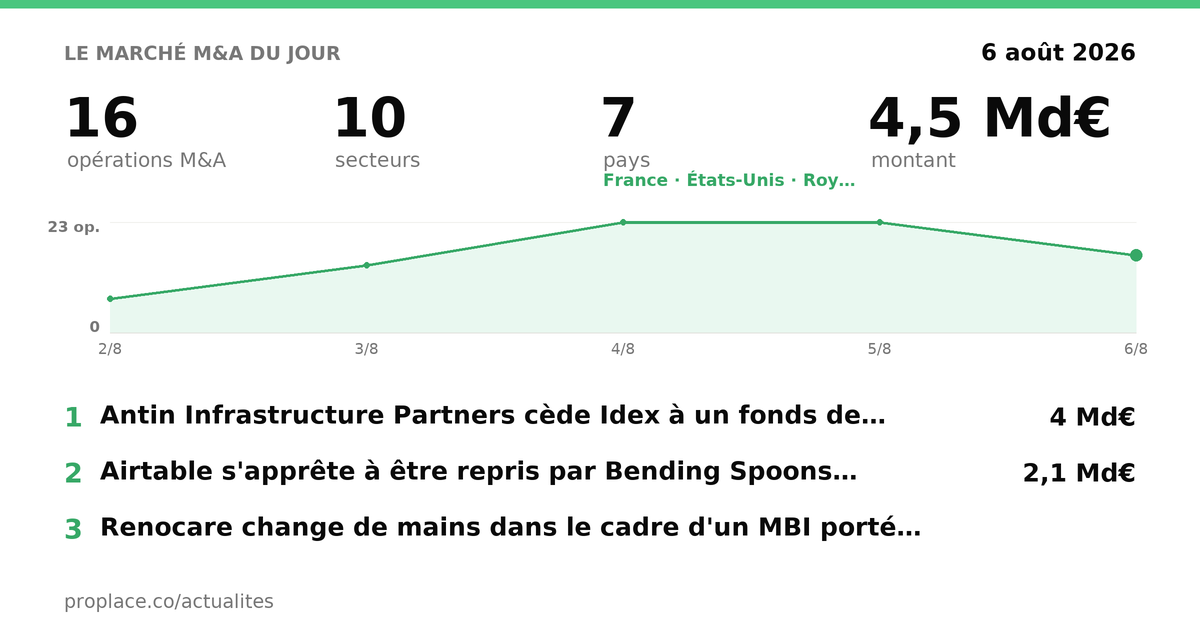
In focus — the deals we decoded
Antin sells Idex for 4 billion: when urban heating becomes the preferred asset for large funds
Antin Infrastructure Partners is selling Idex—an operator of urban heating and cooling networks, including the La Défense network—to a JP Morgan Investment Management fund for an enterprise value of 4 billion euros. Antin acquired Idex in 2018 for 1.3 billion: the investment has tripled in eight years.
The immediate reading is flattering for Antin: a good exit, price target met despite French political instability and Middle East tensions, a competitive sales process with several candidates before JP Morgan prevailed in the final stretch.
But what is at stake here goes beyond a fund's performance. An urban heating network is, by nature, a local monopoly: pipes are buried, concession contracts run for decades, and the client—the city, the landlord, the office building—cannot "change providers" as they would change telecom operators. This is exactly the type of asset that large institutional savings managers (pension funds, life insurers, sovereign wealth funds) are looking for in a world of durably uncertain interest rates: a predictable revenue stream, indexed to inflation, backed by irreplaceable physical infrastructure. JP Morgan is not buying a service company; it is buying a rent embedded in the city's concrete.
Second layer: the energy transition is pushing local authorities to develop these networks, not reduce them. Heating networks powered by geothermal energy, incineration units, or data centers (which reject heat) are at the heart of urban decarbonization plans. Idex, with its "still very significant prospects" according to sources close to the deal, is not at the end of a cycle—it is at the beginning of a new favorable regulatory cycle.
For an acquirer or French capital looking at this sector: the transaction sets a valuation benchmark for all similar assets in France and Europe. Mid-sized heating network operators, currently in first-generation PE portfolios, will find themselves in the spotlight.
Renocare acquired by search fund: SME transfer through a new channel
Source: cfnews.net → · Sector FinTech — 📬 subscribe to the FinTech newsletter
Renocare, a Bayonne-based SME specializing in home renovation in the Southwest, is changing hands as part of an MBI led by a search fund. Amount undisclosed.
The search fund is a mechanism still little known in France: an individual entrepreneur raises initial capital to finance their acquisition search, then a second capital to finance the purchase itself, before taking operational control of the target. It is a form of transfer that bypasses traditional institutional LBO channels and is particularly suited to profitable SMEs that are too small to interest mid-cap funds. In a French renovation market driven by regulatory obligations (DPE, MaPrimeRénov'), Renocare represents exactly the target profile that this channel addresses: stable cash flow, buoyant market, exiting founder.
Airtable sold to Bending Spoons for $2.25 billion: the cruel arithmetic of liquidation preferences
Airtable—an American no-code database platform—is acquired by Italian company Bending Spoons for approximately $2.25 billion (around 2.1 billion euros). The company had raised nearly $1.4 billion and peaked at a valuation of $11.7 billion in late 2021 during its Series F. The discount is 81% from the peak.
The raw figure is spectacular, but it doesn't say who truly loses. This is where the arithmetic becomes instructive. Early-stage investors (Series A, B, C) likely recovered their investment or made a modest gain, protected by their preference rights. Series F investors—those who invested at $11.7 billion in 2021 at the peak of the bubble—are the big losers: they financed a valuation that commercial reality never confirmed. In between, employees holding ordinary stock options saw their gains evaporate, and some intermediate funds may have made secondary sales before the exit, crystallizing losses or partial gains.
For any investor or executive currently negotiating funding round terms: the structure of liquidation preferences is not a boilerplate clause; it is the mechanism that determines, in the event of a disappointing exit, who absorbs the loss. The entry valuation is a view; preferences are a contractual reality.
Volution acquires getAir for 40 million euros: decentralized ventilation as a regulatory bet
Volution Group (LSE: FAN), a British manufacturer of energy-efficient ventilation solutions, acquires getAir GmbH, founded in 2014 in Mönchengladbach (Germany), for 40 million euros. getAir designs decentralized residential ventilation systems with heat recovery, sold to primarily German and European OEMs.
The logic is straightforward: European carbon reduction regulations make the adoption of heat recovery systems mandatory in new and renovated buildings. Volution consolidates a leadership position in Europe in this segment before regulatory demand compresses margins due to an excess of competitors. Acquiring product development capability (getAir) rather than just market share is the right reflex: in a market driven by standards, technical differentiation is the only sustainable barrier.
Codis acquires Catalent's Nottingham site: the complete spray drying chain
Source: prnewswire.com → · Sector Mobility & Transportation — 📬 subscribe to the Mobility & Transportation newsletter
Codis, a CDMO specializing in spray drying and amorphous solid dispersions, finalizes the acquisition of Catalent's Nottingham (UK) site. Amount undisclosed. Combined with its commercial site in Haverhill, Codis now claims the most integrated spray drying chain in Europe, from clinical development to commercial production.
The operation follows a classic build-up logic in pharmaceutical subcontracting: a specialized CDMO acquires complementary capacity to offer a continuum of service that its clients—pharmaceutical laboratories—do not have to fragment among several providers. In a CDMO market under consolidation pressure since the end of the Covid cycle, the ability to cover the entire development-production journey has become a supplier selection criterion, not a marginal advantage.
Kemira acquires REPUR: water chemistry enters activated carbon recycling
Source: kemira.com → · Sector Climate & Energy Tech — 📬 subscribe to the Climate & Energy Tech newsletter
Kemira, a Finnish group leading in chemical solutions for water-intensive industries, acquires REPUR S.r.l., an Italian company specializing in the thermal reactivation of spent activated carbon for municipal and industrial water treatment. REPUR generates just over 5 million euros in revenue and employs 21 people. Price undisclosed.
The size is modest, but the positioning is precise: activated carbon is a critical consumable in water treatment plants (depollution of micro-contaminants, pesticides, pharmaceutical residues), and its thermal regeneration allows it to be reused rather than replaced by virgin carbon. Kemira is not buying volume; it is buying circular service capacity in a regulated market—exactly the type of niche that resists economic cycles.
Hevo Group enters Germany via the acquisition of Müritz
Source: finance.yahoo.com → · Sector Food & AgTech — 📬 subscribe to the Food & AgTech newsletter
Hevo Group, the European arm of Global Eggs (Brazil), acquires Müritz, a German producer of organic and free-range eggs supplying Edeka, located 150 km north of Berlin. Amount undisclosed. The operation brings Hevo's capacity to approximately 180 million dozen eggs per year and marks its entry into Germany, Europe's largest food market.
Global Eggs, valued at $8 billion after Warburg Pincus's entry in March, is methodically building a continental egg production platform (Spain, now Germany), relying on local acquisitions rooted in existing distribution networks. In a food sector where raw material price volatility and health crises can destabilize an isolated producer, geographical diversification is both industrial insurance and a growth strategy.
Moore (Waterland) acquires Adagium: SME M&A consulting consolidates in the Brainport region
Source: dealnews.ai → · Sector Knowledge & Media — 📬 subscribe to the Knowledge & Media newsletter
Moore, a Dutch accounting and consulting firm backed by Waterland Private Equity, acquires Adagium, an M&A consulting firm for SMEs based in Veghel, in the Brainport region (Eindhoven). Founded in 2006, Adagium has completed over 450 transactions and has been named best Dutch acquisition firm three years in a row. Amount undisclosed.
Classic build-up in SME consulting: Waterland is densifying Moore's geographical and sectoral coverage in one of the most dynamic industrial regions of the Netherlands—Brainport is home to ASML, NXP, and a deeptech supplier ecosystem. Controlling M&A consulting in this ecosystem means positioning oneself at the heart of the divestment and acquisition flows of a region whose companies are, by nature, permanent targets or acquirers.
Waterland takes a majority stake in Norisol: technical insulation as a transition infrastructure
Source: dealnews.ai → · Sector Climate & Energy Tech — 📬 subscribe to the Climate & Energy Tech newsletter
Waterland Private Equity acquires a majority stake in Norisol, a Danish company specializing in technical insulation, scaffolding, and industrial services. MS2 Invest and historical shareholders retain minority stakes. Norisol employs over 800 people, boasts an operating margin exceeding 13% in 2025, and anticipates revenue exceeding 1 billion Danish kroner in 2026.
Norisol is present in renewable energy, data centers, defense, and carbon capture—all high-growth investment sectors in Europe. Technical insulation is one of those invisible trades without which no energy infrastructure functions: Waterland is betting on structural demand rather than technological disruption, which explains the robustness of the margins.
ASSA ABLOY acquires Gunnebo Entrance Control: physical security consolidates
ASSA ABLOY (Sweden), a global leader in security and access control, announces the acquisition of Gunnebo Entrance Control, a specialist in industrial access control (turnstiles, gates, airlocks). Amount undisclosed.
A clear sectoral consolidation operation: ASSA ABLOY absorbs a direct competitor in the physical access control segment, strengthening its coverage of industrial sites, airports, and critical infrastructure. In a context of tightening physical security requirements in Europe, the timing is consistent.
Abéo acquires 60% of Hurricane Group: urban sports equipment enters the listed perimeter
Abéo (sports equipment, listed on Euronext) acquires 60% of the capital of Hurricane Group, an urban sports player. Amount undisclosed.
Abéo extends its scope to urban sports—skateparks, parkours, indoor structures—a growing segment driven by the integration of urban disciplines into the Olympic Games and by demand from local authorities. The 60% controlling stake allows Abéo to integrate Hurricane while retaining the founding team in the capital, a classic scheme to preserve the product culture of a young target.
All of today's M&A, by sector
The full list for today — including the deals decoded above.
Industrial Tech & Manufacturing · 3 →
- Norisol — Waterland acquiert une majorité de Norisol pour accélérer sa croissance
- Engineering Thermoplastics Business — Mutares complète son plus grand rachat : l'activité thermoplastiques de SABIC
- Gunnebo Entrance Control — ASSA ABLOY acquiert Gunnebo Entrance Control, spécialiste des portiques de sécurité
Climate & Energy Tech · 2 →
- Idex — Le fonds Antin cède Idex, spécialiste des réseaux de chaleur, pour 4 milliards
- REPUR — Kemira acquiert REPUR pour renforcer son offre de traitement durable de l'eau
Biotech & Pharma · 1 →
- Catalent Nottingham — Codis acquiert l'usine Catalent de Nottingham pour renforcer son réseau spray dry
Construction & PropTech · 1 →
- Renocare — Un search fund acquiert Renocare, PME bayonnaise de rénovation d'habitations
FinTech · 1 →
- Adagium — Moore (soutenu par Waterland) acquiert Adagium pour développer la finance d'entreprise
Food & AgTech · 1 →
- Hevo (Global Eggs) réalise une acquisition en Allemagne dans le secteur des œufs
Gaming · 1 →
- Hurricane Group — Abéo acquiert 60 % d'Hurricane Group, spécialiste des sports urbains
Logistics & Supply Chain · 1 →
- GetAir — Volution Group acquiert GetAir en Allemagne pour renforcer sa présence
Mobility & Transportation · 1 →
- Options Travel — Engine acquiert Options Travel pour développer une plateforme de réservation IA
Other deals (sector not classified) · 1
- Innovation : cette deeptech lyonnaise cartographie l'invisible - Journal du Bâtiment et des TP
🚀 Fundraisings today · 14
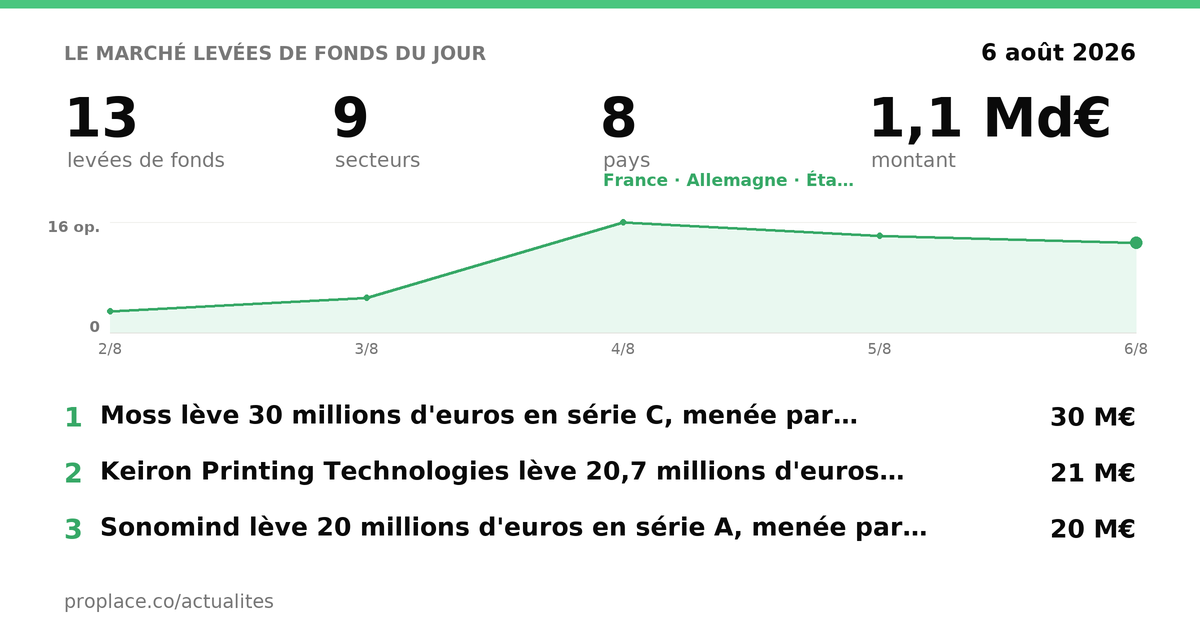
In focus — the deals we decoded
Ardian finances Arche MC2's takeover with 500 million in private debt: medico-social software as a recurring asset
Ardian arranges a 500 million euro unitranche financing to support the joint takeover of Arche MC2 by Montefiore Investment and Activa Capital, with significant reinvestment from management. The financing includes a credit line dedicated to external growth. Arche MC2, based in Aix-en-Provence, publishes software covering the entire value chain of social and medico-social aid actors in France. The company's valuation was between 250 and 500 million euros during the secondary LBO finalized in January 2026; revenue now exceeds 70 million euros.
The amount of financing—500 million for a company valued between 250 and 500 million—is worth noting. This is not an anomaly: the credit line for future acquisitions is included in the envelope, and unitranche private debt in B2B software with high recurring revenue is currently trading at high multiples, precisely because revenues are predictable and clients—medico-social establishments, nursing homes, associations—are unlikely to change management systems.
Arche MC2 illustrates a profile that the private debt market values maximally: a de facto quasi-monopoly in a regulated niche, public or parapublic clients whose budgets are ring-fenced, and a high barrier to change (data migration, training, integration with health insurance billing systems). For Montefiore and Activa, the external growth line financed by Ardian signals that the consolidation of the French medico-social software sector is only halfway through.
Sonomind raises 20 million to treat resistant depression with ultrasound: medical deeptech at the clinical stage
Sonomind, a French startup founded in September 2025, closes a 20 million euro Series A led by Critical Path Ventures and Bpifrance (French Tech Seed, Deep Tech 2030 / France 2030). The company is developing a low-intensity focused ultrasound therapy targeting deep brain structures, without surgery or implants, to treat drug-resistant depression—affecting 30% to 50% of depressive patients. A first trial in 2025 showed a 60% reduction in symptom severity after five days. The goal is CE and FDA marking by 2029.
The profile is unusual: a Series A of this size, less than a year after creation, for a technology that only has pilot data so far. What justifies it is the size of the addressable market (330 million people affected by depression according to the WHO, a significant fraction of whom experience treatment failure) and the absence of a credible non-invasive alternative in this segment—transcranial magnetic stimulation (TMS) has penetration limits, deep brain stimulation is surgical.
For an investor or medtech industrialist: the real risk is not the technology (focused ultrasound has a clinical history in other indications), it is the multi-center randomized trial starting in 2026. The data from this trial will be the true value marker—well before the 2029 CE marking.
Moss achieves unicorn status with 30 million euro Series C: SME expense management fintech crosses the billion mark
Source: sifted.eu → · Sector FinTech — 📬 subscribe to the FinTech newsletter
Moss, a Berlin-based fintech for SME expense management (corporate cards, invoice management, reimbursements, automated accounting), closes a 30 million euro Series C led by Portage with participation from Cherry Ventures. The valuation exceeds 1 billion euros: Moss becomes a unicorn. Founded in 2019, the company is regulated by BaFin under PSD2 and ISO 27001 certified.
A 30 million Series C to cross the billion valuation mark is an unusually low ratio—meaning that previous rounds had already valued the company very close to the threshold, and this round is more of a market signal than a massive funding need. The announced strategy—deploying configurable AI agents for each financial task—positions Moss in the emerging segment of automating SME finance functions, a market where traditional ERPs (SAP, Sage) remain oversized and costly for structures with fewer than 500 people.
Unicorn status in European fintech is now more of a recruitment and commercial credibility tool than an indicator of profitability. What matters next: the retention rate of SME clients and the ability to monetize AI agents without degrading regulatory trust—BaFin is watching.
Keiron raises 20.7 million to revolutionize solder paste printing: precision electronics deeptech
Source: emsnow.com → · Sector Industrial Tech & Manufacturing — 📬 subscribe to the Industrial Tech & Manufacturing newsletter
Keiron Printing Technologies (Eindhoven, Netherlands) raises 20.7 million euros in a Series A, co-led by Invest-NL, DeepTechXL, and Waves Capital, with participation from Ramphastos Investments, ATUM Ventures, Cottonwood Technology Fund, and TNO Ventures. The company is developing LiFT (Laser-Induced Forward Transfer) technology for high-precision solder paste printing in advanced electronics manufacturing.
Solder paste printing is one of the most critical and defective steps in printed circuit board manufacturing—a problem known for decades in an industry worth over 600 billion euros annually. Keiron's laser technology replaces mechanical stencils with an entirely digital process, eliminating a major source of defects and enabling geometries impossible with conventional methods.
The investment thesis is clear: as electronic boards become denser (embedded AI, defense, automotive), tolerance for solder defects collapses. Keiron is positioned on a bottleneck that the industry has not been able to solve otherwise. For a European equipment manufacturer or EMS, this is the type of process technology that can once again become a competitive advantage against Asian foundries.
conmeet raises 6 million in seed: an operating system for construction sites
conmeet, a construction technology startup, raises 6 million euros in seed funding from Reimann Investors and Smedvig Ventures to develop its AI operating system dedicated to construction sites. Operational details undisclosed.
The construction sector remains one of the least digitized in the economy, with productivity gains structurally lower than in manufacturing. Construction site coordination tools (planning, communication between trades, work monitoring) represent a fragmented market that several European startups are seeking to aggregate. At this stage of maturity, the key question is on-site adoption: workers and site managers are the true validation filter, not purchasing departments.
📩 Subscribe to our newsletter to follow daily M&A and fundraising news: https://proplace.co/newsletter
All of today's fundraisings, by sector
The full list for today — including the deals decoded above.
B2B Software & Cloud · 3 →
- Estel Technologies — Estel Technologies lève 270 K€ en pré-seed pour sa plateforme commerciale
- Ardian accompagne un éditeur de logiciel français via de la dette privée - L'Agefi
- Shiplog — Shiplog lève 1 M$ en pré-seed pour son IA de customer intelligence B2B
FinTech · 3 →
- Moss — Moss lève 30 M€ en série C et atteint le statut de licorne avec sa suite IA finance
- Moment — Moment lève 22 M$ en série A pour accélérer les paiements en Afrique
- Aavalynx — Aavalynx lève 1,5 M£ en pré-seed pour son offre fintech
MedTech & Devices · 2 →
- Sonomind — Sonomind lève 20 M€ pour sa thérapie par ultrasons et vise un marquage CE en 2029
- Twinsight — Twinsight lève 1,6 M€ pour commercialiser SurgiTwin 3D aux États-Unis
Construction & PropTech · 1 →
- conmeet — conmeet lève 6 M€ en seed pour son OS IA pour la construction
D2C & Consumer Brands · 1 →
- Féroce — Féroce lève 3 M€ et lance des boxes protéinées pour élargir son marché
Developer & IT Infrastructure · 1 →
- HappyRobot — Orange investit dans HappyRobot, spécialiste des agents IA autonomes
Industrial Tech & Manufacturing · 1 →
- Keiron — Keiron lève 20,7 M€ en série A pour sa technologie LiFT en électronique
Robotics & Automation · 1 →
- Exclaim Robotics — Exclaim Robotics lève 4,29 M€ en pré-seed pour des robots autonomes en data centers
Space Tech · 1 →
- ICEYE — ICEYE lève 1 Md€ en série F avec le soutien du fonds Scaleup Europe