
Analysis of the day
Analysis of M&A & Fundraising Operations on July 31, 2026
Digital sovereignty, industrial consolidation, and deeptech capital: a busy day in France and Europe, from Orange's massive AI infrastructure injection to Dassault's bets on aerial autonomy.
· Proplace
🌐 Translated from the French original by AI — the French version is authoritative.
📊 Today's pulse — 33 deals · 19 M&A · 14 fundraisings · €7.5bn in play.
Infrastructure, sovereignty, sectoral consolidation, and deeptech capital — July 31st saw movements that, taken together, outline a European reflex: to regain control over what is becoming strategic, be it computing, cybersecurity, law, or energy. Here is the complete overview.
🤝 Mergers & acquisitions today · 19
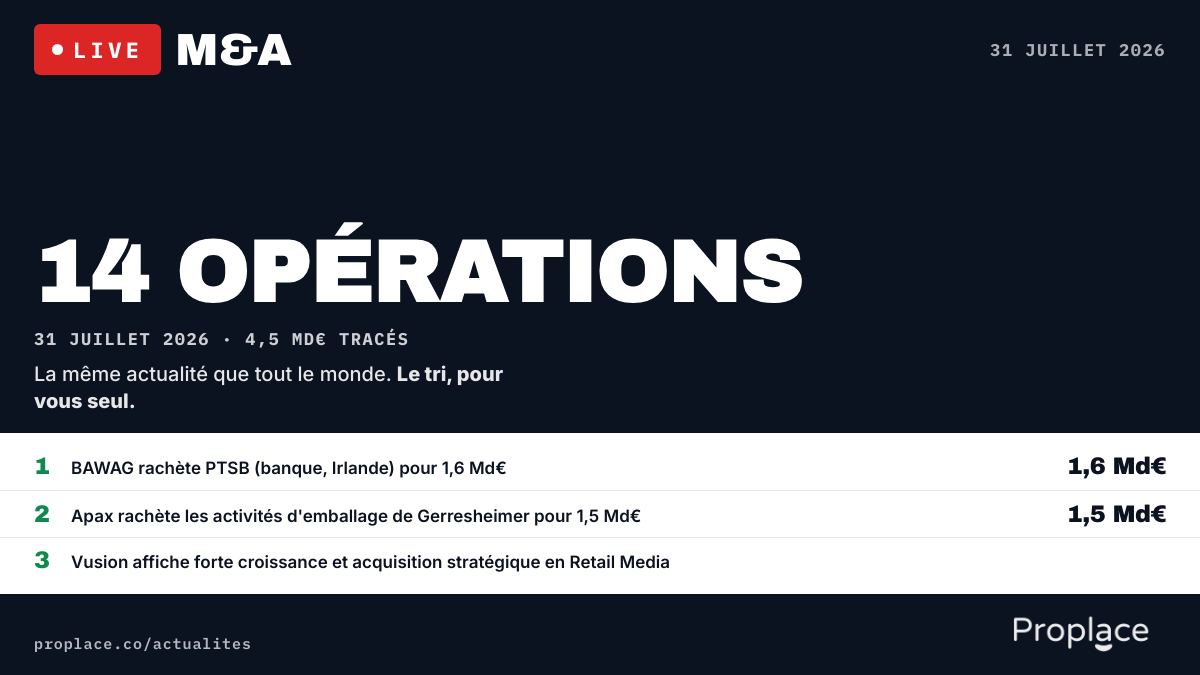
In focus — the deals we decoded
Orange and Morrison: 3 Billion to Catch the AI Infrastructure Train
Orange and Morrison are jointly investing 3 billion euros in French data centers, with a stated goal of 400 MW of sovereign capacity.
The immediate interpretation: Orange is investing in its own infrastructure to capture the computing demand generated by the explosion of AI. A growth strategy, a sovereignty strategy, nothing surprising for an incumbent operator seeking to leverage its network assets.
But what deserves attention is the scale of the bet and its profound nature. Almost all this money goes into concrete, cooling, power supply, and server racks — very little into engineers or software expertise. This is a massive physical capital investment whose profitability depends entirely on one assumption: that the computing demand from French and European companies will remain sustained and, above all, that it will not migrate to American hyperscalers despite their colossal economies of scale. The sovereign argument is real — sensitive clients (defense, health, finance) have data localization constraints — but it does not cover the entire addressable market.
400 MW is a considerable capacity: for context, a data center of this power consumes as much electricity as a medium-sized city of several hundred thousand inhabitants. Orange is betting that the location rent — the value that sovereign clients attribute to their data not leaving French soil — will be enough to justify a return on an investment that American giants could duplicate at a lower cost if they decided to play the European compliance card. For an industrial investor or a CIO, the question is not whether Orange is right to build, but at what price it will charge tomorrow — and whether that price will be competitive against AWS or Google Cloud in "EU region" mode.
VusionGroup: Retail Media Acquisition as a Sign of Maturity
VusionGroup reports H1 2026 revenue of 839 million euros, showing strong growth, and simultaneously announces a strategic acquisition in Retail Media, the precise details of which have not yet been communicated.
The essential point here is not the figure — growth is confirmed and annual outlook maintained — but the underlying strategic move. VusionGroup built its position on Electronic Shelf Labels, a physical infrastructure deployed in major global retail stores. By entering Retail Media, it is not acquiring technology: it is monetizing the infrastructure it has already put in place. Each in-store screen becomes an addressable advertising panel, each piece of in-store behavioral data becomes an asset.
This is the classic tollbooth logic: build the infrastructure, then charge for passage — here, brands that want to reach consumers at the precise moment of purchase decision. For retail or digital advertising players, VusionGroup is becoming an advertising network disguised as a hardware provider.
Lactalis Enters Exclusive Negotiations to Acquire Triballat
Source: en.edairynews.com → · Sector Food & AgTech — 📬 subscribe to the Food & AgTech newsletter
Lactalis has entered exclusive negotiations to acquire Triballat, a French producer of dairy specialties, for a reported amount of around 365 million euros.
Triballat is known for its Vrai brand (organic yogurts) and specialty cheeses — segments with higher margins than standard milk, driven by consumers willing to pay a premium. Lactalis, the world's largest dairy group, is pursuing a classic consolidation strategy here: absorbing a differentiated competitor to capture its margins and distribution networks, while eliminating an independent player that could have grown or been acquired by a foreign competitor.
In an agri-food sector where mass distribution squeezes prices and energy and logistics costs remain high, premium brands are the rare pockets of value that resist — Lactalis knows this and is methodically collecting them.
Béaba Suavinex: A Fifth LBO, or the Art of Turning an Asset Without Transforming It
Source: cfnews.net → · Sector FinTech — 📬 subscribe to the FinTech newsletter
Béaba Suavinex, a Franco-Spanish childcare group, completes a fifth LBO for approximately 40 million euros, moving from Bluegem CP to a new majority sponsor.
Five successive LBOs on the same asset is a phenomenon worth examining. In each round, a fund buys, improves operational profitability, and resells with a capital gain. The group holds up — the Béaba and Suavinex brands have real notoriety in premium childcare — but five private equity reviews also signal that no industrial acquirer has deemed the asset strategic enough to integrate it permanently.
An asset that undergoes five LBOs is a profitable but orphaned asset: too small for large groups, too mature for growth funds, it circulates among financial sponsors who extract value from it without ever truly transforming it. For a childcare or consumer goods industrialist, it might be time to consider whether integration would create more value than the next debt round.
Icade Takes Control of Comet: A Real Estate Company Buying Flows, Not Walls
Icade acquires 81.5% of Comet, a corporate event space operator, for approximately 40 million euros (up to 55 million with earn-out conditional on 2026 performance). Comet generated 43.9 million euros in revenue in 2025 across 14 sites, 12 of which are in Île-de-France.
The surface reading: a real estate company diversifies its revenue by adding a service component to its property portfolio. A strategy for valuing office assets in a post-Covid market where flexibility and events have replaced long-term leases.
But let's look at the price: 40 million for an operator generating 44 million in revenue. Icade is not buying real estate — it is buying a portfolio of 7,000 key accounts and an operational brand. What Comet has built is a service platform (Meetings, Hospitality, Workplaces) that transforms square meters into billable-by-the-hour experiences. Icade is not diversifying: it is acquiring the service layer it lacked to value its own real estate assets at a price per client and per square meter far superior to that of a classic lease. The earn-out conditional on 2026 performance says it all: the real price will depend on Comet's ability to maintain its growth once integrated into a listed group.
Ekinops: A 3 Million Acquisition and a Strategic Plan That Matters
Ekinops integrates Chimere (consolidated since April 2026, still not significantly contributing to H1) in a context of slightly increasing H1 results — 58.2 million euros in revenue, +2% — and confirms its Bridge strategic plan focused on cybersecurity and data center interconnection. The contribution of Olfeo (consolidated since June 2025) amounts to 3.2 million euros for the half-year.
Ekinops is a textbook case of a network equipment provider transforming into a security solutions provider. Growth is modest but gross margin is increasing, and the share of software and services reaches 21% — an indicator of recurrence and pricing power. The challenge for Ekinops is not size, but the speed at which the software component can overtake the hardware component, whose margins are structurally compressed by Asian competition.
The EU Launches Tender for its AI Gigafactories
The European Union is launching its tender to build the first AI gigafactories in Europe — massive computing infrastructures designed to provide the continent with model training capacity that does not depend on American hyperscalers or Chinese providers.
This is less a financial operation than a major political signal. The EU explicitly recognizes that computing infrastructure has become a strategic resource, just like energy or semiconductors. The tender is the form that the decision not to leave critical infrastructure in the hands of external actors takes in the 21st century — the same logic that led states to nationalize electricity grids in the previous century. For European digital infrastructure players, this is an opportunity for massive public funding; for American hyperscalers, it is a signal that the European institutional market will gradually slip away from them.
Deepki Completes Another Acquisition in the UK
Deepki, a French specialist in ESG data for real estate, completes another acquisition in the United Kingdom, the financial details of which have not been disclosed.
Deepki is methodically building a European reference position in energy and carbon data for real estate assets — a market driven by regulation (CSRD, green taxonomy, reporting obligations for real estate funds). Each acquisition in the UK strengthens both the customer base and geographical coverage, in a market where the size of managed data is a direct competitive advantage. In a sector where value lies in the comprehensiveness of the database and the ability to compare assets, consolidation is a necessity, not an option.
Legora Acquires Wexler: The Swedish Legal Unicorn's Fifth Acquisition of the Year
Source: eu-startups.com → · Sector Horizontal & Productivity SaaS — 📬 subscribe to the Horizontal & Productivity SaaS newsletter
Legora, a Swedish legal AI unicorn valued at 4.7 billion euros after its 513 million euro Series D, acquires Wexler, a London-based factual intelligence platform specializing in extracting and verifying facts from massive document corpora. This is Legora's fifth acquisition in 2026.
The pace is striking: five acquisitions in seven months for a company founded in 2023. This is not classic external growth — it is a strategy of assembling a complete technology stack before the market consolidates around one or two dominant players.
Wexler's logic is precise. In law, any dispute or investigation relies on establishing facts — who said what, when, in which document. This is manual, costly work, perfectly suited to automation by AI agents. By integrating Wexler, Legora is not acquiring a feature: it is appropriating the factual verification infrastructure that becomes the foundation of any automated legal decision.
Legora is building what Americans call a "moat" — a defensive ditch: the more layers it integrates (research with Qura, real estate with Cadastral, facts with Wexler), the more difficult its system becomes to replicate by a competitor starting from scratch. Wexler's engineering team forms Legora's London hub — a signal that this acquisition is as much a massive talent recruitment as a product acquisition. For French law firms and legal departments, Legora is becoming indispensable.
Mapfre Takes 38.9% of Tuio: Spanish Insurance Buys its Digital Transformation
Source: reinsurancene.ws → · Sector FinTech — 📬 subscribe to the FinTech newsletter
Mapfre, a Spanish international insurer, acquires 38.9% of Tuio, a Spanish insurtech integrated with ChatGPT for selling insurance products, for a reported amount of around 411 million euros (a structure combining existing share purchase and participation in a capital increase).
Tuio claims that over 20% of its new customers now come through AI assistants — a figure that, if confirmed, marks a shift in insurance distribution channels. Mapfre is not buying technology: it is buying a proof of concept at scale, that insurance can be sold through a conversational agent without human intervention.
The minority stake (38.9%) is a cautious decision: Mapfre keeps Tuio independent to avoid killing the agility that gives it value, while securing a real option on the transformation of its own distribution if the model proves scalable in Latin America and Europe. For French insurance players, this is a clear signal: AI conversational distribution is no longer a distant horizon.
AHEAD HEALTH and Preventive Medicine: A Structuring Sector
AHEAD HEALTH (Switzerland) raises an additional 9 million euros and establishes itself in Germany and the Netherlands, in a move that illustrates the progressive structuring of preventive medicine into a full-fledged industry — combining imaging, biology, AI, and longitudinal monitoring.
The sector brings together players like Prenuvo (preventive whole-body MRI) and ZOĪ (in-depth biological assessments). What was once reserved for a few high-end private clinics is gradually becoming a scalable offering, driven by falling imaging costs and the ability of AI models to interpret complex medical data. The real market is not treatment: it is longitudinal health data, whose value grows with time and comprehensiveness — whoever holds ten years of a patient's follow-up holds an asset that no one else can reconstruct.
ARBURG Acquires Stork IMM: Two Injection Machine Manufacturers United
ARBURG (Germany) acquires Stork IMM (Netherlands, Hengelo), a manufacturer of high-speed plastic injection molding machines for packaging, from Stibbe Participaties. Amount not disclosed.
ARBURG expands its portfolio to include large clamping force machines (over 5,000 kN) and the industrial packaging segment, where Stork IMM is recognized. The logic is both defensive and offensive: in a plastic injection market under pressure (volatile volumes, increasing Asian competition, necessary economies of scale), consolidation among premium European players is a structural response. Two historical brands merging to present a common front against low-cost competitors — the classic pattern of European heavy industry in a rationalization phase.
Kaleidex Acquires Meditec Source: Entry into the Tuttlingen Surgical Cluster
Source: dealnews.ai → · Sector Knowledge & Media — 📬 subscribe to the Knowledge & Media newsletter
Kaleidex (backed by Ansor), a contract manufacturing organization for medical devices, acquires Meditec Source GmbH (Tuttlingen, Germany), a specialist in the development and sourcing of surgical instruments in orthopedics, traumatology, and spine. Amount not disclosed.
Tuttlingen is the world capital of surgical instruments — hundreds of specialized manufacturers concentrated within a few square kilometers, with know-how and regulatory certification networks (European MDR) that take years to build. By acquiring Meditec Source, Kaleidex is not buying a factory: it is buying an address, a network, and regulatory expertise. For a CMO that wants to serve clients in the European medical device market, being present in Tuttlingen is the equivalent of having an office in the City for a bank — credibility precedes the contract.
BAWAG Acquires PTSB for 1.6 Billion Euros: European Banking Consolidation Accelerates
Source: businessplus.ie → · Sector Mobility & Transportation — 📬 subscribe to the Mobility & Transportation newsletter
BAWAG (Austria) obtains approval from PTSB (Permanent TSB, Ireland) shareholders for its 1.6 billion euro acquisition — 91.3% of votes in favor, well above the required 75% threshold. The transaction still needs to pass before the Irish High Court and the ECB before being finalized, likely in Q1 2027.
BaWAG, an Austrian bank aggressive in European acquisitions, continues its pan-European expansion strategy by absorbing a medium-sized Irish retail bank. Ireland is a concentrated banking market (Bank of Ireland and AIB dominate) where PTSB had been seeking support for two years.
What is remarkable is less the operation itself than the signal it sends: European banking consolidation, blocked for a decade by regulators and national resistance, is resuming — and it is the most agile players, not the largest, who are benefiting. For intermediate-sized French banks, the question of their own positioning in this consolidation deserves to be asked.
French Tech 2030: Applications Are Open
La French Tech opens applications for the French Tech 2030 program, citing Quobly, Exotrail, and Aqemia as examples from previous cohorts — in quantum computing, space propulsion, and computational chemistry, respectively. No financial transaction, but a signal about the sectors where the French state seeks to identify future deeptech champions.
All of today's M&A, by sector
The full list for today — including the deals decoded above.
B2B Software & Cloud · 2 →
- Balio — Contents acquiert Balio (bien-être d'entreprise, Espagne)
- Afidium — Travelsoft rachète Afidium via Orchestra (logiciel voyage, France)
Commerce & Consumer · 2 →
- Comet — Icade prend le contrôle de Comet (événementiel, France)
- Spas Organisation — UNIFY Group finalise l'acquisition de Spas Organisation (événementiel, France)
D2C & Consumer Brands · 2 →
- Béaba Suavinex — Béaba Suavinex fait l'objet d'un LBO (puériculture, France)
- Okaïdi — Okaïdi sort de redressement judiciaire (vêtements enfants, France)
Industrial Tech & Manufacturing · 2 →
- Stork IMM — ARBURG acquiert Stork IMM (machines de plasturgie, Pays-Bas)
- AEMtec — Micross acquiert AEMtec (emballage avancé et optoélectronique, Allemagne)
MedTech & Devices · 2 →
- Meditec Source — Kaleidex acquiert Meditec Source (dispositifs chirurgicaux, Allemagne)
- Gerresheimer — Apax acquiert deux divisions d'emballage pharma de Gerresheimer (Allemagne)
FinTech · 1 →
- PTSB — BAWAG rachète PTSB (banque, Irlande) pour 1,6 Md€
Food & AgTech · 1 →
- Triballat — Lactalis entre en négociation exclusive pour acquérir Triballat (fromage, France)
Future of Work & HR Tech · 1 →
- RHSuite.com — Silae acquiert RHSuite.com (logiciel RH, France)
Health & Wellness · 1 →
- Les Laboratoires Herbolistique — Les Laboratoires Herbolistique fait l'objet d'un LBO (cosmétiques, France)
InsurTech · 1 →
- Tuio — Mapfre acquiert 38,9% de Tuio (distribution d'assurance digitale, Espagne)
Legal Tech · 1 →
- Wexler — Legora acquiert Wexler (IA juridique, Royaume-Uni)
Retail & E-commerce Tech · 1 →
- Vusion — Vusion affiche forte croissance et acquisition stratégique en Retail Media
Other deals (sector not classified) · 2
- Orange injecte 3 milliards d'euros dans ses data centers français avec Morrison et vise 400 MW de capacité souveraine - Lavoixdefrance.fr
- Ekinops améliore sa marge au premier semestre 2026 et confirme ses objectifs ann
🚀 Fundraisings today · 14
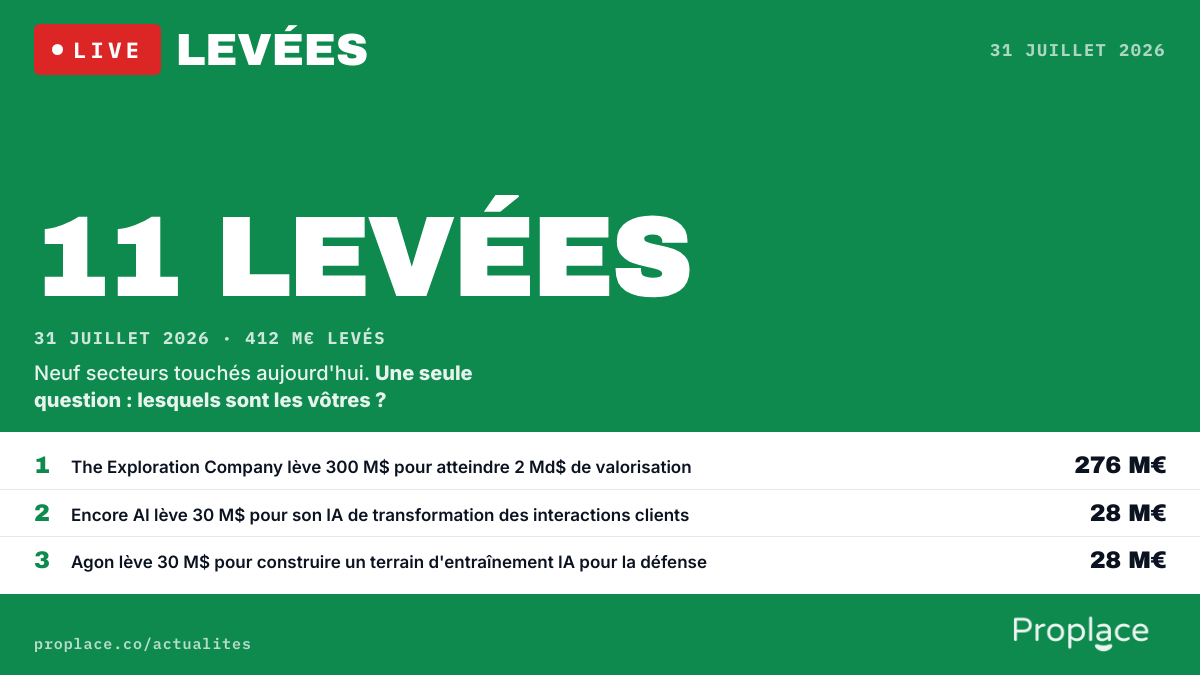
In focus — the deals we decoded
Harmattan AI Raises $200 Million with Dassault Aviation: When Defense Funds Its Own Brain
Source: ideal-investisseur.fr →
Harmattan AI closes a Series B of 200 million dollars (approximately 184 million euros), valued at 1.4 billion dollars, with Dassault Aviation leading the round. The objective: to integrate embedded AI into future aerial combat systems, particularly for autonomous drone control within the framework of the Rafale F5 and the UCAS program.
This is where the surface reading and reality diverge most sharply. Ostensibly: a major defense industrialist invests in a promising AI startup. Classic.
But let's look at who is funding and why. Dassault Aviation does not do venture capital to diversify its balance sheet. It funds Harmattan AI because the capabilities this startup is developing are a prerequisite for its own future contracts — the Rafale F5 and UCAS cannot exist without the embedded AI that Harmattan is developing. In other words, Dassault is investing in its own critical supplier to ensure that it still exists in five years, that it is not acquired by a competitor or an American player, and that the technology remains accessible within a sovereign framework.
This is a form of financing that economists sometimes call "dependency investment": one does not seek a financial return on the investment, one seeks to secure a critical supply chain. The 1.4 billion dollar valuation of a startup a few years old says less about Harmattan's market value than about the price Dassault is willing to pay not to depend on technology it does not control.
For other French and European defense industrialists, this is a model to study: in dual-use (civil/military) technologies with high AI content, the boundary between strategic client and investor no longer makes sense — he who funds controls, and he who does not fund will find himself dependent.
NEVERHACK Raises €11M: Sovereign Cybersecurity Seeks Its GPUs
NEVERHACK raises 11 million euros from its existing shareholders Carlyle and IK Partners in an internal round (support round). The group, which generates 220 million euros in revenue, will deploy these funds across three axes: industrialization of its cyber AI solutions, expansion of trusted infrastructures in Europe (France, Italy, Estonia), and scaling up of teams.
The most structuring detail is discreet: NEVERHACK will invest in GPU capabilities localized in Europe. In cybersecurity, AI is not just used to detect intrusions — it continuously analyzes volumes of security logs that human teams could not process. But for the most sensitive clients (defense, energy, public sector), analyzing this data on American cloud infrastructures is a risk in itself.
NEVERHACK is building the argument that processing sovereignty is as important as software sovereignty — and that clients who accept this will pay a premium for this guarantee. An internal round at this stage of development (€220M revenue) is also a signal that shareholders believe in the execution without needing new entrants to validate the thesis.
The Exploration Company Raises $300 Million: Space as an Industrial Frontier
The Exploration Company, a German-French startup specializing in cargo spacecraft for the International Space Station and the orbital economy, aims for a 2 billion dollar valuation with a 300 million dollar (approximately 276 million euro) fundraising.
The Exploration Company is developing the Nyx spacecraft, capable of resupplying the Space Station and, eventually, serving a commercial orbital economy. What makes this fundraising significant is the scale of the bet: a 2 billion valuation for a company whose product has not yet completed a full commercial mission.
But this is precisely the time to raise. The window to become a credible player in space logistics is closing: SpaceX dominates, but European space agencies (ESA) and commercial clients are actively seeking non-American alternatives. The Exploration Company is playing the diversification of suppliers card — the same sovereign argument as Harmattan AI in defense, applied to low Earth orbit. For industrial deeptech investors, this is one of the few segments where Europe can still claim a leading global position if it funds quickly and strongly.
Aria Raises €7M and Launches a €240M Facility: Invoice Financing in the Age of AI
Source: arabfounders.net → · Sector FinTech — 📬 subscribe to the FinTech newsletter
Aria closes a Series A extension of 7 million euros, led by 115K (La Banque Postale's venture arm), with 13books Capital participating. The extension brings the Series A total to 22 million euros. Simultaneously, Aria launches a 240 million euro debt facility structured via a securitization led by Nomura, with the participation of Fost, Sienna, and Montpensier Arbevel.
The real operation is not the 7 million in equity — it's the 240 million in debt. Aria buys invoices from suppliers, transfers them to a securitization vehicle, and this vehicle issues securities backed by future payments from buyers. When buyers pay, the capital is recycled to finance new invoices. This is a modernized factoring mechanism, integrated directly into ERPs and B2B platforms.
What distinguishes Aria is the ambition of the infrastructure: by integrating into companies' existing management systems, it makes invoice financing invisible — the supplier is paid immediately without changing their workflow, the buyer maintains their payment terms without changing theirs. The entry of 115K (La Banque Postale) into the capital and board of directors is a distribution signal: La Banque Postale can open Aria access to a network of client companies that few fintechs can reach directly.
Inforcer Raises $50 Million: Security for SMEs in the Age of AI
Source: techcrunch.com → · Sector Cybersecurity — 📬 subscribe to the Cybersecurity newsletter
Inforcer (London) raises 50 million dollars (approximately 46 million euros) in Series C, led by Insight Partners. The company helps small and medium-sized enterprises prepare for security and AI risks.
Inforcer addresses a real blind spot: large companies have security teams, budgets, and tools. SMEs have neither, and yet are exposed to the same threats — or even more so, because they are often the weakest link in a large group's supply chain. Insight Partners, a specialist in B2B software scale-ups, brings both a network of contacts and a check here. The security market for SMEs is structurally underserved and regulatorily pushed — NIS2 in Europe creates a compliance obligation for thousands of companies that have no tools to meet it.
Intropy Raises €9.5 Million: AI for Spare Parts
Intropy (London) raises 9.5 million euros to build an AI operating system for the spare parts industry — inventory management, part identification, order automation.
The industrial spare parts market is massive, fragmented, and remarkably undigitized. Distributors still work with paper catalogs and proprietary databases that are incompatible with each other. Intropy is betting that AI can do what classic ERPs have never managed: read a technical drawing, identify a part without an exact reference, and automate the order — reducing the processing cost of a complex order from several hours to a few seconds. For French industrialists with fleets of equipment to maintain, this is a concrete and immediate use case.
Pstryk Raises €7M: Dynamic Electricity Pricing for Polish Households
Pstryk (Poland) raises 7 million euros in Series A, with Future Energy Ventures, Axpo, Montis, and existing investors. The mobile platform allows households to buy and manage their electricity with dynamic pricing.
Dynamic electricity pricing — prices that vary hour by hour depending on supply and demand on the grid — is a reality in several European markets (Nord Pool in Scandinavia, spot market in Germany). In Poland, the market is opening up. Axpo, a Swiss energy trader, is both a strategic and financial investor here: it has an interest in the existence of residential demand aggregators to balance the grid. Pstryk is potentially a virtual battery: thousands of households shifting their consumption (washing machines, water heaters, electric car charging) when electricity is abundant and cheap — which is as good for grid stability as it is for the consumer's bill.
📩 Subscribe to our newsletter to follow daily M&A and fundraising news: https://proplace.co/newsletter
All of today's fundraisings, by sector
The full list for today — including the deals decoded above.
B2B Software & Cloud · 3 →
- Encore AI — Encore AI lève 30 M$ pour son IA de transformation des interactions clients
- Intropy — Intropy lève 9,5 M€ pour son OS IA des pièces détachées
- Mimir — Mimir lève 600 K$ en pre-seed pour son IA d'automatisation e-commerce
Climate & Energy Tech · 2 →
- Pstryk — Pstryk lève 7 M€ pour transformer l'achat d'électricité des ménages (Pologne)
- Greyparrot — Greyparrot lève 27 M$ pour son IA de gestion des déchets
Cybersecurity · 2 →
- NEVERHACK — NEVERHACK lève 11 M€ pour accélérer dans l'IA cyber souveraine
- Wallix — Wallix sécurise 25 M€ de financement non dilutif, pouvant atteindre 65 M€
Space Tech · 2 →
- The Exploration Company — The Exploration Company lève 300 M$ pour atteindre 2 Md$ de valorisation
- Agon — Agon lève 30 M$ pour construire un terrain d'entraînement IA pour la défense
FinTech · 1 →
- Aria — Aria lève 7 M€ en extension de Series A pour son financement de factures
Future of Work & HR Tech · 1 →
- TaskHer — TaskHer lève 650 K£ pour intégrer plus de femmes dans les métiers du bâtiment
MedTech & Devices · 1 →
- EVERSION — EVERSION lève 2,3 M€ pour ses semelles intelligentes contre la douleur
Other deals (sector not classified) · 2
- Harmattan AI — Dassault Aviation mène un tour de table de 200 M$ pour Harmattan AI
- Orange relève ses objectifs pour 2026, après une robuste croissance de ses résultats semestriels