
Analysis of the day
M&A and Fundraising Analysis for July 25, 2026
Logistics mergers, food giant divestitures, major MBOs, and a billion-dollar humanoid robotics deal: a day when Europe reorganizes its industrial capital while AI infrastructure continues to absorb liquidity.
· Proplace
🌐 Translated from the French original by AI — the French version is authoritative.
📊 Today's pulse — 50 deals · 30 M&A · 20 fundraisings · €41.4bn in play.
July 25 illustrates two simultaneous and almost contradictory movements: on one hand, European industrial capital in full recomposition—logistics, energy, pharma, automotive—and on the other, digital infrastructure that continues to concentrate massive fundraisings on the promise of boundless computing demand. In between, a few French private equity deals bear witness to an SME fabric that is refinancing and transferring ownership, discreetly but steadily.
🤝 Mergers & acquisitions today · 30
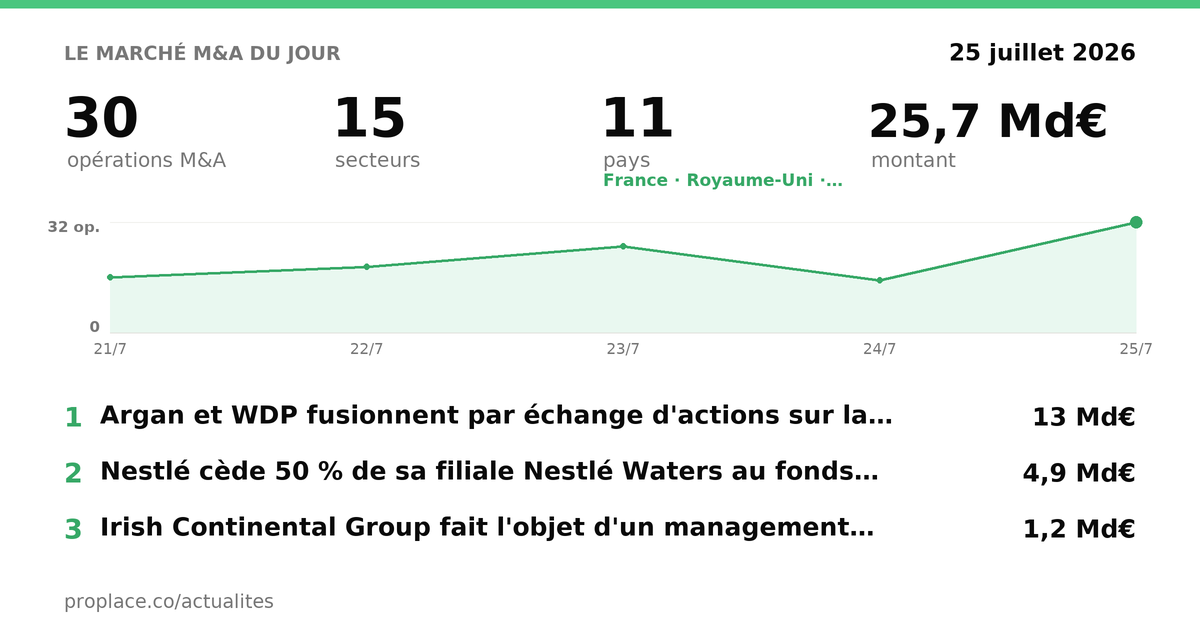
In focus — the deals we decoded
Argan and WDP: When two real estate companies create a European logistics champion
Source: investir.lesechos.fr →
Argan and its Belgian counterpart WDP announce a merger by share exchange—three newly issued WDP shares for each Argan share—creating a combined €13 billion logistics portfolio spread across eight countries, with over €700 million in annual rental income. The implicit premium is 21% for Argan shareholders, who will also receive an exceptional dividend of €11 per share before completion. General meetings are expected in November, with the merger effective in Q1 2027.
The immediate interpretation is that of sectoral consolidation: logistics platforms have been under pressure since the e-commerce slowdown, interest rates have tightened refinancing conditions, and critical mass is becoming a decisive advantage for negotiating leases with large shippers. Two medium-sized players prefer to merge rather than find themselves in a weak position against pan-European giants.
What deserves attention is the mechanism of share exchange rather than cash: no one is exiting, no one is really cashing out—they are betting together on the revaluation of a more liquid and visible common asset. WDP will obtain an additional listing on Euronext Paris to remain in the SBF 120, signaling that the new entity seeks French market depth as much as size. For a French institutional investor, the question is simple: prefer to hold shares in a European champion listed in Paris, or exit at the 21% premium before the logistics cycle turns.
Nestlé sells half of its water business to Platinum Equity: A JV that says everything about Nestlé's state
Nestlé announces the creation of a 50/50 joint venture named Peranel with the American fund Platinum Equity, which will house the entirety of Nestlé Waters—Perrier, Vittel, San Pellegrino, Acqua Panna, over thirty brands in one hundred and twenty countries. The entity's valuation stands at €4.9 billion, less than ten times EBITDA. Nestlé will receive approximately €3 billion upon finalization, expected in H1 2027.
The primary takeaway: Nestlé is divesting a capital-intensive, low-growth asset exposed to ESG criticism regarding water privatization, to recover cash and refocus the group on its higher-value-added categories.
But the choice of a 50-50 joint venture rather than a total divestment is the real signal. Nestlé does not want—or cannot—completely separate from such iconic brands from a reputational standpoint. By retaining half, it maintains oversight over management and an implicit buyback option if Platinum creates value. For Platinum, the multiple of less than ten times EBITDA on a portfolio of global premium brands is a reasonable entry: the challenge will be to show that a fund can do better than a large group on mature assets by optimizing distribution and cutting structural costs. The precedent of major food brands sold to PEs—Findus, Iglo, LU—suggests mixed long-term results but decent exit multiples in five years.
Accor sells Essendi to Blackstone: The end of a real estate legacy
Accor is selling its approximately 30.7% stake in Essendi (the former Accor Invest hotel portfolio) to a consortium comprising Blackstone and Colony IM for up to €975 million—€675 million upon completion and a conditional earn-out of €300 million. The transaction is expected to close in Q4 2026.
Accor has spent a decade transforming itself from an owner-operator to a pure brand and services operator. This divestment is the penultimate piece of that puzzle: the group no longer wants to carry real estate on its balance sheet; it wants to collect fees on others' overnight stays.
The price structure—€675 million firm plus €300 million conditional—reveals a disagreement on the asset's value that both parties resolved by spreading it over time. Blackstone is betting that the underlying hotels will refinance better or appreciate more than Accor is willing to wait for. For Accor, taking certainty today rather than speculating on a turnaround in the hotel market is consistent with an asset-light strategy: the cash from the sale will likely fund buybacks of management contracts or acquisitions of light brands. It's the Marriott-Hilton model, twenty years later.
ICG: CEO buys out the company for €1.2 billion
Source: rte.ie → · Sector Knowledge & Media — 📬 subscribe to the Knowledge & Media newsletter
Eamonn Rothwell, CEO of Irish Continental Group (parent company of Irish Ferries), is leading a management buyout that values the group at €1.2 billion, representing a 28.2% premium over the last closing price. The independent board of directors unanimously recommended the offer. The transaction remains subject to shareholder and regulatory approval.
A €1.2 billion MBO for a listed ferry company is a rare operation. What Rothwell implicitly tells the markets: the company is worth more privately than publicly. The constraints of listing—quarterly reporting, potential activism, share price volatility—weigh on a long-cycle transport infrastructure, where investment decisions (new routes, new ships) are measured in decades. Privatization will give him the freedom to manage for the long term without having to report every quarter. For shareholders exiting at the 28% premium, it's welcome liquidity on an illiquid stock. The real question is the financing of the operation: at this valuation level, the debt is substantial, and a ferry company remains exposed to fuel prices and tourism conditions.
Bain Capital acquires Vitabiotics for approximately €1.1 billion
Bain Capital is set to acquire Vitabiotics, a British food supplement group (Pregnacare, Perfectil, Wellman), for an estimated valuation of approximately £900 million, or about €1.1 billion. The founder, Professor Kartar Lalvani, will transition to Chairman Emeritus; his son Tej Lalvani, who has led the company since 2015, will benefit financially from the transaction. Bain plans to accelerate international expansion, strengthen e-commerce, and invest in product development, while maintaining research in the UK.
Vitabiotics is a textbook case for private equity in consumer health brands: strong brand recognition, established distribution, decent margins, but limited organic growth in a mature UK market. Bain's thesis is clear—internationalization and e-commerce—but that's exactly what every acquirer of this type of asset promises. The real value will be in executing distribution in Asia and Africa, where the group already has operations via VB Group. To watch: the ability to preserve the scientific credibility of the brands while industrializing growth.
Vinci Energies launches a €504 million tender offer for All for One: An entrepreneur moving up the stack
Source: highways.today → · Sector Developer & IT Infrastructure — 📬 subscribe to the Developer & IT Infrastructure newsletter
Vinci Energies has submitted a tender offer of €67.50 per share for All for One Group SE, a SAP specialist listed in Frankfurt, valuing the group at €504 million in annual revenue. The premium is 95.5% over the last closing price before the announcement and 104.9% over the weighted average of the last three months—Vinci is therefore paying double the market price.
The obvious interpretation: Vinci Energies wants recurring revenue in enterprise software to balance its exposure to construction contracts.
But the 95% premium is worth dwelling on. A contractor does not pay double the market price for diversification: it pays for a strategic position it cannot build alone. All for One manages SAP systems for over 4,500 German Mittelstand companies on multi-year contracts—this is not a project pipeline that empties, it's an operating annuity on its clients' critical IT infrastructure. For Vinci, whose Axians division already builds cables, data centers, and networks, acquiring the editor that runs ERPs on this infrastructure means controlling two layers of the same value chain. The exorbitant premium is explained by the impossibility of replicating an installed base of 4,500 loyal customers in a few years. Concretely, for a French industrial digital player: when a group of this size pays one hundred times the usual premium for an SAP integrator, it means that the value is no longer in the project but in the dependency relationship—and that this relationship is now monetized like infrastructure.
Getec acquires Cogenio for €400 million: Decentralized industrial energy gains momentum
Source: inforcapital.com → · Sector Developer & IT Infrastructure — 📬 subscribe to the Developer & IT Infrastructure newsletter
Getec, a German energy services group, is finalizing the acquisition of Cogenio from Infracapital (80%) and Enel (20%) for approximately €400 million. Cogenio, a specialist in industrial energy self-consumption solutions, operates over two hundred installations in Spain, Italy, and Germany, primarily on industrial rooftops with 10- to 15-year PPAs.
The operation illustrates a fundamental trend: energy is no longer sold only from centralized power plants; it is produced on factory rooftops with long-term contracts that resemble real estate more than energy. For Getec, acquiring Cogenio means acquiring two hundred PPA contracts—as many recurring revenues backed by physical assets. For Enel, selling its minority stake in a decentralized services subsidiary is consistent with a refocus on large-scale production and grid. To remember for French industrialists: the logic of self-consumption with long-term PPAs is now valued as infrastructure—which fundamentally changes how these projects are financed and structured.
Polpharma acquires Biofarm for €257 million: Central European pharmaceutical consolidation accelerates
Polpharma Group is finalizing the acquisition of Biofarm, one of the leaders in the Romanian pharmaceutical market (uninterrupted operations since 1921, over one hundred products in sixty therapeutic areas), for approximately €257 million. Integration will be gradual, maintaining local identity and existing operations.
Polpharma is methodically building an integrated pharmaceutical platform in Central and Eastern Europe. Romania is a significant market, under-penetrated by Western generics, with an aging population and increasing health coverage. Biofarm has been a trusted brand there for a century. For French pharmaceutical groups looking at Eastern Europe: quality assets in these markets are becoming scarce and expensive—Polpharma has just locked in a position that is difficult to circumvent.
Geely takes 34% of Ford's Spanish plant for €221 million
Source: ievchina.com → · Sector Industrial Tech & Manufacturing — 📬 subscribe to the Industrial Tech & Manufacturing newsletter
Geely Auto (via its subsidiary GeelySPV) is acquiring 34% of the capital of Ford's Spanish entity for €221 million. The three parties—Geely, Ford, and the target company—simultaneously plan to create a contract manufacturing joint venture, paving the way for the production of Geely vehicles in Ford's Spanish plant.
The immediate interpretation: Ford fills an underutilized plant, Geely bypasses European tariffs by producing locally.
What's more interesting is the method. Where BYD builds a factory in Hungary from scratch and Chery does the same in Spain, Geely enters through the side door: it buys a minority fraction of an existing asset, integrates into an already approved supply chain, inherits already obtained regulatory approvals, and shares risks with Ford. For €221 million—a modest sum on the scale of the automotive industry—Geely secures an industrial bridgehead in Western Europe. Ford, for its part, recovers capital and a partner that brings volume: it's a survival logic for a plant whose electric future remained uncertain. The model of automotive subcontracting—running lines for a third party—is not new (Magna Steyr has been doing it for decades), but its application to a Chinese manufacturer entering Europe marks a qualitative change in the continent's industrial geography.
WSP Global raises its offer for Arcadis to €51.5: The valuation war begins
Source: business-news-today.com → · Sector HealthTech & Digital Health — 📬 subscribe to the HealthTech & Digital Health newsletter
WSP Global (Canada) has submitted a second non-binding offer for Arcadis (Amsterdam) at €51.5 per share—in cash and WSP shares—valuing the group at approximately €4.4 billion. Arcadis's board had rejected an initial offer of €48.5, deemed insufficient. The stock rose more than 20% over two sessions.
The central tension is that of an engineering and consulting firm whose governance is structurally defensive—shareholder foundation, employee-owner culture—facing a Canadian acquirer seeking to build a global champion in technical services. WSP is testing whether a modest premium and a share component are enough to convince a Dutch board rooted in its stakeholder values. Second-quarter results are expected on July 30: if they are good, Arcadis will have an additional argument to resist. If they disappoint, pressure on the board will intensify. To be followed closely by anyone interested in the consolidation of engineering services in Europe.
PLG Group acquires iaBilet: Eastern European ticketing consolidation
Source: seenews.com → · Sector Media & Entertainment — 📬 subscribe to the Media & Entertainment newsletter
PLG Group (Estonia) signs the acquisition of iaBilet, a Romanian online ticketing platform, from private equity fund Resource Partners and the founders. Amount undisclosed.
Online ticketing remains a fragmented market in Central and Eastern Europe, where well-established local players coexist without any having reached critical mass to negotiate with major event organizers. PLG is building a pan-European position in this space, with Estonia as its technological base and Romania—a market of twenty million inhabitants with strong leisure growth—as its southern bridgehead.
Commerzbank finally opens the door to UniCredit: The European bank takes shape
Source: au.marketscreener.com →
The chairman of Commerzbank's supervisory board, Jens Weidmann, has invited UniCredit to open formal negotiations on the terms of a merger, abandoning all frontal resistance. Amount not yet defined—Commerzbank's market capitalization exceeds €10 billion.
This moment has implications beyond the banking sector. For years, German resistance to an Italian takeover of a symbolic national bank was as much political as financial. The fact that Weidmann—former president of the Bundesbank, a figure of German financial orthodoxy—is the one opening the door signals that resistance has been exhausted in the face of shareholder arithmetic. UniCredit now holds enough voting rights to influence the next general meeting. What is being negotiated now are the social conditions—employment, headquarters, commitments to German SME clients. For the European banking sector, this is a signal that cross-border consolidations, long blocked by financial nationalism, are becoming possible again. The next piece on the chessboard will be to see which European regulator seizes the opportunity to accelerate banking union.
Go! Formations refinances with unitranche: Stabilization of a Lorraine LBO
Source: cfnews.net → · Sector FinTech — 📬 subscribe to the FinTech newsletter
Go! Formations, a Lorraine-based organization for regulatory and vocational training with approximately €40 million in revenue, owned by Activa Capital since 2024, is refinancing its debt with unitranche. Refinancing operation with no change in shareholding.
A unitranche refinancing at this stage of the LBO signals that Activa is consolidating the financing structure to prepare for the next phase of the value plan—likely build-up acquisitions in a professional training sector undergoing regulatory changes. Nothing spectacular, but a signal of a portfolio being managed properly.
Impulsa enters LBO: First fund-backed passage for a Parisian accounting firm
Source: cfnews.net → · Sector FinTech — 📬 subscribe to the FinTech newsletter
Impulsa, a Parisian accounting firm with €20 million in revenue, is undertaking its first LBO with the entry of an unnamed fund. Transaction amount undisclosed.
The French accounting sector is experiencing a wave of consolidation driven by funds betting on recurring mandates and platform synergies. Impulsa is taking the classic step: from family or managerial capital to a financial sponsor who will accelerate acquisitions. The thesis is simple—the market is fragmented, independent firms struggle to invest in digital and attract talent, a well-capitalized aggregator can create value quickly.
Heliblade: First flight of a French high-altitude solar drone
Heliblade, a French startup, has successfully completed the first flight of its stratospheric solar drone: 4 kg, several months of autonomy, cruising altitude of 20 km. The French army has expressed interest. No financial operation announced at this stage.
This is not yet a transaction, but it is a development step that usually precedes a fundraising round or a development contract with the DGA. A solar drone capable of staying for months at 20 km altitude is an alternative to satellites for surveillance, communications, and intelligence—at a fraction of the cost. To watch in the coming months for those following French defense deep tech.
Fibre Excellence: Matthieu Pigasse tries to save the French paper pulp leader
Fibre Excellence, the French leader in paper pulp, is facing a financial crisis. Matthieu Pigasse has structured a €90 million rescue plan, conditional on financial support from the State. Negotiations are ongoing.
The French paper industry is caught between high energy costs, competition from Scandinavian and Iberian producers, and a structurally declining demand for certain graphic papers. The fact that Pigasse is requesting public contribution signals that the plan is not viable without guarantees or subsidies—which raises the classic question of supporting a strategic industrial asset (jobs, territory, fiber sovereignty) versus the risk of financing a declining economic model. The precedent of French paper mills over the last twenty years is not encouraging.
All of today's M&A, by sector
The full list for today — including the deals decoded above.
B2B Software & Cloud · 3 →
- All for One Group — VINCI Energies offre 67,50€/action pour All for One (spécialiste SAP)
- ArisGlobal — Dassault Systèmes acquiert ArisGlobal pour jusqu'à 2 Md$ (logiciels pharma)
- Impulsa — Impulsa (expertise-comptable, 20 M€ CA) s'initie au LBO avec un fonds
FinTech · 3 →
- Commerzbank — UniCredit engage des négociations pour reprendre Commerzbank (banque, Allemagne)
- Capital Banking Solutions — Isovalie réalise son premier build-up avec Capital Banking Solutions (logiciels bancaires)
- Luminor — OTP Bank acquiert Luminor pour entrer sur les marchés baltes (14 pays)
Industrial Tech & Manufacturing · 3 →
- Cilas — Lumibird cède ses 37% dans Cilas et reprend une activité laser
- Azkoyen — Ohmnia lance une OPA sur Azkoyen (industrie, Espagne) valorisée 244,5 M€
- Lumibird — Lumibird renforce son positionnement dans les technologies laser stratégiques
Climate & Energy Tech · 2 →
- Cogenio — Getec rachète Cogenio (énergie, Allemagne) pour 400 M€
- BlueNord — Vår Energi acquiert BlueNord (actifs énergétiques, Danemark) pour 1,33 Md$
Construction & PropTech · 2 →
- Arcadis — WSP Global propose une offre révisée de 51,5 M€ pour Arcadis (ingénierie, Pays-Bas)
- Argan — Argan et WDP fusionnent pour créer un expert logistique de 13 Md€ de patrimoine
Food & AgTech · 2 →
- Triballat — Lactalis rachète Triballat (fromages PDO, France) en négociation exclusive
- Eaux (Nestlé Waters) — Nestlé vend 50% de sa filiale Eaux (Perrier, Vittel) à Platinum Equity pour 4,9 Md€
Mobility & Transportation · 2 →
- Ford Spain Operations — Geely acquiert 34% des opérations espagnoles de Ford pour 221 M€
- Irish Continental Group — Le PDG d'Irish Continental Group mène un LBO de 1,2 Md€ (Irish Ferries)
Biotech & Pharma · 1 →
- Biofarm — Polpharma Group acquiert Biofarm (pharma roumaine depuis 1921) pour 257 M€
Commerce & Consumer · 1 →
- iaBilet — PLG Group (Estonie) acquiert iaBilet, plateforme de billetterie roumaine
Cybersecurity · 1 →
- Verisure — Investors | Verisure
D2C & Consumer Brands · 1 →
- i-Run — i-Run passe sous le contrôle du fonds LFPI et reprend Trakks (Belgique)
Education & EdTech · 1 →
- Go! Formations — Go! Formations (formations réglementaires, 40 M€ CA) se refinance en unitranche
Health & Wellness · 1 →
- Vitabiotics — Bain Capital rachète Vitabiotics (santé & bien-être, Royaume-Uni) pour ~900 M£
Retail & E-commerce Tech · 1 →
- Rakuten France — Rakuten France ferme sa marketplace, Pixmania monte au créneau
Other deals (sector not classified) · 6
- Le parcours complet du Tour de France 2026
- Offres du jour-Fusions et acquisitions - 24/07/2026 à 22:45 - Boursorama
- Ascensions du Galibier, du col de Sarenne et arrivée à l'Alpe d'Huez : la 20e étape du Tour de France 2026 passe-t-elle près de chez vous ?
- EN DIRECT Tour de France : Arrivée royale à l’Alpe d’Huez… Seixas espère dépasser Del Toro… Suivez la 19e étape avec nous…
- La vingtième étape du Tour: "la plus dure de l'histoire" à la veille de Paris
- Essendi — Accor cède sa participation dans Essendi à Blackstone pour 975 M€
🚀 Fundraisings today · 20
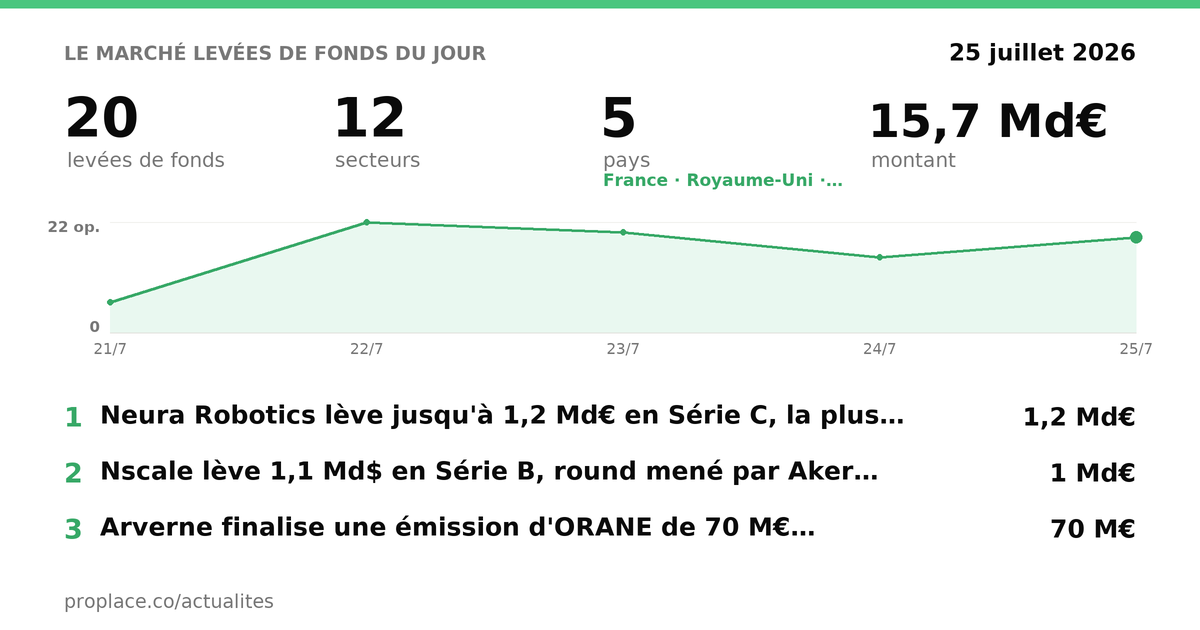
In focus — the deals we decoded
Neura Robotics raises €1.2 billion: European humanoid robotics enters the big league
Source: lemondeinformatique.fr → · Sector Industrial Tech & Manufacturing — 📬 subscribe to the Industrial Tech & Manufacturing newsletter
Neura Robotics (Germany) announces a Series C fundraising of up to €1.2 billion, conditional on achieving objectives defined by investors—the largest European fundraising in robotics. The company develops humanoid robots for industrial applications.
The obvious interpretation: after GPUs and data centers, capital is turning to robots as the next frontier of automation.
What deserves reflection: a humanoid robot is, at its core, a machine that aims to replace human labor in its most generalized form. The investment thesis is based on the idea that the cost of industrial labor in Europe makes substitution profitable in the medium term. But the conditional structure of the fundraising—€1.2 billion subject to objectives—is unusual at this stage: it signals that investors want proof of execution before releasing the full funds. This is healthy discipline in a sector where technological demonstrations often precede industrial-scale deployments by several years. For European industrialists looking at robotics as a response to deindustrialization: Neura is a bet that Europe can keep the R&D and production of these machines at home, rather than importing them from China or the United States.
Nscale raises $1.1 billion: Nvidia continues to fund the infrastructure that buys its chips
Source: datacenterdynamics.com → · Sector Developer & IT Infrastructure — 📬 subscribe to the Developer & IT Infrastructure newsletter
Nscale (London), an AI data center developer, raises $1.1 billion in Series B, led by Aker ASA, with participation from Blue Owl, Dell, Fidelity, Nokia, Nvidia, Point72, and T.Capital. The company has not yet built its own data center in the UK but has signed agreements with OpenAI and Microsoft.
Nvidia's presence in the capital has become the signature of a well-oiled mechanism: the chip manufacturer invests in players who will buy its GPUs, who then use that money to order more Nvidia chips. Money circulates among the same hands, demand seems real but is partly self-generated. Nscale has raised $1.1 billion to build data centers it hasn't yet built, based on contracts with OpenAI and Microsoft—two players who themselves are burning capital at an unprecedented rate. This is not necessarily a problem if end-customer computing demand is real and growing. But for a French institutional investor evaluating this type of asset: the real question is not the fundraising, it's the balance sheet in eighteen months—rack occupancy rates, real cost of deployed capital, and ability to generate margins in a market where hyperscalers are also building their own infrastructure.
Arverne issues €70 million in ORANE: French geothermal energy is creatively financed
Arverne, a French provider of geothermal solutions, finalizes an issuance of Redeemable Bonds in New or Existing Shares (ORANE) for €70 million, fully subscribed by Geogreen, Bpifrance, ADEME Investissement, Crédit Mutuel Equity, and Eiffel Investment Group. The bonds carry a 7% fully capitalized interest rate; repayment can be made in cash or in shares of Arverne, Lithium de France, or 2gré.
The ORANE is a hybrid instrument that preserves the issuer's cash flow—capitalized interest does not go out in cash—while offering subscribers upside exposure via conversion into shares. The tripartite repayment structure (cash or shares of three different entities) reflects the complexity of Arverne's portfolio: geothermal for energy, geothermal lithium for battery transition, related assets. That Bpifrance and ADEME are at the forefront confirms that this low-carbon energy infrastructure benefits from structural public support—which reduces financing risk but also signals that autonomous commercial profitability is not yet there. The "Dual Flow" strategic plan that Arverne wants to accelerate with these funds relies on the convergence between geothermal heat production and lithium extraction at the same sites—an original industrial thesis, but whose large-scale execution remains to be demonstrated.
Top French fundraisings of the week: Cyllene, Gradium, Bohr Energie
The three largest French fundraisings of the past week total €69.3 million: Cyllene Therapeutics (biotech, €33 million), Gradium (AI, €26.3 million), and Bohr Energie (€10 million). Biotech, AI, and energy—three sectors that concentrate most of French venture capital at the moment.
This weekly podium confirms a trend: French venture capital is focusing on science-intensive sectors where France has real academic strengths. Cyllene in therapeutics, Gradium in applied AI, Bohr in decarbonized energy—three bets on markets where technological differentiation creates lasting entry barriers.
Forsee Power opens its capital for €20 million
Source: laminutepositive.com →
Forsee Power, a French specialist in battery systems for heavy electric mobility (buses, rail, maritime), is opening its capital for €20 million to support the execution of its strategic plan. Investors not specified in available information.
Forsee Power occupies a strategic niche: batteries for heavy vehicles and public transport, a market less publicized than consumer automotive but structurally promising with the electrification of bus and train fleets in Europe. This fundraising finances industrial ramp-up in a sector where customer qualification cycles are long and entry barriers are high.
SquareMind raises $18 million for Swan, the dermatologist robot
Source: renseignementeconomique.fr →
SquareMind raises $18 million (approximately €17 million) to deploy Swan, its autonomous skin imaging robot, in response to the saturation of dermatology practices. Investors not specified in available information.
The thesis is clear and documented: dermatology is one of the most strained medical specialties in France, with waiting times of several months for a first appointment. A robot capable of performing diagnostic-quality skin imaging in a general practitioner's office or pharmacy shifts the bottleneck. The main risk is not technological but regulatory and economic: who pays, who is responsible, and how do dermatologists welcome a tool that could, in the long term, reduce their volume of first-line procedures.
Uniti raises $12 million for its agentic AI in real estate
Source: aiproptechnews.com → · Sector Data & Analytics — 📬 subscribe to the Data & Analytics newsletter
Uniti closes a Series A of $12 million (approximately €11 million) led by Pathlight, with participation from MetaProp and individual investors including Romain Huet (OpenAI). The funds will finance the deployment of AI agents for real estate operators—from leasing to collections, maintenance, and customer reviews—across more than fifteen integrated management systems.
Uniti is tackling a huge and under-digitalized market: the operational management of real estate portfolios (self-storage, senior residences, collective housing, flexible offices). The promise of AI agents handling 100% of incoming calls without human intervention is already a reality for some of their clients. The presence of Romain Huet from OpenAI in the capital is a signal of conviction regarding the maturity of the underlying models.
Cobl.ai raises €6 million from Eurazeo to automate commercial documents
Cobl.ai raises €6 million from Eurazeo to automate the production of commercial documents—quotes, proposals, contracts—using artificial intelligence.
Commercial document production is a considerable time sink in the sales cycles of SMEs and mid-caps. Cobl.ai is tackling this productivity opportunity with a verticalized approach. Eurazeo's early-stage investment signals an interest in the commercial process automation vertical, a fragmented but potentially very large market.
telli raises $15 million in seed to automate customer relations
telli (Berlin) raises $15 million in seed, led by redalpine, with participation from Mutschler, Cherry Ventures, and Y Combinator. The startup develops AI agents to automate customer interactions—voice, chat, SMS, WhatsApp, email—for B2C companies.
telli is part of an exploding category: conversational agents for customer relations. Y Combinator's presence in the seed round is a recognized mark of quality. Differentiation from the dozens of competitors in this space will rely on the depth of system integrations and the quality of the Charlie model, their internal agent management tool.
kausable raises €12 million in seed for an adaptive reasoning AI model
kausable raises €12 million in seed, led by UVC Partners and Entourage, to develop a "reasoning-first" and adaptive frontier AI model.
The race for European foundation models continues. kausable is betting on an adaptive reasoning architecture—the ability to adjust the level of reasoning according to task complexity—as a differentiator against American models. A €12 million seed for a frontier model is ambitious but consistent with the funding levels needed to stay in the race. At this stage, everything depends on the team and the technical thesis.
📩 Subscribe to our newsletter to follow daily M&A and fundraising news: https://proplace.co/newsletter
All of today's fundraisings, by sector
The full list for today — including the deals decoded above.
B2B Software & Cloud · 4 →
- telli — telli lève 15 M$ en seed pour automatiser les opérations client (Berlin)
- kausable — kausable lève 12 M€ en seed pour son IA sans réentraînement (Heidelberg)
- Startup du Loiret lève 1,5 M€ pour son IA de gestion immobilière
- Cobl.ai — Cobl.ai lève 6 M€ auprès d'Eurazeo pour automatiser les documents commerciaux
Developer & IT Infrastructure · 3 →
- Fly.io — Fly.io lève 25 M$ en Série D pour son infrastructure agentic IA
- Nscale — Nscale lève 1,1 Md$ pour ses centres de données IA (Aker, Nokia, Nvidia)
- Mistral — Mistral lève 1,7 Md€ pour construire un modèle IA souverain européen
Climate & Energy Tech · 2 →
- Arverne — Arverne finalise l'émission d'ORANE de 70 M€ pour ses solutions géothermales
- Forsee Power — Forsee Power lève 20 M€ pour soutenir son plan stratégique (batteries)
Robotics & Automation · 2 →
- Neura Robotics — Neura Robotics lève 1,2 Md€, plus grosse levée robotique en Europe
- Humanoid — Humanoid lève 152 M$ en Série A pour la robotique humanoïde (Royaume-Uni)
Construction & PropTech · 1 →
- Uniti — Uniti lève des fonds pour développer sa couche IA agentic (PropTech)
Cybersecurity · 1 →
- Ossprey — Ossprey lève 2,65 M$ en pré-seed pour la sécurité de la chaîne d'approvisionnement
Food & AgTech · 1 →
- Aptimiz — Aptimiz lève 1,4 M€ pour internationaliser son outil pour exploitants agricoles
Future of Work & HR Tech · 1 →
- Skello — Skello lève 200 M€ auprès de Bridgepoint pour son expansion européenne
Gaming · 1 →
- Engo — Engo lève 5 M€ pour ses lunettes connectées ultra-légères dédiées au sport
HealthTech & Digital Health · 1 →
- SquareMind — SquareMind lève 18 M$ pour déployer Swan, robot d'imagerie cutanée dermatologique
Industrial Tech & Manufacturing · 1 →
- Arrakis — Arrakis lève 28 M£ pour déployer des agents IA industriels (ex-Accel)
Mobility & Transportation · 1 →
- Reboat — Reboat accélère sur le marché méditerranéen des bateaux reconditionnés
Other deals (sector not classified) · 1
- Le podium des levées de fonds de la semaine dernière 🔥 ...