
Analysis of the day
M&A and Fundraising Analysis for July 27, 2026
Europe seeks its billions in space, humanoid robotics breaks world records, and France sets two deeptech seed funding milestones — today's overview for decision-makers and investors.
· Proplace
🌐 Translated from the French original by AI — the French version is authoritative.
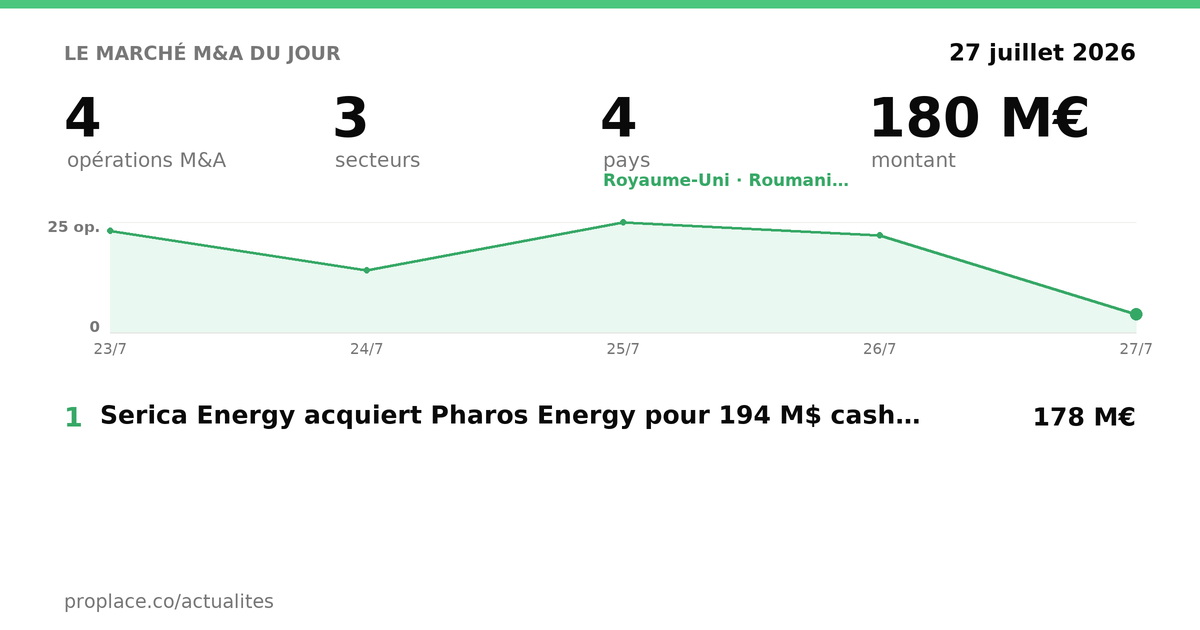
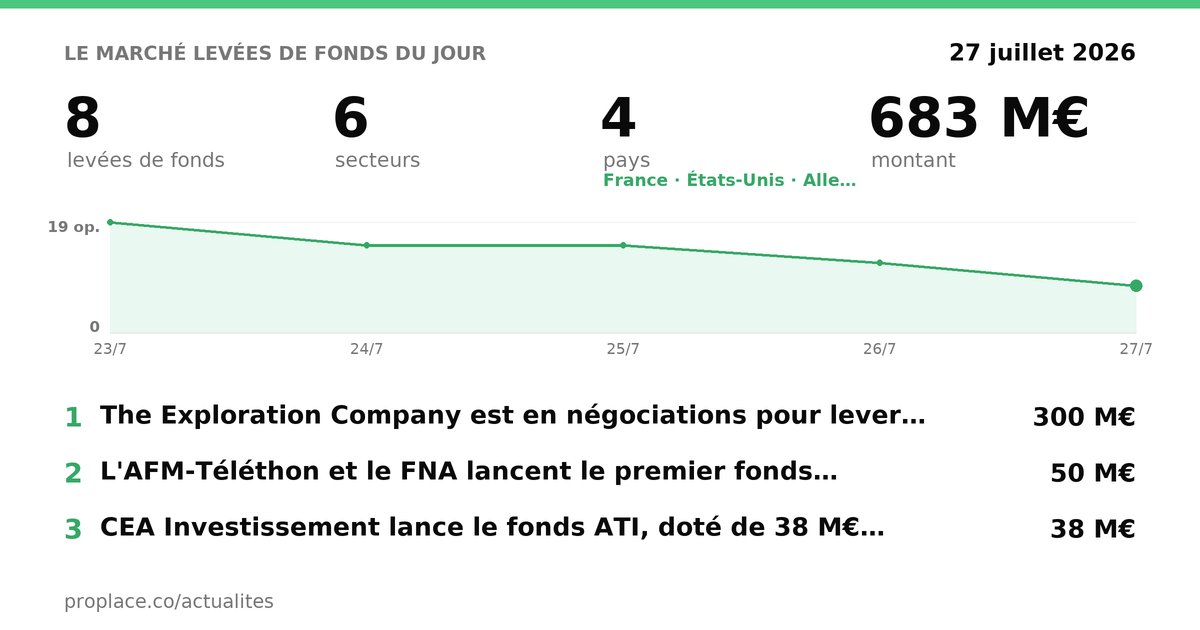
📊 Today's pulse — 12 deals · 4 M&A · 8 fundraisings · €864m in play.
July 27 is marked by two parallel dynamics: in Europe, capital is massively flowing towards future infrastructure — orbital space, humanoid robots, semiconductors — while in France, the state as a shareholder plays its first-round role in two strategic sectors. An M&A operation in British hydrocarbons reminds us that the energy transition has not yet rendered fossil assets illiquid.
🤝 Mergers & acquisitions today · 4
In focus — the deals we decoded
Schneider Electric: when an electrical cabinet manufacturer becomes the invisible infrastructure of the digital age
Schneider Electric is not announcing an acquisition today, but L'Usine Nouvelle's article documents a deeper transformation: driven by the explosion in data center demand, the company is accelerating its repositioning as a French champion of industrial tech. The raw fact is there — the company derives a growing share of its growth from power and cooling infrastructure for computing centers.
The obvious interpretation: Schneider is riding the AI wave. That's true, but it's only the surface. What's happening at a deeper level is more interesting. Data centers are extraordinarily demanding physical objects — in terms of space, water, electricity, and thermal security systems. Every billion dollars invested in global compute mechanically translates into orders for energy management equipment. Schneider understood before many others that the real rent of the digital age doesn't necessarily belong to those who write the code, but to those who power the machine.
This positioning — mandatory infrastructure provider for a structurally growing sector — is precisely the type of asset that industrial acquirers and infrastructure funds are looking at with increasing attention: a rent on the flow, not a bet on the product.
Acwa Robotics: the robot that inspects what the human eye cannot see
Source: x.com → · Sector Industrial Tech & Manufacturing — 📬 subscribe to the Industrial Tech & Manufacturing newsletter
Acwa Robotics is not a fundraising event today but a development operation documented by L'Usine Nouvelle: the company has deployed its pipeline inspection robot in Marseille, Bordeaux, Lyon, and at the Gravelines nuclear power plant. No amount is communicated.
The notable fact is in the list of sites: a nuclear power plant. The inspection of aging underground infrastructure — water networks, industrial pipelines, nuclear enclosures — is a mandatory regulatory maintenance market, thus captive and recurring. This is not technological luxury; it's compliance. For an industrial acquirer or an infrastructure fund, this type of asset has a rare quality: demand is not discretionary.
Serica Energy acquires Pharos Energy: an overbid that says something about the value of Asian fossil assets
Source: lse.co.uk → · Sector Climate & Energy Tech — 📬 subscribe to the Climate & Energy Tech newsletter
Serica Energy (UK) acquires Pharos Energy for $194M in cash, or 32.67 pence per share including a special dividend. The operation extends Serica's positions in Vietnam and Egypt.
What makes the operation clear is the context: a first acquirer, Ratio Petroleum Energy (Israel), had already signed an agreement for £124.3M a few weeks ago. Pharos's board withdrew its recommendation and turned to Serica, whose offer is deemed superior — not only in price, but in "certainty of completion." This notion of certainty is the real signal. In a tense geopolitical context (Middle East, Israeli actor), certainty of execution can be worth as much as a few tens of millions more.
For French capital exposed to mid-size oil assets in Southeast Asia or North Africa, this operation confirms that these assets are finding buyers at prices that have not collapsed — the energy transition has not yet killed the liquidity of production fossil fuels.
All of today's M&A, by sector
The full list for today — including the deals decoded above.
Climate & Energy Tech · 1 →
- Pharos — Serica Energy rachète Pharos (énergie, GB) pour 194 M$
Construction & PropTech · 1 →
- Gerantis — Strikwerda Investments acquiert une majorité de Gerantis (gestion immobilière, Belgique)🔮 The next move: robaws — The acquirer seeks to strengthen their PropTech offering with a specialized cloud ERP for construction and installation, a logical next step. · graditi inc. — Their expertise in residential construction management complements their expansion into property management, following the integration of DomiLinq. · hypothesis, not a fact
Media & Entertainment · 1 →
- iaBilet — PLG rachète iaBilet (billetterie, Roumanie)
Other deals (sector not classified) · 1
- DIRECT - Tour de France 2026 : 600.000 personnes attendues à l'arrivée, suivez la 19e étape entre Gap et l'Alpe d'Huez - ICI
🚀 Fundraisings today · 8
In focus — the deals we decoded
A €50M seed fund for biotherapies: AFM-Téléthon moves from philanthropy to venture capital
The AFM-Téléthon and the Fonds National d'Amorçage are launching, as part of the future investment program, the first seed fund dedicated to innovative biotherapies and rare diseases, endowed with €50M.
The immediate interpretation: another public fund for French biotech. But the structure deserves attention. AFM-Téléthon is not a sovereign fund or a classic corporate — it's an association that has funded fundamental research on neuromuscular diseases for thirty years, and co-founded Genethon, one of the few global players capable of producing viral vectors for large-scale gene therapy. This fund is not an opportunistic diversification into biotech: it's an organization that intimately knows the science, researchers, and regulatory obstacles of the sector, deciding to convert its expertise into a financial instrument.
This is precisely the type of vehicle that the French ecosystem lacks: a first-round investor who understands biology before understanding the cap table. For a gene therapy or genome editing startup seeking its first institutional ticket, this fund is a qualitatively different resource from a generalist.
CEA Investissement launches ATI: €38M to transform public research into businesses
Source: aefinfo.fr → · Sector Education & EdTech — 📬 subscribe to the Education & EdTech newsletter
CEA Investissement is launching the ATI (Amorçage Technologique Investissement) fund, endowed with €38M, dedicated to young French companies whose offering is based on strong technological innovation originating from the CEA.
CEA Investissement has existed since 1999 and has funded about fifty companies. ATI is therefore an additional vintage of a proven model, not an institutional gamble. What is structurally important: the CEA produces innovations in fields — nuclear, semiconductors, materials, defense, energy — where the maturation cycle is long and where generalist private venture capital is hesitant to enter alone. A fund backed by the research institution itself partially solves this problem: the investor knows the technology from the inside, which reduces the usual information asymmetry between researcher and financier.
For a private co-investor, the presence of CEA Investissement in a seed round is a signal of technical validation, not just financial.
Humanoid robotics breaks all records — and ten of the fifteen largest global fundraisings go to China
Source: x.com → · Sector Industrial Tech & Manufacturing — 📬 subscribe to the Industrial Tech & Manufacturing newsletter
According to Dealroom data, humanoid robotics startups have raised $8.6Bn since the beginning of 2026, which is 1.8 times the entire year 2025, only halfway through. The largest round in Europe is that of the German Neura Robotics ($1.4Bn). But ten of the fifteen largest global fundraisings in the sector have been carried out by Chinese startups.
The raw figure is spectacular. What is more interesting is the geography. Humanoid robotics is not a sector where the West holds a structural advantage — unlike advanced semiconductors or language models. China combines a massive manufacturing industrial base (which creates demand for automation), lower hardware development costs, and access to public-private capital without comparable regulatory friction. For a European investor looking at this sector, the question is not "should we go there" but "in which part of the value chain can Europe hold a defensible position" — and the answer points to precision components and control software, not final assembly.
The Exploration Company aims for $2Bn valuation: Europe tries to build its SpaceX
The Exploration Company (TEC), founded in 2021 and led by Hélène Huby, is in discussions to raise at least $300M at a valuation exceeding $2Bn. The Scaleup Europe Fund — a European Union vehicle managed by EQT, with over €5Bn — is considering one of its first investments in TEC. Previous investors include Balderton, Bessemer, and Plural; the last round was approximately $160M in 2024.
TEC is developing a reusable cargo capsule for low Earth orbit — the Nyx family — and a rocket engine named Storm, with the ambition to commercially serve the International Space Station by 2028. It has received initial support from ESA in this context.
The obvious interpretation: Europe wants its SpaceX. The reality is more nuanced. TEC is not trying to compete with SpaceX on heavy launchers — a field where the gap is abysmal — but on the orbital cargo transport segment in low Earth orbit, a market that NASA and ESA have structurally decided to commercialize rather than operate themselves. It's a market of public contracts disguised as a commercial market: the initial demand is institutional, predictable, and the specifications are co-written with the public client. This model — strategic infrastructure financed by a public order, with commercial optionality afterwards — is precisely what justifies the entry of the Scaleup Europe Fund.
The operation also has a clear geopolitical dimension: since SpaceX demonstrated that orbital transport could be privatized, European dependence on a single American actor for access to space has become a documented sovereign vulnerability. TEC is, in part, a response to this vulnerability — which explains why Brussels' money is entering the capital.
For a French or European institutional investor, this round combines three rarely met characteristics: disruptive technology, a guaranteed public client in the short term, and political backing that reduces the risk of regulatory delisting. The main risk remains technical execution in a sector where delays are measured in years.
📩 Subscribe to our newsletter to follow daily M&A and fundraising news: https://proplace.co/newsletter
All of today's fundraisings, by sector
The full list for today — including the deals decoded above.
Space Tech · 2 →
- The Exploration Company — The Exploration Company lève 300 M€+ pour atteindre 2 Md€ de valorisation
- Exploration Company — Exploration Company lève 300 M€+ pour atteindre 2 Md€ de valorisation
B2B Software & Cloud · 1 →
- Investissements d'avenir : lancement d'un fonds d'amorçage de 50 millions d'euros dédié aux biothérapies innovantes
Commerce & Consumer · 1 →
- Reboat — Reboat lève 3 M€ pour le reconditionnement de bateaux
Education & EdTech · 1 →
- Investissements d'avenir : CEA Investissement lance le fonds d'amorçage ATI, doté de 38 millions d'euros
Future of Work & HR Tech · 1 →
- Engo — Engo lève 2,5 M€ pour son IA d'organisation du quotidien
Social & Creator Economy · 1 →
- Passionfroot — Passionfroot lève 15 M$ en série A pour sa plateforme de creator-led growth
Other deals (sector not classified) · 1
- STMicroelectronics relève ses prévisions mais chute en Bourse après ses résultats du T2 - SCIENCES ET TECHNOLOGIES - L’info du jour - Journal Chrétien