
Analysis of the day
M&A and Fundraising Analysis for July 26, 2026 SUBTITLE=== All-out consolidation: from Burgundy vineyards to African delivery markets, from Irish banking to Swiss peptides — the day reveals European and global capital in full strategic repositioning. ===BODY=== A busy day, geographically extensive and sectorally eclectic. Real estate logistics is being reshaped on a large scale in the background, but the flow of sourced transactions runs from Burgundy to Sub-Saharan Africa, from Irish retail banking to Swiss biochemistry, from French fire safety to Parisian artificial voice. Several threads intersect: the search for rare and non-reproducible assets, the consolidation of fragmented markets under pressure from private capital, and the race for infrastructure that controls flows — of goods, data, and people. # 🤝 M&A Transactions ## Roederer enters Burgundy: when champagne buys what money can no longer create **Louis Roederer** acquires **Domaine Pierre Damoy** in Gevrey-Chambertin — **8 hectares** of grand crus including Chambertin, Chambertin-Clos de Bèze, Chapelle-Chambertin, and the Clos Tamisot monopole, for an estimated value of around **€50M** based on recent transactions on the Côte-d'Or. The immediate interpretation: a family-owned Champagne house, the most profitable in its category, diversifies its portfolio into Burgundy, the world's most expensive vineyard. Classic patrimonial diversification. But let's look at the underlying mechanism. Roederer is not buying a brand, a factory, or a distribution network. It is buying land — land whose total surface area has been fixed by decree for centuries and cannot increase by a single square meter. Chambertin covers only 12.9 hectares in total on the planet. What Roederer has just acquired is a share of an asset whose supply is structurally impossible to expand, while global demand — driven by Asian and American markets, and a growing wealthy clientele — continues to expand. This is not an investment in a wine company: it is the acquisition of a fragmented natural monopoly, a pure land rent whose value mechanically increases with scarcity. *The deeper signal: the great Champagne dynasties (Roederer, but also LVMH with its Burgundy purchases) are not fleeing to Burgundy out of a love for Pinot Noir — they are seeking assets whose value cannot be copied, delocalized, or disrupted. In a world where almost everything is reproducible, the classified grand cru plot remains one of the rare assets whose scarcity is guaranteed by geology and law.* For a family office or a French patrimonial investor: grand cru Burgundy is no longer just a passion asset, it is an asset class in its own right, with increasing liquidity and low correlation to financial markets. The consolidation window closes with each transaction. ## Charterhouse / Batibig: modular construction enters the private equity arena **Charterhouse Capital** acquires **Batibig**, a modular construction player in France. The transaction is advised by **Freshfields**, **Moncey Avocats**, **Mayer Brown**, and **Ropes & Gray** — a top-tier legal team that signals a carefully structured transaction, even if the amount remains confidential. Modular construction addresses a simple constraint: build quickly, at a controlled cost, in contexts where traditional building is too slow or too expensive. Field hospitals, emergency housing, temporary offices, industrial infrastructure. *Charterhouse's entry signals that the sector is considered mature enough to absorb a build-up strategy — consolidating a still fragmented market under a single platform, with the purchasing and deployment synergies that this implies.* ## Astorg / Barkene: technical security, a bet on regulatory obligation **Astorg** acquires **Barkene**, a multi-specialist critical technical services platform founded in 2018 in Pantin — electronic security, fire protection, automatic doors, remote surveillance, nearly 40 agencies in France. The financing is structured as a unitranche by **CAPZA**. Barkene has grown rapidly through organic growth and targeted acquisitions since its creation. Astorg is now stepping in to accelerate this movement on a different scale. *What makes this sector attractive to private equity is not spectacular: it is precisely its mandatory nature. Fire standards, security certifications, recurring maintenance contracts — these are revenues that regulation makes almost captive. A building cannot decide to stop maintaining its fire protection system. It is this visibility of cash flows, and not any technological disruption, that justifies the valuation.* ## Mitigram / Export Enterprises: tracing the thread of international trade **Mitigram**, a Swedish fintech specializing in international trade finance, acquires **Export Enterprises SA** (Paris), publisher of the **eexpand** platform for export trade intelligence. Amount undisclosed. Until now, Mitigram operated where a company had already identified its foreign buyer and was looking to finance the transaction — letter of credit, guarantee, working capital facility. eexpand intervenes upstream: exploring a market, identifying partners, evaluating an opportunity. *By acquiring this link, Mitigram is not expanding laterally — it is moving upstream. The company that discovers a promising distributor in Morocco or Indonesia via eexpand will need a financing instrument a few weeks later. Mitigram will already be there. This is a funnel strategy: capturing the customer when their financing need does not yet exist, to be the first present when it emerges.* ## Green Dot / Léko: the packaging sector verticalizes **Green Dot** (DSD, Germany) is in advanced discussions to acquire **50%** of **Valorie SAS**, the holding company of the packaging eco-organization **Léko** and **Léko-Pro**, whose current shareholder is the German group **Reclay**. Due diligence is underway, with closing expected by the end of summer. Léko is an approved eco-organization: it collects contributions from producers and finances the recycling of household packaging in France, under the extended producer responsibility (EPR) framework. Green Dot, for its part, operates in industrial plastic recycling. *The operation is a vertical integration in the regulatory sense: linking the collection of compliance obligations (Léko collects eco-contributions) to the industrial recycling capacity (Green Dot processes the material). Rather than selling a service to an independent eco-organization, Green Dot wants to be on both sides of the chain — the one that collects compliance money and the one that recycles the material. In a context of tightening European requirements on plastic packaging, this integrated position becomes a structural advantage.* Note: the operation is classified as M&A because Green Dot acquires 50% of Valorie, representing joint control. ## Eiffage strengthens its presence in Spain with three acquisitions **Eiffage** makes three acquisitions in Spain: **CVS** (industrial refrigeration and fire protection, 300 employees, €60M revenue in 2024, 11 sites), **M3i Controls**, and **Inmotechnia**. Amounts undisclosed. The logic is that of a large construction and services group densifying its geographical and technical coverage in the Iberian market. CVS in particular, with its integrated value chain from engineering to maintenance, complements Eiffage's energy services portfolio in Spain. *Three simultaneous acquisitions signal a deliberate acceleration, not an isolated opportunity — Eiffage is building an Iberian platform, not a position.* ## Uber / Glovo Africa and Talabat: the continent as a growth driver **Uber** acquires **Delivery Hero** for **€14.8Bn** ($16.9Bn), thereby inheriting **Glovo**'s African operations (Ivory Coast, Kenya, Morocco, Nigeria, Tunisia, Uganda) and **Talabat**'s Egyptian business. Simultaneously, **Delivery Hero** sells 14 businesses to **SSW Partners** for approximately **$1.6Bn** to clear antitrust hurdles — SSW notably acquires Glovo's European operations (Spain, Portugal, Poland, Romania) and brands like Yemeksepeti in Turkey. The obvious interpretation: Uber consolidates global food delivery and gains an African presence in high-demographic-growth markets. The operation is more precisely structured. Uber doesn't want all of Delivery Hero — it wants Africa and Egypt, where online delivery penetration is still low and the population is young. Mature European markets (Spain, Poland, Turkey), where margins are squeezed and competition is intense, go to SSW. *This is an explicit geographical arbitrage: Uber sells markets where the price war is already lost or won to buy markets where it has not yet begun. The real bet is not food delivery itself — it is the combination of ride-hailing + delivery in the same markets, a network density that makes each ride or order cheaper to operate than for a single-product competitor.* For an investor or operator looking at Africa: Uber has just set a valuation and competition marker in six African countries. Local players who do not yet have a strategic partner will find themselves under pressure. ## Nestlé / Platinum Equity — Peranel: when big brands become yield assets **Nestlé** creates a 50/50 joint venture with **Platinum Equity** to house all of its global water business — **Perrier**, **S.Pellegrino**, **Buxton**, **Acqua Panna**, **Nestlé Pure Life**, more than 30 brands. The total valuation is **€4.9Bn**, including approximately **€3Bn** in cash proceeds for Nestlé. Nestlé has been simplifying its portfolio for several years, divesting or restructuring slower-growth businesses to focus on more dynamic categories. Bottled water, a mature and capital-intensive market, fits this logic. *What is striking here is less the sale than the structure. Nestlé is not divesting — it is creating a joint venture and retaining 50%. Platinum Equity brings its operational discipline and appetite for quiet restructurings (that's its business), Nestlé retains exposure to the brands without bearing the balance sheet alone. This is a way to partially monetize an asset without losing control or reputation — and to let a third party do the optimization work that Nestlé could not do itself without reputational risk.* British unions have already warned: the transaction structure does not change their interpretation of the intentions. ## OCS Group / Mitie: British facilities management consolidates at a high premium **OCS Group** acquires **Mitie**, a leading British facilities management company (cleaning, security, maintenance), for **€3.8Bn** (£3.1Bn) in cash, representing a premium of **+46.8%** over the unaffected share price on July 20. A cash premium of almost 47% is a strong signal: OCS judged that waiting or negotiating a lower price risked another buyer stepping in. *Facilities management is a sector that resembles Barkene from a higher perspective: recurring revenues, long contracts, low cyclicality. The value creation lever is the pooling of operational costs over an expanded customer base — fewer trucks, fewer dispatch centers, better negotiation of supplies. The high premium indicates that OCS valued these very concrete synergies, not any digital transformation.* ## Samsung Biologics / PolyPeptide: the pharmaceutical supply chain reshapes under pricing pressure **Samsung Biologics** acquires **PolyPeptide**, a Swiss manufacturer of active pharmaceutical peptides, for **€1.7Bn** ($1.8Bn) — the largest acquisition in Korean biopharma history. PolyPeptide operates sites in India, France, Belgium, Sweden, and two in California, employs 1,400 people, and generated €389M in revenue in 2025 (+16%). The US tariff context is explicit in the announcement: Trump has announced tariffs on generic drugs imported into the United States, eventually rising to 100%. PolyPeptide manufactures the active ingredients for GLP-1s (diabetes and obesity treatments, a globally exploding market). *Samsung Biologics is not just buying production capacity — it is buying a position in the supply chain of a molecule whose global demand will grow for years (GLP-1), while also acquiring manufacturing sites already established in Europe and the United States, thus partially protected from US tariffs. This is an industrial response to a political constraint: when borders close to molecule flows, you buy factories on the other side of the border.* For French pharmaceutical players: PolyPeptide's site in France becomes strategic in this configuration. ## Bawag / PTSB: European retail banking seeks critical mass **Bawag** (Austria) acquires **57.5%** of **Permanent TSB** (PTSB, Ireland) for **€1.62Bn** (€2.97 per share), of which approximately **€931M** goes to the Irish state which was selling its post-crisis stake. European banking consolidation has been progressing in discreet steps for ten years. Bawag, already present in Ireland through its mortgage subsidiary Moco, adds a full retail bank with deposits, mortgage loans, and individual customers. *Ireland is a concentrated banking market (three dominant players after the 2008 failures) with a growing economy and a young population. Bawag is not looking to disrupt — it is looking to benefit from a market structure favorable to decent margins, in a country where demand for mortgage credit remains strong. This is traditional banking that embraces being traditional banking, which is rarer than it seems.* ## Blackstone / Skroutz: private equity bets on Greek online commerce **Blackstone** acquires a majority stake in **Skroutz**, a Greek online marketplace, from **CVC Capital Partners**. Amount undisclosed. Skroutz is the dominant price comparison and marketplace in Greece. CVC, an early investor, is handing over to Blackstone for the next phase of development. *Greece has one of the highest e-commerce growth rates in Southern Europe — a still under-penetrated market, a connected population, and a recovering economy. Blackstone is buying a dominant position in a catching-up market, which is often more profitable than a marginal position in a mature market.* ## Dawsongroup / Dan Ryan Truck Rental: KKR pushes into continental Europe **Dawsongroup** (backed by **KKR**) acquires **Dan Ryan Truck Rental**, Ireland's oldest truck and commercial vehicle rental company. Amount undisclosed. Dawsongroup, a British asset rental player (trucks, refrigerated equipment), crosses the Irish Sea to establish a first continental foothold. *The operation is simple in its logic: KKR has a European consolidation thesis for Dawsongroup, and Ireland, an English-speaking, culturally close market, is the natural first step before broader expansion. Dan Ryan continues under its brand — the value is in the customer network and local reputation, not in the brand name.* ## IK Partners / MDT Technologies → Bregal Unternehmerkapital: industrial home automation changes hands **IK Partners** sells **MDT Technologies**, a German manufacturer of KNX-standard home automation components (sensors, actuators, building management), to **Bregal Unternehmerkapital**. MDT employs 250 people, has more than doubled its production since IK's entry in 2020, and distributes 600 references. A classic continuation transaction in private equity: IK transformed a founder-led company into a professionalized platform with a complete management team, an expanded portfolio, and a nascent international presence. Bregal takes over for the next phase. *MDT benefits from an open standard (KNX) deeply embedded in European professional installation — a loyal installed base and installers who do not easily change protocols. It is this soft technical lock-in, rather than spectacular growth, that justifies the valuation.* # 🚀 Fundraisings ## Gradium: zero-latency artificial voice, Kyutai's bet **Gradium**, a Parisian startup spun out of the **Kyutai** research laboratory (backed by **Xavier Niel**), raises **€64M** ($70M) in seed funding from **FirstMark Capital**, **Eurazeo**, **Xavier Niel**, **DST Global Partners**, and **Eric Schmidt**. Gradium develops audio language models — artificial voices capable of responding in near real-time, without the perceptible delay that makes current voice assistants artificial. The goal: vocal interaction as fluid as human conversation, for AI agents, voice interfaces, and embedded assistants. A €64M seed round for a company just out of stealth is an anomaly in size — or rather, it is the signature of a bet on infrastructure. *Gradium is not building a voice application: it is building the low-level layer on which other applications will rely. Latency is the real unsolved problem of AI voice — everyone knows how to make a machine speak, but no one yet knows how to make it respond instantly at scale. If Gradium solves this problem, it is not selling a product, it is selling a standard. This is what investors bought — a potential infrastructure position, not a feature.* For the French deeptech ecosystem: Kyutai continues to prove that French public research can generate world-class spinouts. 📩 Subscribe to our newsletter to follow daily M&A and fundraising news: https://proplace.co/newsletter ===WHYS=== 1. the acquirer seeks to consolidate its presence in Latin America after African expansion, strengthening its leadership in emerging markets 2. Their expertise in dark stores and AI in Africa complements their recent African acquisitions to optimize logistics 3. the acquirer seeks to consolidate its position in Latin America after African expansion, strengthening its multi-platform strategy 4. the acquirer seeks to consolidate its position as a European logistics leader, expanding its geographical presence and warehouse portfolio 5. Their portfolio of industrial properties in the United States would extend their geographical footprint beyond Europe, capitalizing on their logistics expertise
· Proplace
🌐 Translated from the French original by AI — the French version is authoritative.
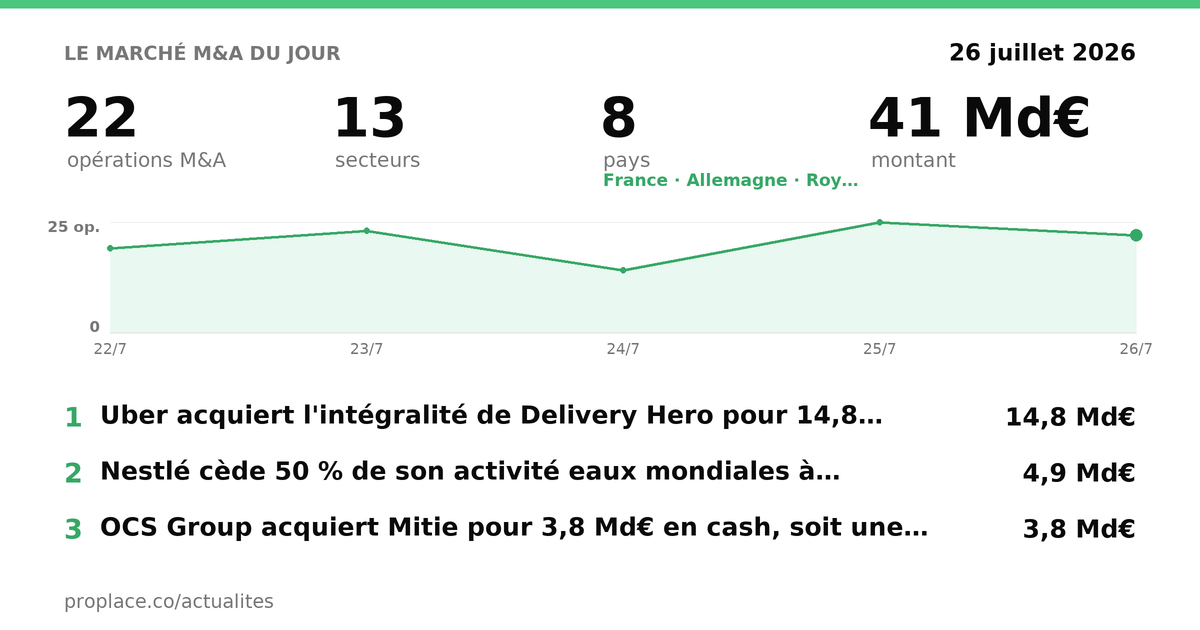
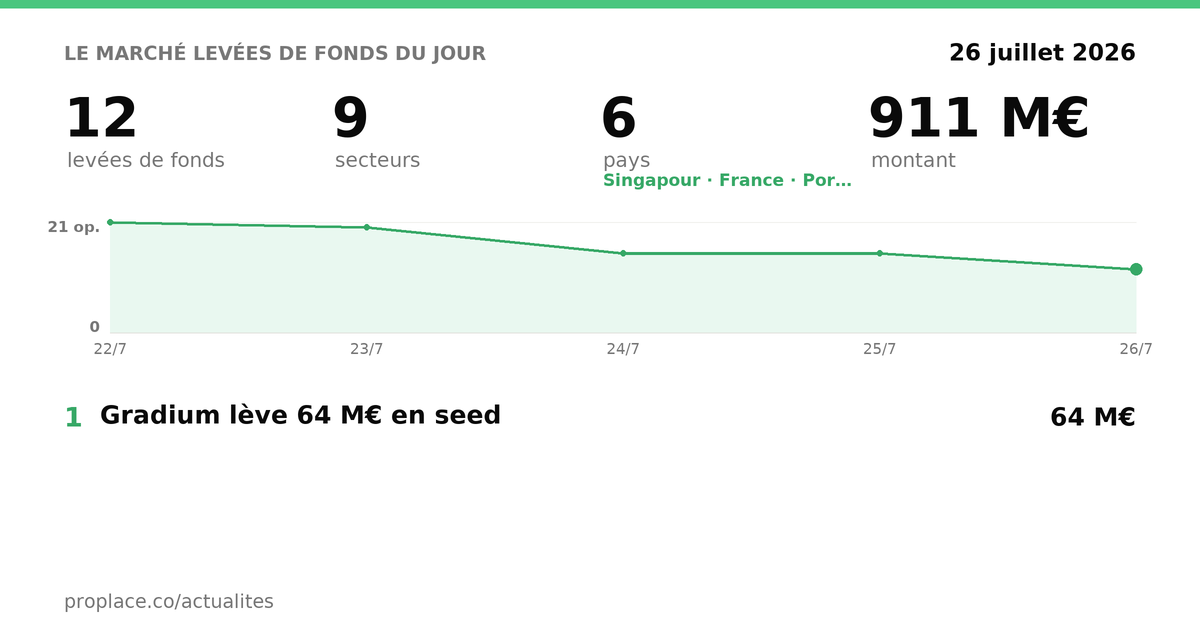
📊 Today's pulse — 34 deals · 22 M&A · 12 fundraisings · €41.9bn in play.
A busy day, geographically extensive and sectorally eclectic. Real estate logistics is being reshaped on a large scale in the background, but the flow of sourced transactions runs from Burgundy to Sub-Saharan Africa, from Irish retail banking to Swiss biochemistry, from French fire safety to Parisian artificial voice. Several threads intersect: the search for rare and non-reproducible assets, the consolidation of fragmented markets under pressure from private capital, and the race for infrastructure that controls flows — of goods, data, and people.
🤝 Mergers & acquisitions today · 22
In focus — the deals we decoded
Roederer enters Burgundy: when champagne buys what money can no longer create
Louis Roederer acquires Domaine Pierre Damoy in Gevrey-Chambertin — 8 hectares of grand crus including Chambertin, Chambertin-Clos de Bèze, Chapelle-Chambertin, and the Clos Tamisot monopole, for an estimated value of around €50M based on recent transactions on the Côte-d'Or.
The immediate interpretation: a family-owned Champagne house, the most profitable in its category, diversifies its portfolio into Burgundy, the world's most expensive vineyard. Classic patrimonial diversification.
But let's look at the underlying mechanism. Roederer is not buying a brand, a factory, or a distribution network. It is buying land — land whose total surface area has been fixed by decree for centuries and cannot increase by a single square meter. Chambertin covers only 12.9 hectares in total on the planet. What Roederer has just acquired is a share of an asset whose supply is structurally impossible to expand, while global demand — driven by Asian and American markets, and a growing wealthy clientele — continues to expand. This is not an investment in a wine company: it is the acquisition of a fragmented natural monopoly, a pure land rent whose value mechanically increases with scarcity.
The deeper signal: the great Champagne dynasties (Roederer, but also LVMH with its Burgundy purchases) are not fleeing to Burgundy out of a love for Pinot Noir — they are seeking assets whose value cannot be copied, delocalized, or disrupted. In a world where almost everything is reproducible, the classified grand cru plot remains one of the rare assets whose scarcity is guaranteed by geology and law.
For a family office or a French patrimonial investor: grand cru Burgundy is no longer just a passion asset, it is an asset class in its own right, with increasing liquidity and low correlation to financial markets. The consolidation window closes with each transaction.
Charterhouse / Batibig: modular construction enters the private equity arena
Charterhouse Capital acquires Batibig, a modular construction player in France. The transaction is advised by Freshfields, Moncey Avocats, Mayer Brown, and Ropes & Gray — a top-tier legal team that signals a carefully structured transaction, even if the amount remains confidential.
Modular construction addresses a simple constraint: build quickly, at a controlled cost, in contexts where traditional building is too slow or too expensive. Field hospitals, emergency housing, temporary offices, industrial infrastructure. Charterhouse's entry signals that the sector is considered mature enough to absorb a build-up strategy — consolidating a still fragmented market under a single platform, with the purchasing and deployment synergies that this implies.
Astorg / Barkene: technical security, a bet on regulatory obligation
Astorg acquires Barkene, a multi-specialist critical technical services platform founded in 2018 in Pantin — electronic security, fire protection, automatic doors, remote surveillance, nearly 40 agencies in France. The financing is structured as a unitranche by CAPZA.
Barkene has grown rapidly through organic growth and targeted acquisitions since its creation. Astorg is now stepping in to accelerate this movement on a different scale. What makes this sector attractive to private equity is not spectacular: it is precisely its mandatory nature. Fire standards, security certifications, recurring maintenance contracts — these are revenues that regulation makes almost captive. A building cannot decide to stop maintaining its fire protection system. It is this visibility of cash flows, and not any technological disruption, that justifies the valuation.
Mitigram / Export Enterprises: tracing the thread of international trade
Source: breakingfintech.news → · Sector FinTech — 📬 subscribe to the FinTech newsletter
Mitigram, a Swedish fintech specializing in international trade finance, acquires Export Enterprises SA (Paris), publisher of the eexpand platform for export trade intelligence. Amount undisclosed.
Until now, Mitigram operated where a company had already identified its foreign buyer and was looking to finance the transaction — letter of credit, guarantee, working capital facility. eexpand intervenes upstream: exploring a market, identifying partners, evaluating an opportunity. By acquiring this link, Mitigram is not expanding laterally — it is moving upstream. The company that discovers a promising distributor in Morocco or Indonesia via eexpand will need a financing instrument a few weeks later. Mitigram will already be there. This is a funnel strategy: capturing the customer when their financing need does not yet exist, to be the first present when it emerges.
Green Dot / Léko: the packaging sector verticalizes
Source: euwid-recycling.com → · Sector Horizontal & Productivity SaaS — 📬 subscribe to the Horizontal & Productivity SaaS newsletter
Green Dot (DSD, Germany) is in advanced discussions to acquire 50% of Valorie SAS, the holding company of the packaging eco-organization Léko and Léko-Pro, whose current shareholder is the German group Reclay. Due diligence is underway, with closing expected by the end of summer.
Léko is an approved eco-organization: it collects contributions from producers and finances the recycling of household packaging in France, under the extended producer responsibility (EPR) framework. Green Dot, for its part, operates in industrial plastic recycling. The operation is a vertical integration in the regulatory sense: linking the collection of compliance obligations (Léko collects eco-contributions) to the industrial recycling capacity (Green Dot processes the material). Rather than selling a service to an independent eco-organization, Green Dot wants to be on both sides of the chain — the one that collects compliance money and the one that recycles the material. In a context of tightening European requirements on plastic packaging, this integrated position becomes a structural advantage. Note: the operation is classified as M&A because Green Dot acquires 50% of Valorie, representing joint control.
Eiffage strengthens its presence in Spain with three acquisitions
Source: ideal-investisseur.fr →
Eiffage makes three acquisitions in Spain: CVS (industrial refrigeration and fire protection, 300 employees, €60M revenue in 2024, 11 sites), M3i Controls, and Inmotechnia. Amounts undisclosed.
The logic is that of a large construction and services group densifying its geographical and technical coverage in the Iberian market. CVS in particular, with its integrated value chain from engineering to maintenance, complements Eiffage's energy services portfolio in Spain. Three simultaneous acquisitions signal a deliberate acceleration, not an isolated opportunity — Eiffage is building an Iberian platform, not a position.
Uber / Glovo Africa and Talabat: the continent as a growth driver
Source: techinafrica.fr → · Sector Mobility & Transportation — 📬 subscribe to the Mobility & Transportation newsletter
Uber acquires Delivery Hero for €14.8Bn ($16.9Bn), thereby inheriting Glovo's African operations (Ivory Coast, Kenya, Morocco, Nigeria, Tunisia, Uganda) and Talabat's Egyptian business. Simultaneously, Delivery Hero sells 14 businesses to SSW Partners for approximately $1.6Bn to clear antitrust hurdles — SSW notably acquires Glovo's European operations (Spain, Portugal, Poland, Romania) and brands like Yemeksepeti in Turkey.
The obvious interpretation: Uber consolidates global food delivery and gains an African presence in high-demographic-growth markets.
The operation is more precisely structured. Uber doesn't want all of Delivery Hero — it wants Africa and Egypt, where online delivery penetration is still low and the population is young. Mature European markets (Spain, Poland, Turkey), where margins are squeezed and competition is intense, go to SSW. This is an explicit geographical arbitrage: Uber sells markets where the price war is already lost or won to buy markets where it has not yet begun. The real bet is not food delivery itself — it is the combination of ride-hailing + delivery in the same markets, a network density that makes each ride or order cheaper to operate than for a single-product competitor.
For an investor or operator looking at Africa: Uber has just set a valuation and competition marker in six African countries. Local players who do not yet have a strategic partner will find themselves under pressure.
Nestlé / Platinum Equity — Peranel: when big brands become yield assets
Source: europesays.com → · Sector Climate & Energy Tech — 📬 subscribe to the Climate & Energy Tech newsletter
Nestlé creates a 50/50 joint venture with Platinum Equity to house all of its global water business — Perrier, S.Pellegrino, Buxton, Acqua Panna, Nestlé Pure Life, more than 30 brands. The total valuation is €4.9Bn, including approximately €3Bn in cash proceeds for Nestlé.
Nestlé has been simplifying its portfolio for several years, divesting or restructuring slower-growth businesses to focus on more dynamic categories. Bottled water, a mature and capital-intensive market, fits this logic.
What is striking here is less the sale than the structure. Nestlé is not divesting — it is creating a joint venture and retaining 50%. Platinum Equity brings its operational discipline and appetite for quiet restructurings (that's its business), Nestlé retains exposure to the brands without bearing the balance sheet alone. This is a way to partially monetize an asset without losing control or reputation — and to let a third party do the optimization work that Nestlé could not do itself without reputational risk. British unions have already warned: the transaction structure does not change their interpretation of the intentions.
OCS Group / Mitie: British facilities management consolidates at a high premium
Source: caproasia.com → · Sector Horizontal & Productivity SaaS — 📬 subscribe to the Horizontal & Productivity SaaS newsletter
OCS Group acquires Mitie, a leading British facilities management company (cleaning, security, maintenance), for €3.8Bn (£3.1Bn) in cash, representing a premium of +46.8% over the unaffected share price on July 20.
A cash premium of almost 47% is a strong signal: OCS judged that waiting or negotiating a lower price risked another buyer stepping in. Facilities management is a sector that resembles Barkene from a higher perspective: recurring revenues, long contracts, low cyclicality. The value creation lever is the pooling of operational costs over an expanded customer base — fewer trucks, fewer dispatch centers, better negotiation of supplies. The high premium indicates that OCS valued these very concrete synergies, not any digital transformation.
Samsung Biologics / PolyPeptide: the pharmaceutical supply chain reshapes under pricing pressure
Samsung Biologics acquires PolyPeptide, a Swiss manufacturer of active pharmaceutical peptides, for €1.7Bn ($1.8Bn) — the largest acquisition in Korean biopharma history. PolyPeptide operates sites in India, France, Belgium, Sweden, and two in California, employs 1,400 people, and generated €389M in revenue in 2025 (+16%).
The US tariff context is explicit in the announcement: Trump has announced tariffs on generic drugs imported into the United States, eventually rising to 100%. PolyPeptide manufactures the active ingredients for GLP-1s (diabetes and obesity treatments, a globally exploding market).
Samsung Biologics is not just buying production capacity — it is buying a position in the supply chain of a molecule whose global demand will grow for years (GLP-1), while also acquiring manufacturing sites already established in Europe and the United States, thus partially protected from US tariffs. This is an industrial response to a political constraint: when borders close to molecule flows, you buy factories on the other side of the border. For French pharmaceutical players: PolyPeptide's site in France becomes strategic in this configuration.
Bawag / PTSB: European retail banking seeks critical mass
Source: brands4sustainability.com → · Sector FinTech — 📬 subscribe to the FinTech newsletter
Bawag (Austria) acquires 57.5% of Permanent TSB (PTSB, Ireland) for €1.62Bn (€2.97 per share), of which approximately €931M goes to the Irish state which was selling its post-crisis stake.
European banking consolidation has been progressing in discreet steps for ten years. Bawag, already present in Ireland through its mortgage subsidiary Moco, adds a full retail bank with deposits, mortgage loans, and individual customers. Ireland is a concentrated banking market (three dominant players after the 2008 failures) with a growing economy and a young population. Bawag is not looking to disrupt — it is looking to benefit from a market structure favorable to decent margins, in a country where demand for mortgage credit remains strong. This is traditional banking that embraces being traditional banking, which is rarer than it seems.
Blackstone / Skroutz: private equity bets on Greek online commerce
Blackstone acquires a majority stake in Skroutz, a Greek online marketplace, from CVC Capital Partners. Amount undisclosed.
Skroutz is the dominant price comparison and marketplace in Greece. CVC, an early investor, is handing over to Blackstone for the next phase of development. Greece has one of the highest e-commerce growth rates in Southern Europe — a still under-penetrated market, a connected population, and a recovering economy. Blackstone is buying a dominant position in a catching-up market, which is often more profitable than a marginal position in a mature market.
Dawsongroup / Dan Ryan Truck Rental: KKR pushes into continental Europe
Source: dawsongroup.co.uk → · Sector Retail & E-commerce Tech — 📬 subscribe to the Retail & E-commerce Tech newsletter
Dawsongroup (backed by KKR) acquires Dan Ryan Truck Rental, Ireland's oldest truck and commercial vehicle rental company. Amount undisclosed.
Dawsongroup, a British asset rental player (trucks, refrigerated equipment), crosses the Irish Sea to establish a first continental foothold. The operation is simple in its logic: KKR has a European consolidation thesis for Dawsongroup, and Ireland, an English-speaking, culturally close market, is the natural first step before broader expansion. Dan Ryan continues under its brand — the value is in the customer network and local reputation, not in the brand name.
IK Partners / MDT Technologies → Bregal Unternehmerkapital: industrial home automation changes hands
IK Partners sells MDT Technologies, a German manufacturer of KNX-standard home automation components (sensors, actuators, building management), to Bregal Unternehmerkapital. MDT employs 250 people, has more than doubled its production since IK's entry in 2020, and distributes 600 references.
A classic continuation transaction in private equity: IK transformed a founder-led company into a professionalized platform with a complete management team, an expanded portfolio, and a nascent international presence. Bregal takes over for the next phase. MDT benefits from an open standard (KNX) deeply embedded in European professional installation — a loyal installed base and installers who do not easily change protocols. It is this soft technical lock-in, rather than spectacular growth, that justifies the valuation.
All of today's M&A, by sector
The full list for today — including the deals decoded above.
Food & AgTech · 3 →
- Nestlé Waters — Platinum Equity acquiert la division eau de Nestlé pour 4,2 Md£
- Pierre Damoy — Louis Roederer rachète le Domaine Pierre Damoy (vignoble, France) pour 8 ha de grands crus
- Barkene — Astorg acquiert Barkene avec le soutien de CAPZA en financement Unitranche
Industrial Tech & Manufacturing · 3 →
- Aasted — PiovanGroup acquiert Aasted (équipements confiserie)
- MDT technologies — IK Partners vend MDT technologies à BU Bregal Unternehmerkapital
- Azkoyen — Jainaga et un consortium basque lancent une OPA de 244 M€ sur Azkoyen
Logistics & Supply Chain · 3 →
- Delivery Hero — Uber acquiert les opérations africaines de Delivery Hero pour 14,8 Md€
- Mitie — OCS Group acquiert Mitie (gestion d'installations, UK) pour 4,1 Md$
- Argan — Argan et WDP fusionnent pour créer un logisticien européen de 13 Md€🔮 The next move: CTP — the acquirer seeks to consolidate its position as a European logistics leader, expanding its geographical presence and warehouse portfolio · Industrial Logistics Properties Trust — Their portfolio of industrial properties in the United States would extend their geographical footprint beyond Europe, capitalizing on their logistics expertise · hypothesis, not a fact
Construction & PropTech · 2 →
- Eiffage — Eiffage renforce sa présence en Espagne avec trois nouvelles acquisitions
- Batibig — Freshfields, Moncey Avocats, Mayer Brown, Ropes & Gray Act On Charterhouse Capitals’ Acquisition Of Batibig - thedealmatter.com
FinTech · 2 →
- Permanent TSB — Bawag acquiert Permanent TSB (banque, Irlande) pour 1,62 Md€
- Export Enterprises — Mitigram acquiert Export Enterprises pour connecter intelligence commerciale et financement
Biotech & Pharma · 1 →
- PolyPeptide — Samsung Biologics acquiert PolyPeptide (peptides, Suisse) pour 1,8 Md$
Climate & Energy Tech · 1 →
- Léko — Green Dot acquiert une participation dans Léko (conformité emballages, France)
Commerce & Consumer · 1 →
- Claquettes-chaussettes et fast-food : dans le train des coureurs du Tour de France
Health & Wellness · 1 →
- Vitabiotics — Bain Capital acquiert Vitabiotics (nutraceutique, UK) pour 850-900 M$
HealthTech & Digital Health · 1 →
- ArisGlobal — Dassault Systèmes acquiert ArisGlobal (logiciel sciences de la vie) de Nordic Capital
Mobility & Transportation · 1 →
- Dan Ryan Truck Rental — Dawsongroup acquiert Dan Ryan Truck Rental (location véhicules, Irlande)
Retail & E-commerce Tech · 1 →
- Skroutz — Blackstone acquiert une majorité de Skroutz (marketplace, Grèce)
Other deals (sector not classified) · 2
- E-Waste EPR Consultants in India 2026
- Battery Waste EPR Consultants in India 2026
🚀 Fundraisings today · 12
In focus — the deals we decoded
Gradium: zero-latency artificial voice, Kyutai's bet
Gradium, a Parisian startup spun out of the Kyutai research laboratory (backed by Xavier Niel), raises €64M ($70M) in seed funding from FirstMark Capital, Eurazeo, Xavier Niel, DST Global Partners, and Eric Schmidt.
Gradium develops audio language models — artificial voices capable of responding in near real-time, without the perceptible delay that makes current voice assistants artificial. The goal: vocal interaction as fluid as human conversation, for AI agents, voice interfaces, and embedded assistants.
A €64M seed round for a company just out of stealth is an anomaly in size — or rather, it is the signature of a bet on infrastructure. Gradium is not building a voice application: it is building the low-level layer on which other applications will rely. Latency is the real unsolved problem of AI voice — everyone knows how to make a machine speak, but no one yet knows how to make it respond instantly at scale. If Gradium solves this problem, it is not selling a product, it is selling a standard. This is what investors bought — a potential infrastructure position, not a feature. For the French deeptech ecosystem: Kyutai continues to prove that French public research can generate world-class spinouts.
📩 Subscribe to our newsletter to follow daily M&A and fundraising news: https://proplace.co/newsletter
All of today's fundraisings, by sector
The full list for today — including the deals decoded above.
Climate & Energy Tech · 3 →
- Rize — Rize lève 31 M$ pour numériser la riziculture bas carbone en Asie du Sud-Est
- Green Dot — Green Dot renforce sa présence en France dans le recyclage des emballages
- Arverne — Arverne lève 70 M€ pour accélérer son plan stratégique en géothermie
B2B Software & Cloud · 2 →
- Monogram — Monogram lève 40 M$ pour son IA grand public
- EquiLibre Technologies — EquiLibre Technologies lève une Series A à 500 M$ minimum avec Creandum
Cybersecurity · 1 →
- Verisure — Verisure recrute 40 salariés en Normandie d'ici fin 2026
Developer & IT Infrastructure · 1 →
- Gradium — Gradium lève 70 M$ pour révolutionner la technologie vocale par l'IA
Education & EdTech · 1 →
- Imagi — Imagi lève 4,5 M$ pour révolutionner l'enseignement du code et l'IA à l'école
Future of Work & HR Tech · 1 →
- Skello — Skello lève 200 M€ pour consolider son logiciel RH en Europe
Industrial Tech & Manufacturing · 1 →
- Arrakis — Arrakis lève 38 M$ pour son IA d'optimisation des opérations industrielles
Mobility & Transportation · 1 →
- Pollen — Pollen lève 3,2 M€ pour son infrastructure d'échange de batteries pour motos électriques
Other deals (sector not classified) · 1
- Ossprey — Ossprey lève 2,65 M$ en financement pre-seed