
Analysis of the day
M&A and Fundraising Analysis for July 20, 2026 SUBTITLE=== Delivery, pharma, industrial robotics, and green energy move together: July 20, sector by sector, for decision-makers and investors. ===BODY=== On-demand delivery, pharmaceutical contract manufacturing, Irish mortgage credit, industrial robotics, biomethane, LPG shipping — today covers a broad spectrum, without forcing an overarching thesis. Two transactions dominate by their scale: **Uber**'s acquisition of **Delivery Hero** for **$14.8 billion**, and **Samsung Biologics**' acquisition of Swiss CDMO **PolyPeptide Group** for **2.7 trillion won** (approximately $1.8 billion). Around these, more discreet but instructive movements are taking place: consolidation in Irish credit, an equity investment in German premium pet food, two LPG vessels acquired with secured charters, and on the fundraising side, a record European seed round in robotics, an industrial biomethane company seeking funds, and an anti-mosquito drone from Y Combinator. # 🤝 M&A Transactions ## Uber-Delivery Hero: When mobility buys hunger to be more than just a transporter **Uber** announces the acquisition of **Delivery Hero** for **$14.8 billion**, or approximately 41.50 euros per share — a spectacular premium on a stock that traded below 20 euros before April 2026. **Prosus**, a 17% shareholder, is divesting its entire stake to facilitate the closing. In parallel, Delivery Hero is divesting its operations in 14 countries, streamlining the scope of the acquisition. The surface reading: Uber is consolidating on-demand delivery, doubling its presence in over 100 markets, and promising synergies between ride-hailing and food delivery. Platform logic, economies of scale, the discourse is well-rehearsed. But the real story is elsewhere. Uber already held 25% of Delivery Hero's capital directly, plus 12% via financial instruments — totaling 37% even before the announcement. This is not an acquisition that comes out of nowhere: it's the conversion of a financial position into operational control. The question is not "why Uber is buying" but "why now, and why at this price." For several quarters, food delivery has been searching for its profitability model. Delivery costs are structurally high, margins per order remain thin, and growth is slowing in mature markets. Delivery Hero, despite its global reach, has long burned cash. By paying 41.50 euros for a stock that was worth less than 20 euros a few months earlier, Uber is paying an urgency premium — a sign that the alternative (letting Delivery Hero restructure alone, or even be acquired by a competitor) was deemed more costly than integration. *What the operation truly reveals: consolidation in on-demand delivery is no longer a growth strategy; it's a race for critical mass to dilute fixed costs that no one has managed to reduce otherwise. For a French or European player in this segment — Getir, Stuart, any B2B delivery operator — the message is clear: the field is narrowing, and the two or three global survivors will be those who have absorbed the others before markets saturate.* ## Samsung Biologics acquires PolyPeptide Group: The Korean bet on the peptide wave **Samsung Biologics** announces the acquisition of **100% of PolyPeptide Group**, a Swiss CDMO specializing in peptide manufacturing, for **2.7 trillion won** (approximately $1.8 billion). The transaction — the largest ever in Korean biopharmaceuticals — will first involve the acquisition of the majority stake from the largest shareholder (55.65%), followed by a cash tender offer planned for mid-September, with a targeted closing at the end of December 2026. PolyPeptide operates six production sites in five countries (Sweden, Belgium, France, India, United States). The obvious reading: Samsung Biologics, a global leader in biopharmaceutical contract manufacturing for monoclonal antibodies, is seeking to diversify its portfolio into peptides — a rapidly growing segment driven by the explosion of obesity and diabetes treatments (GLP-1 and analogues). The acquisition of a leading manufacturer immediately gives it capacity and technical credibility. What deserves attention: Samsung Biologics has been building its position in South Korea for years (five factories in Songdo, three under construction). But global demand for peptide manufacturing capacity now far exceeds supply — Novo Nordisk and Eli Lilly are struggling to supply their own networks. By acquiring PolyPeptide, Samsung is not just buying tanks and processes: it is buying six years of lead time over anyone who would want to build these capacities from scratch, in a context where the lead times for commissioning a peptide CDMO site are measured in years. *For European pharmaceutical companies — laboratories or funds invested in healthcare — the operation signals that manufacturing capacity is now the rare asset, not the molecule. Whoever controls the production tools controls market access.* ## Pepper Advantage absorbs Dilosk and ICS Mortgages: The silent consolidation of Irish credit **Pepper Advantage**, a subsidiary of the American fund **J.C. Flowers & Co.**, which already manages approximately **75 billion euros** in assets in Ireland, Spain, and the United Kingdom, announces the acquisition of **Dilosk DAC**, an Irish mortgage origination and servicing platform operating under the **Dilosk** and **ICS Mortgages** brands. The amount was not disclosed. Closing is expected at the end of Q3 2026, subject to regulatory approvals. Dilosk manages a mortgage portfolio of approximately **1.7 billion euros** and has issued over **3.2 billion euros** through eleven public securitizations since 2013. The platform covers traditional residential, buy-to-let, and bridging loans for capital market investors and private credit. *The operation is a financial plumbing consolidation: Pepper Advantage is integrating an Irish origination engine into its credit management infrastructure, strengthening its position in a mortgage market that remains under-banked since the 2008 crisis. For private credit players in Europe, it's a reminder that proprietary origination platforms — those that generate the deal flow — are as valuable as the balance sheets they feed.* ## United Petfood takes 50% of SmartPetPro: Entry into German premium **United Petfood** acquires **50%** of the capital of **SmartPetPro**, a German producer of premium wet pet food. The amount was not disclosed. Lars Oehlmann remains CEO, and co-founders Stefan Pfannmöller and Erich Herrmann remain involved in strategy. Germany is one of Europe's largest pet food markets, and the premium wet segment is growing faster than the overall market there. United Petfood brings its international network and industrial resources; SmartPetPro retains its entrepreneurial identity and customer proximity. *A classic build-up operation in a sector where premiumization creates niches that are difficult for large groups to attack: United Petfood is buying distribution and local legitimacy rather than building from scratch.* ## Adenac acquires two Japanese LPG vessels with secured charters **Adenac Ship Management**, the commercial arm of **Vitamodo Scheepsbeheer BV** (Netherlands), based in Athens, announces the acquisition of two 3,500 cbm pressurized LPG carriers, built in Japan in 2009, for a total amount of approximately **32 million euros**. The two vessels enter the fleet with two years of employment already guaranteed by contract. Adenac is pursuing a disciplined fleet building strategy: quality assets, secured charters upon entry, and revenue visibility. The operator had already acquired a third LPG carrier earlier in the year, fixed for five years. *In shipping, the value of an asset without guaranteed employment is a promise; with two years of signed charters, it's a cash flow. Adenac's strategy — buying small, covering immediately — is a rational response to the volatility of LPG freight rates, which remain exposed to geopolitical risks on the Gulf and Northeast Asian routes.* # 🚀 Fundraisings ## microagi raises $55 million in seed funding: The largest seed round in German history **microagi**, a German startup founded less than a year ago by former **Red Bull Racing** and **Mercedes-AMG Petronas** Formula 1 engineers, announces a **$55 million** seed round — the largest seed round ever in Germany. The round is led by **Hummingbird**, with participation from **Northzone**, **LocalGlobe**, **Village Global**, and **redalpine**. The funds will finance the deployment of **Atlas**, the company's industrial data and automation platform, to large European industrial groups. The positioning: microagi deploys robotic systems in real production environments and leverages the operational data collected to continuously improve the performance of the entire fleet. The logic is one of learning effects — more deployments, better the platform, harder to catch up for a competitor starting out. What justifies the size of the round at this stage: the founders come from a world where 99.9% reliability and real-time management of complex systems are prerequisites, not aspirations. Formula 1 is a laboratory of engineering under extreme constraint — exactly what the manufacturing industry demands from its automation suppliers. This is not a marketing signal; it's a guarantee of operational credibility for industrial buyers who have been burned by robotic demos that don't scale. *For European industrial corporations — automotive, aerospace, chemicals — the window to adopt these platforms as early partners (and thus influence the product roadmap) is closing as deployments accumulate among competitors. The delay in adopting industrial robotics is, unlike software, difficult to catch up once production data is captured elsewhere.* ## Lénéo begins fundraising for its industrial biomethane **Lénéo**, a new French industrial biomethane developer-producer, announces the launch of a fundraising round whose target amount has not yet been disclosed, described as "significant" by sources close to the matter. Industrial biomethane — distinct from agricultural biogas — targets volumes and process temperatures that small rural units cannot achieve. The French regulatory and tariff context remains favorable, and industrial demand for renewable gas injected into networks is accelerating under pressure from large groups' decarbonization commitments. *An operation to watch: the amount and composition of the round will be crucial for evaluating the real industrial ambition. In methanization, the size of the units directly determines economic competitiveness — a significant fundraising will signal a developer-consolidator logic, not an isolated project.* ## Tornyol and the anti-mosquito drone: Y Combinator bets on autonomous bioprotection **Tornyol**, a Parisian startup founded by Alex Toussaint and Clovis Piedallu, has been selected by **Y Combinator** — the amount was not disclosed, but is consistent with YC standards for a seed round. The company is developing a 40-gram autonomous micro-drone that detects flying insects by acoustic analysis of wingbeats, identifies them by species, and neutralizes them by high-speed collision — without chemicals. The announced technical milestone: first successful "shot" in controlled conditions on a moth. The initial commercial target is the protection of delimited areas (gardens, urban areas), with a longer-term ambition for vector-borne disease control on a square kilometer scale using drone swarms. *The interest of the operation is not the drone itself, but the methodological breakthrough: replacing a chemical pesticide (substance, logistics, residual toxicity) with a rechargeable autonomous mechanical agent. If the acoustic recognition accuracy holds at scale, the business model — fleet rental, surface-based service — is structurally different from the biocide market. Y Combinator is rarely wrong about the direction, even when the path is long.* 📩 Subscribe to our newsletter to follow daily M&A and fundraising news: https://proplace.co/newsletter ===WHYS=== 1. the acquirer seeks to consolidate their presence in Southeast Asia after the integration of Delivery Hero 2. Their strong presence in Latin America would consolidate their global expansion post-Delivery Hero, particularly in Brazil 3. would strengthen their presence in Southeast Asia, following the global expansion of the Delivery Hero acquisition 4. Their pizza expertise and multinational presence would complement their post-Delivery Hero expansion 5. the acquirer seeks to strengthen their expertise in Swiss CDMO and diversify their high-potency manufacturing capabilities, thereby complementing 6. Their expertise in GMP microbial production complements their expansion into peptides, diversifying their technological capabilities post-acquisition
· Proplace
🌐 Translated from the French original by AI — the French version is authoritative.
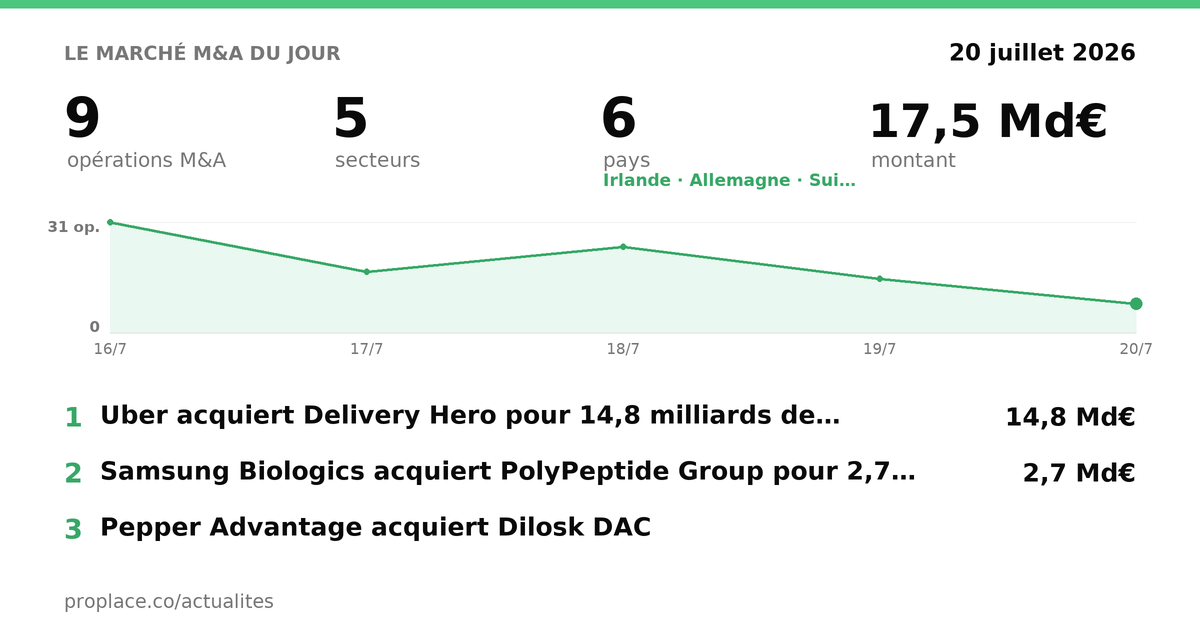
📊 Today's pulse — 10 deals · 7 M&A · 3 fundraisings · €17.6bn in play.
On-demand delivery, pharmaceutical contract manufacturing, Irish mortgage credit, industrial robotics, biomethane, LPG shipping — today covers a broad spectrum, without forcing an overarching thesis. Two transactions dominate by their scale: Uber's acquisition of Delivery Hero for $14.8 billion, and Samsung Biologics' acquisition of Swiss CDMO PolyPeptide Group for 2.7 trillion won (approximately $1.8 billion). Around these, more discreet but instructive movements are taking place: consolidation in Irish credit, an equity investment in German premium pet food, two LPG vessels acquired with secured charters, and on the fundraising side, a record European seed round in robotics, an industrial biomethane company seeking funds, and an anti-mosquito drone from Y Combinator.
🤝 Mergers & acquisitions today · 7
In focus — the deals we decoded
Uber-Delivery Hero: When mobility buys hunger to be more than just a transporter
Source: economiematin.fr → · Sector Mobility & Transportation — 📬 subscribe to the Mobility & Transportation newsletter
Uber announces the acquisition of Delivery Hero for $14.8 billion, or approximately 41.50 euros per share — a spectacular premium on a stock that traded below 20 euros before April 2026. Prosus, a 17% shareholder, is divesting its entire stake to facilitate the closing. In parallel, Delivery Hero is divesting its operations in 14 countries, streamlining the scope of the acquisition.
The surface reading: Uber is consolidating on-demand delivery, doubling its presence in over 100 markets, and promising synergies between ride-hailing and food delivery. Platform logic, economies of scale, the discourse is well-rehearsed.
But the real story is elsewhere. Uber already held 25% of Delivery Hero's capital directly, plus 12% via financial instruments — totaling 37% even before the announcement. This is not an acquisition that comes out of nowhere: it's the conversion of a financial position into operational control. The question is not "why Uber is buying" but "why now, and why at this price."
For several quarters, food delivery has been searching for its profitability model. Delivery costs are structurally high, margins per order remain thin, and growth is slowing in mature markets. Delivery Hero, despite its global reach, has long burned cash. By paying 41.50 euros for a stock that was worth less than 20 euros a few months earlier, Uber is paying an urgency premium — a sign that the alternative (letting Delivery Hero restructure alone, or even be acquired by a competitor) was deemed more costly than integration.
What the operation truly reveals: consolidation in on-demand delivery is no longer a growth strategy; it's a race for critical mass to dilute fixed costs that no one has managed to reduce otherwise. For a French or European player in this segment — Getir, Stuart, any B2B delivery operator — the message is clear: the field is narrowing, and the two or three global survivors will be those who have absorbed the others before markets saturate.
Samsung Biologics acquires PolyPeptide Group: The Korean bet on the peptide wave
Source: en.yna.co.kr → · Sector Mobility & Transportation — 📬 subscribe to the Mobility & Transportation newsletter
Samsung Biologics announces the acquisition of 100% of PolyPeptide Group, a Swiss CDMO specializing in peptide manufacturing, for 2.7 trillion won (approximately $1.8 billion). The transaction — the largest ever in Korean biopharmaceuticals — will first involve the acquisition of the majority stake from the largest shareholder (55.65%), followed by a cash tender offer planned for mid-September, with a targeted closing at the end of December 2026. PolyPeptide operates six production sites in five countries (Sweden, Belgium, France, India, United States).
The obvious reading: Samsung Biologics, a global leader in biopharmaceutical contract manufacturing for monoclonal antibodies, is seeking to diversify its portfolio into peptides — a rapidly growing segment driven by the explosion of obesity and diabetes treatments (GLP-1 and analogues). The acquisition of a leading manufacturer immediately gives it capacity and technical credibility.
What deserves attention: Samsung Biologics has been building its position in South Korea for years (five factories in Songdo, three under construction). But global demand for peptide manufacturing capacity now far exceeds supply — Novo Nordisk and Eli Lilly are struggling to supply their own networks. By acquiring PolyPeptide, Samsung is not just buying tanks and processes: it is buying six years of lead time over anyone who would want to build these capacities from scratch, in a context where the lead times for commissioning a peptide CDMO site are measured in years.
For European pharmaceutical companies — laboratories or funds invested in healthcare — the operation signals that manufacturing capacity is now the rare asset, not the molecule. Whoever controls the production tools controls market access.
Pepper Advantage absorbs Dilosk and ICS Mortgages: The silent consolidation of Irish credit
Source: pulse2.com → · Sector Construction & PropTech — 📬 subscribe to the Construction & PropTech newsletter
Pepper Advantage, a subsidiary of the American fund J.C. Flowers & Co., which already manages approximately 75 billion euros in assets in Ireland, Spain, and the United Kingdom, announces the acquisition of Dilosk DAC, an Irish mortgage origination and servicing platform operating under the Dilosk and ICS Mortgages brands. The amount was not disclosed. Closing is expected at the end of Q3 2026, subject to regulatory approvals.
Dilosk manages a mortgage portfolio of approximately 1.7 billion euros and has issued over 3.2 billion euros through eleven public securitizations since 2013. The platform covers traditional residential, buy-to-let, and bridging loans for capital market investors and private credit.
The operation is a financial plumbing consolidation: Pepper Advantage is integrating an Irish origination engine into its credit management infrastructure, strengthening its position in a mortgage market that remains under-banked since the 2008 crisis. For private credit players in Europe, it's a reminder that proprietary origination platforms — those that generate the deal flow — are as valuable as the balance sheets they feed.
United Petfood takes 50% of SmartPetPro: Entry into German premium
United Petfood acquires 50% of the capital of SmartPetPro, a German producer of premium wet pet food. The amount was not disclosed. Lars Oehlmann remains CEO, and co-founders Stefan Pfannmöller and Erich Herrmann remain involved in strategy.
Germany is one of Europe's largest pet food markets, and the premium wet segment is growing faster than the overall market there. United Petfood brings its international network and industrial resources; SmartPetPro retains its entrepreneurial identity and customer proximity.
A classic build-up operation in a sector where premiumization creates niches that are difficult for large groups to attack: United Petfood is buying distribution and local legitimacy rather than building from scratch.
Adenac acquires two Japanese LPG vessels with secured charters
Source: shippingtelegraph.com → · Sector Mobility & Transportation — 📬 subscribe to the Mobility & Transportation newsletter
Adenac Ship Management, the commercial arm of Vitamodo Scheepsbeheer BV (Netherlands), based in Athens, announces the acquisition of two 3,500 cbm pressurized LPG carriers, built in Japan in 2009, for a total amount of approximately 32 million euros. The two vessels enter the fleet with two years of employment already guaranteed by contract.
Adenac is pursuing a disciplined fleet building strategy: quality assets, secured charters upon entry, and revenue visibility. The operator had already acquired a third LPG carrier earlier in the year, fixed for five years.
In shipping, the value of an asset without guaranteed employment is a promise; with two years of signed charters, it's a cash flow. Adenac's strategy — buying small, covering immediately — is a rational response to the volatility of LPG freight rates, which remain exposed to geopolitical risks on the Gulf and Northeast Asian routes.
All of today's M&A, by sector
The full list for today — including the deals decoded above.
Biotech & Pharma · 1 →
- Samsung Biologics rachète une CDMO suisse pour 2,7 billions de won
Commerce & Consumer · 1 →
- Delivery Hero — Uber rachète Delivery Hero pour 14,8 milliards de dollars🔮 The next move: Food Delivery Brands — Their pizza expertise and multinational presence would complement their post-Delivery Hero expansion · hypothesis, not a fact
FinTech · 1 →
- Dilosk — Pepper Advantage rachète Dilosk, plateforme irlandaise de prêts hypothécaires
Food & AgTech · 1 →
- SmartPetPro — United Petfood acquiert 50% de SmartPetPro pour l'alimentation premium pour animaux en Allemagne
Logistics & Supply Chain · 1 →
- Adenac (Grèce) acquiert deux navires-citernes LPG japonais
Other deals (sector not classified) · 2
- Le parcours complet du Tour de France 2026
- Le gouvernement lance la troisième phase de “Villages d’avenir” avec un rôle du préfet renforcé - Acteurs Publics
🚀 Fundraisings today · 3
In focus — the deals we decoded
microagi raises $55 million in seed funding: The largest seed round in German history
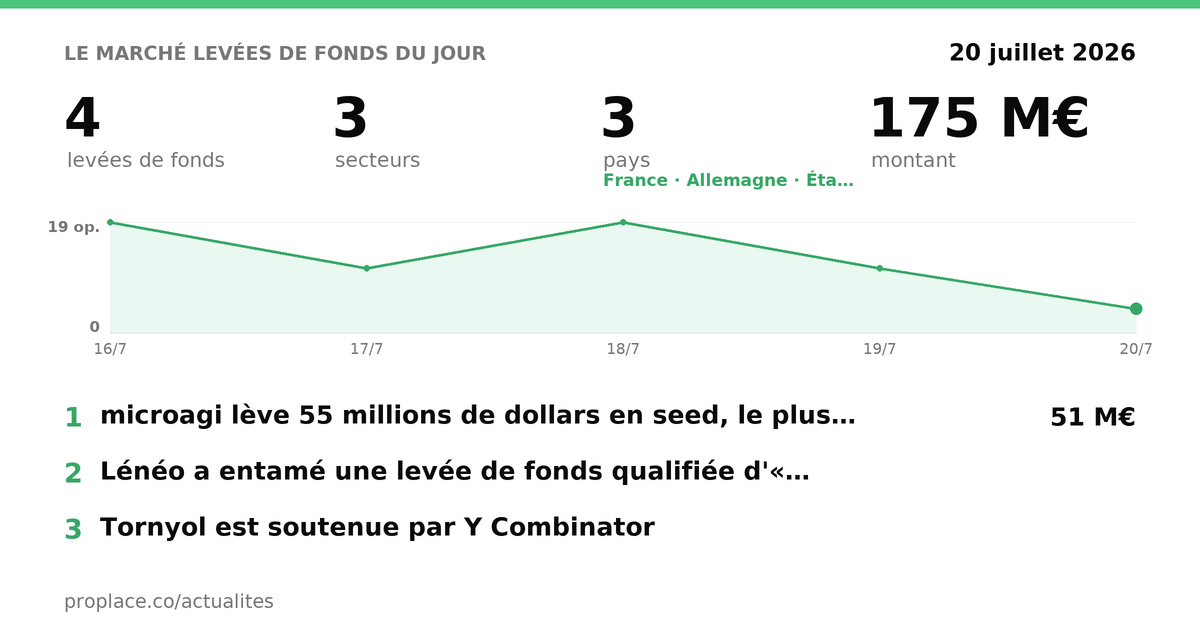
microagi, a German startup founded less than a year ago by former Red Bull Racing and Mercedes-AMG Petronas Formula 1 engineers, announces a $55 million seed round — the largest seed round ever in Germany. The round is led by Hummingbird, with participation from Northzone, LocalGlobe, Village Global, and redalpine. The funds will finance the deployment of Atlas, the company's industrial data and automation platform, to large European industrial groups.
The positioning: microagi deploys robotic systems in real production environments and leverages the operational data collected to continuously improve the performance of the entire fleet. The logic is one of learning effects — more deployments, better the platform, harder to catch up for a competitor starting out.
What justifies the size of the round at this stage: the founders come from a world where 99.9% reliability and real-time management of complex systems are prerequisites, not aspirations. Formula 1 is a laboratory of engineering under extreme constraint — exactly what the manufacturing industry demands from its automation suppliers. This is not a marketing signal; it's a guarantee of operational credibility for industrial buyers who have been burned by robotic demos that don't scale.
For European industrial corporations — automotive, aerospace, chemicals — the window to adopt these platforms as early partners (and thus influence the product roadmap) is closing as deployments accumulate among competitors. The delay in adopting industrial robotics is, unlike software, difficult to catch up once production data is captured elsewhere.
Lénéo begins fundraising for its industrial biomethane
Lénéo, a new French industrial biomethane developer-producer, announces the launch of a fundraising round whose target amount has not yet been disclosed, described as "significant" by sources close to the matter.
Industrial biomethane — distinct from agricultural biogas — targets volumes and process temperatures that small rural units cannot achieve. The French regulatory and tariff context remains favorable, and industrial demand for renewable gas injected into networks is accelerating under pressure from large groups' decarbonization commitments.
An operation to watch: the amount and composition of the round will be crucial for evaluating the real industrial ambition. In methanization, the size of the units directly determines economic competitiveness — a significant fundraising will signal a developer-consolidator logic, not an isolated project.
Tornyol and the anti-mosquito drone: Y Combinator bets on autonomous bioprotection
Source: mugglehead.com → · Sector FinTech — 📬 subscribe to the FinTech newsletter
Tornyol, a Parisian startup founded by Alex Toussaint and Clovis Piedallu, has been selected by Y Combinator — the amount was not disclosed, but is consistent with YC standards for a seed round. The company is developing a 40-gram autonomous micro-drone that detects flying insects by acoustic analysis of wingbeats, identifies them by species, and neutralizes them by high-speed collision — without chemicals.
The announced technical milestone: first successful "shot" in controlled conditions on a moth. The initial commercial target is the protection of delimited areas (gardens, urban areas), with a longer-term ambition for vector-borne disease control on a square kilometer scale using drone swarms.
The interest of the operation is not the drone itself, but the methodological breakthrough: replacing a chemical pesticide (substance, logistics, residual toxicity) with a rechargeable autonomous mechanical agent. If the acoustic recognition accuracy holds at scale, the business model — fleet rental, surface-based service — is structurally different from the biocide market. Y Combinator is rarely wrong about the direction, even when the path is long.
📩 Subscribe to our newsletter to follow daily M&A and fundraising news: https://proplace.co/newsletter
All of today's fundraisings, by sector
The full list for today — including the deals decoded above.
Robotics & Automation · 2 →
- microagi — microagi lève 55 M$ pour l'intelligence robotique en Allemagne
- Tornyol — Tornyol développe un drone autonome pour éliminer les moustiques
Climate & Energy Tech · 1 →
- Lénéo — Lénéo lève des fonds pour son biométhane industriel