
M&A and Fundraising Analysis for November 18, 2026
From physical robotics to AI-driven drug discovery, defense, space, and European deeptech: capital is being deployed across all fronts of the real economy today — the complete overview for decision-makers and investors.
· Proplace
🌡️ Sectors on the move — hover a sector to see its deals, click to open it
Open this edition in the cockpit →Every deal of the day, unfolded, evaluable in one click.
The day is marked by an unusual concentration of large-scale funding rounds in sectors where technology is now becoming tangible — from therapeutic molecules to factory robots, precision munitions to quantum computers. In parallel, M&A operations outline a patient consolidation in logistics, food, micromobility, and industrial services. Two speeds, one logic: capital seeks either technological breakthrough or the densification of an already operational network.
🤝Signed-deals stream · 1414 in the edition · 13 evaluable in the cockpit
- Aviotvpworld.com
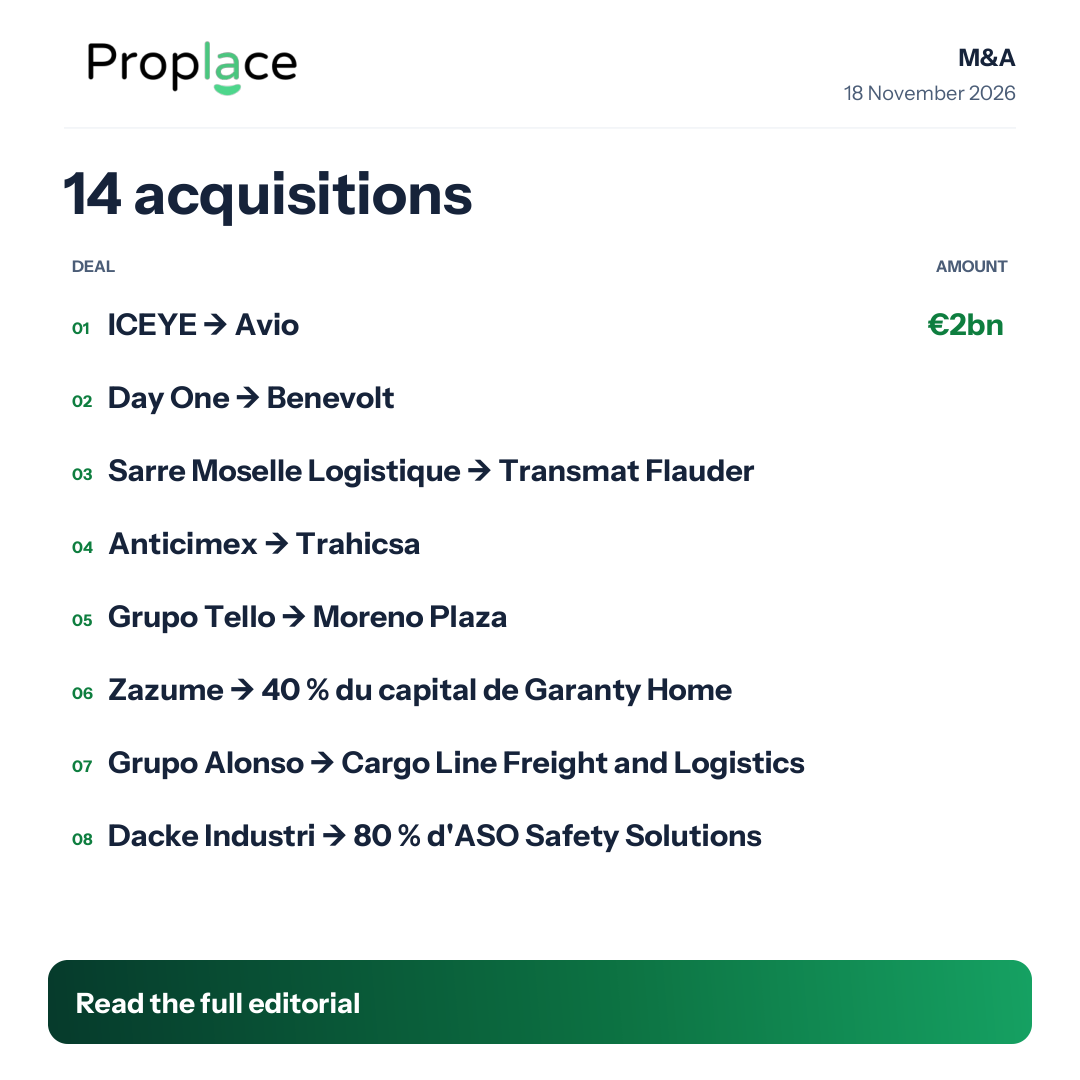
ICEYE wants to buy a rocket to no longer depend on one
- Benevolt
Day One acquires Benevolt in court: consolidating solidarity engagement
Day One acquires Benevolt in court: consolidating solidarity engagement
Source: agence-api.ouest-france.fr →
Day One, an Orléans-based startup that supports companies in their solidarity engagement initiatives (skills-based volunteering, employee volunteering, CSR programs), has acquired the assets of Benevolt, a Nantes-based platform connecting volunteers and associations founded in 2017, through a court-ordered acquisition. The amount was not disclosed. Benevolt claimed over 370,000 volunteers and 8,700 listed associations.
This operation, which follows the acquisition of the Toulouse-based platform Kolabee in April 2026, consolidates Day One as the reference point for companies wishing to structure their associative engagement. The court-ordered acquisition here is a low-cost consolidation accelerator: Day One acquires a network of nearly 10,000 associations without paying the premium of a healthy acquisition, and instantly expands its national territorial coverage. For players in the CSR and patronage sector, the dynamic is clear: the corporate solidarity engagement market is structuring itself around a few platforms capable of aggregating a critical mass of associations and users.
- Transmat Flauder
Sarre Moselle Logistique absorbs Transmat Flauder: regional densification
Sarre Moselle Logistique absorbs Transmat Flauder: regional densification
Source: transportinfo.fr → · Sector Mobility & Transportation — 📬 subscribe to the Mobility & Transportation newsletter
Sarre Moselle Logistique (SML 57), a transport and logistics operator based in Maizières-lès-Metz, specializing in local and regional distribution in Moselle, Meurthe-et-Moselle, and Luxembourg, has acquired Transmat Flauder, a Sarreinsming-based transporter founded in 1974 and specializing in general merchandise transport for the agri-food and industrial sectors, with complementary activities in groupage, storage, and express delivery. Amount not disclosed.
Classic regional consolidation operation: SML strengthens its capabilities and presence in a geographical area it already knows, by integrating a historical operator whose agri-food and industrial clientele is complementary to its own positioning.
- Trahicsa
Anticimex swallows Trahicsa: the pest control acquisition machine
Anticimex swallows Trahicsa: the pest control acquisition machine
Anticimex, a Swedish multinational specializing in pest control and environmental health, has acquired Trahicsa (Tractaments Higiènic-Sanitaris), a Sant Mateu (Castellón) company active for over twenty years in pest control, legionella prevention, termite and woodworm treatments, as well as general disinfections, in the markets of the Valencian Community, Catalonia, and Aragon. Trahicsa showed 13% revenue growth in 2025 with about fifteen employees. Amount not disclosed.
The logic is that of an industrial franchise network: each acquisition adds a geographical area, a customer base, and trained technicians, without having to build local reputation from scratch. Trahicsa, profitable and growing, offers a foothold in a Spanish pest control market that is rapidly consolidating under regulatory and climatic pressure.
- Moreno Plaza
Grupo Tello acquires Moreno Plaza: focusing on fresh meat
Grupo Tello acquires Moreno Plaza: focusing on fresh meat
Amount not disclosed.
Strategic interpretation: the acquisition specifically strengthens the fresh meat segment, a distinct segment from processed or cured meat products where Grupo Tello is already active. Moreno Plaza brings an Andalusian foothold and a complementary range that densifies the group's commercial offering to Spanish large-scale distribution. In a Spanish meat sector that is concentrating around a dozen national operators, reaching €465 million in revenue is the threshold from which a group can negotiate its listings and supplies on a different scale.
- Ecosistemastartupecosistemastartup.com
Zazume takes 40% of Garanty Home: proptech buys physical distribution
- Cargo Line Freight and Logisticselestrechodigital.com
Grupo Alonso acquires Cargo Line: bridgehead in the Middle East
- 80 % d'ASO Safety Solutions
Dacke Industri acquires 80% of ASO Safety Solutions: industrial safety sensors
- Västervik Drone Science Park
Teracom acquires Västervik Drone Science Park: the Swedish state equips itself for drones
Teracom acquires Västervik Drone Science Park: the Swedish state equips itself for drones
Teracom, a Swedish state-owned company specializing in secure communications for defense and critical infrastructure, has acquired Västervik Drone Science Park, the Swedish national drone testing and development center designated by the Swedish Transport Agency, operating in the country's first and largest UAS zone. Teracom is also engaging in discussions with the municipality of Västervik to acquire the adjacent airport. Amount not disclosed.
The operation connects two complementary assets: Teracom's secure and high-availability communication infrastructure — already deployed in the Swedish air network — and Västervik's operational testing area. The result is an integrated environment for developing, testing, and validating connected drone systems, in a context where Ukrainian experience has demonstrated the critical importance of unmanned systems in modern conflicts. For defense and autonomous aerial mobility industrialists seeking a certified European testing ground, this creates a reference infrastructure.
- Flatiron Energy
EQT acquires Flatiron Energy: storing electricity where it's most needed
EQT acquires Flatiron Energy: storing electricity where it's most needed
Source: affarsvarlden.se → · Sector Climate & Energy Tech — 📬 subscribe to the Climate & Energy Tech newsletter
EQT, a Swedish asset manager, has entered into an agreement to acquire Flatiron Energy, a US developer and operator founded in 2021, specializing in large-scale battery energy storage projects in the northeastern United States (New England, New York, East Coast). The seller is Hull Street Energy. No amount was disclosed. The transaction is being made through the EQT Transition Infrastructure fund and extends similar investments in the United Kingdom (Statera Energy) and Germany (Juniz Energy).
Battery storage in the American Northeast addresses a structural tension: it is the area of the country with the densest electricity demand, the oldest grids, and where the integration of renewables creates the strongest flexibility constraints. A portfolio of 24 GWh in this geography, with long-term contracts already signed, is a regulated infrastructure asset — predictable, non-cyclical — that large transition funds can value like private sovereign debt. For EQT, this is the consistency of an energy infrastructure thesis deployed simultaneously across three European and American markets.
- l'activité CMC d'Alira Healthmanufacturingchemist.com
Biomapas enters the United States via Alira Health CMC
- Cogitat
Indivi acquires Cogitat: reading the brain to measure drug effect
Indivi acquires Cogitat: reading the brain to measure drug effect
Indivi, a Swiss neurotech company based in Basel (with offices in Cordoba and Boston), designs precise measurement tools to help biopharma sponsors design smaller clinical trials and detect therapeutic effects earlier. Its platform combines motor and cognitive assessments on smartphones, in neurological indications (Parkinson's, MS, Alzheimer's, neuromuscular diseases). It has acquired Cogitat, an Imperial College London spin-out, which developed NeuroRVQ, a foundation model for EEG capable of decoding cognitive function from brain signals, without prior individual calibration. Amount not disclosed.
The problem this acquisition solves is fundamental in neurological drug development: clinical trials for brain diseases fail massively because we don't know how to measure early enough whether a treatment has a real biological effect. A model capable of reading fine and universal EEG signals — without training the model on each patient — could provide drug developers with an objective biomarker where they currently only have subjective clinical scales. For Indivi, integrating NeuroRVQ into its multimodal measurement platform means moving from a monitoring tool to an early therapeutic response detection tool — which is precisely what pharmaceutical sponsors pay the most for.
- Motto
Cooltra acquires Motto: consolidating Parisian electric bikes
Cooltra acquires Motto: consolidating Parisian electric bikes
Cooltra, a Barcelona-based light mobility operator founded in 2006 (already an acquirer of Cityscoot in France and Kleta's bike activity in 2025), has acquired Motto, a young Parisian company founded in 2021 that offers an electric bike subscription including maintenance, theft and damage insurance, assistance, and a mobile application. Motto claims over 2,000 daily users in Île-de-France and a positive EBITDA margin in 2025. Together, the two entities have over 6,000 electric bikes with the ambition to double this figure by 2030. Amount not disclosed.
Motto is profitable and gaining traction in a Parisian market where demand for subscription-based micromobility is structurally driven by city policy. Cooltra is not acquiring a struggling startup: it is buying a competitive position in the French capital, Western Europe's densest urban market for this type of offering, at a time when the sector is entering, in its own words, a decisive consolidation phase. For a mobility operator seeking to gain European scale, Paris is a reference market that cannot be afforded to a competitor.
ICEYE wants to buy a rocket to no longer depend on one
ICEYE, a Finnish-Polish company specializing in synthetic aperture radar (SAR) observation satellites, has launched a cash acquisition offer for Avio, an Italian space launcher manufacturer, at €41 per share, valuing it at over €2 billion. Avio, listed in Milan, develops and operates the light launcher Vega-C as well as propulsion engines for European institutional programs.
The immediate interpretation: ICEYE is growing and wants to secure its access to orbit. But the move is more precise than that. ICEYE sells information — radar imagery available in a few hours for defense, humanitarian, or insurance clients — and its competitive advantage relies entirely on the refresh rate of its constellation. Depending on a third-party launcher for each additional satellite means giving a supplier control over its operational pace. Acquiring Avio is verticalizing the value chain in the most literal sense: owning the vector that puts the tool that produces the data that is sold into orbit. The stated strategic argument — "Europe must control its critical space infrastructure" — is real, but it also serves a very concrete industrial logic for ICEYE itself. For an investor or a European defense player, this is a signal that vertical consolidation in space is no longer reserved for large institutional programs.
Zazume takes 40% of Garanty Home: proptech buys physical distribution
Source: ecosistemastartup.com → · Sector Construction & PropTech — 📬 subscribe to the Construction & PropTech newsletter
Zazume, a Barcelona-based proptech that digitizes the management of the entire long-term residential lease cycle, has acquired 40% of the capital of Garanty Home, a network of real estate franchises operating in over 30 cities and 12 Spanish autonomous communities with 45 franchises and over 90 agents. The operation includes a purchase option for 100% of the capital.
The logic is clear and worth a closer look. Zazume is a digitally native company: it finds its landlord clients online, manages leases via its platform, and optimizes rental yields. But a fraction of the market — older landlords, inherited assets, assets in medium-sized cities — continues to handle its real estate affairs in a physical agency. Building this network from scratch would cost several years and cash that Zazume does not have. Buying 40% of an already operational network with an option on the remainder means acquiring distribution without tying up the capital of organic expansion — and transforming a channel competitor into a growth vector. For any founder building a digital model in a sector with a physical presence, this is a mechanism to remember.
Grupo Alonso acquires Cargo Line: bridgehead in the Middle East
Source: elestrechodigital.com →
Grupo Alonso, a Spanish logistics and transport holding company present on five continents (international transport, port terminals, rail, storage), has acquired Cargo Line Freight and Logistics, a UAE-based company founded in 2004, specializing in two segments: logistics for luxury fashion brands between Europe and the Middle East, and freight transport for solar infrastructure projects in the region. Cargo Line was named SME of the Year at the Logistics Middle East Awards 2026. Amount not disclosed.
The acquisition expands Alonso Forwarding's freight forwarding division into a high-growth logistics market, leveraging Cargo Line's commercial relationships and local operational expertise — two assets that cannot be imported. The combination of a luxury freight network and a solar energy clientele is particularly well-positioned: both segments are rapidly expanding in the Middle East, and their logistical requirements (urgency for luxury, size for solar) are distinct enough to constitute a real barrier to entry.
Dacke Industri acquires 80% of ASO Safety Solutions: industrial safety sensors
Source: news.cision.com → · Sector Horizontal & Productivity SaaS — 📬 subscribe to the Horizontal & Productivity SaaS newsletter
Founder Helmut Friedrich remains a minority shareholder and retains his role as CEO. ASO integrates into Dacke Industri's Measurement & Control division.
Strategic interpretation: ASO brings expertise in safety sensors that directly complements the division's existing portfolio, with an already established international industrial customer base. Retaining the founder in the capital and management is a consistent practice for this type of technical niche acquisition: the value lies as much in customer relationships and accumulated know-how as in the products themselves.
Biomapas enters the United States via Alira Health CMC
Source: manufacturingchemist.com → · Sector HealthTech & Digital Health — 📬 subscribe to the HealthTech & Digital Health newsletter
Biomapas, an outsourced pharmaceutical services group (regulatory affairs, pharmacovigilance, clinical development, digital consulting), supported by the Carbyne Equity Partners fund since October 2024, has acquired the CMC (Chemistry, Manufacturing and Controls) division of Alira Health, a Boston-based team of over 35 specialists who support biopharma companies in preclinical and clinical phases on complex modalities — monoclonal antibodies, ADCs, oligonucleotides, CAR-T therapies, molecules, and peptides. The new entity is called Biomapas North America. Amount not disclosed.
This acquisition is Biomapas' third international expansion in less than two years. The logic is that of an aggregator of outsourced pharma services: each acquisition adds a competence (CMC, pharmacovigilance, regulatory) and a geography (Europe, Turkey, India, United States), progressively building the multi-service platform that biopharma sponsors prefer over managing multiple specialized providers. Entering the United States via Boston — the world's leading biopharma ecosystem — is a signal of global platform ambition consistent with the €200 million valuation target announced earlier this year.
ADU divests its temporary staffing business to Piening: refocusing on facility management
ADU is refocusing on its two core businesses: building services and security services. The two companies have also entered into a cross-cooperation agreement to mutually refer clients as needed. Amount not disclosed.
Classic strategic refocusing operation between two long-standing family business partners. Piening densifies its regional presence (Paderborn, Warburg, Kassel); ADU simplifies its operational model.
💰Fresh-funding radar · 77 evaluable in the cockpit
- Isomorphic Labs
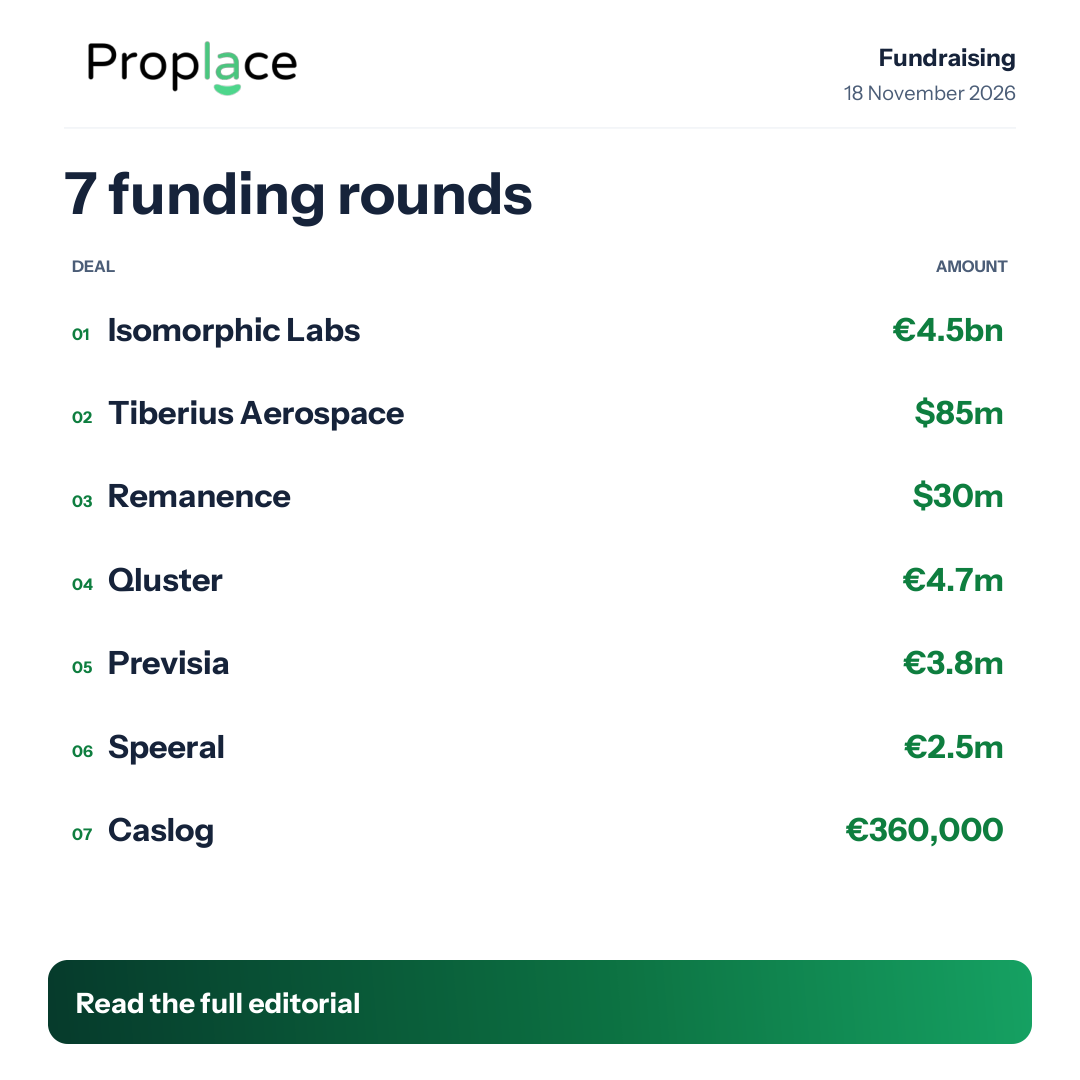
Isomorphic Labs raises €4.5 billion: biology as a computational problem
Isomorphic Labs raises €4.5 billion: biology as a computational problem
Isomorphic Labs, a British company founded in 2021 by Sir Demis Hassabis (also founder of DeepMind, now an Alphabet subsidiary), designs drugs using artificial intelligence. Its molecule design engine, IsoDDE, relies on foundational AI models capable of working across multiple therapeutic areas and multiple drug modalities simultaneously. The company aims to move from computational design to therapeutic candidates in clinical trials. It announced a €4.5 billion (approximately $5 billion) Series C funding round, co-led by Greenoaks and Sequoia Capital, with Andreessen Horowitz and continued participation from Alphabet as a significant investor. All existing investors renewed their participation: Thrive Capital, MGX, GV, CapitalG, Temasek, and the UK Sovereign AI Fund. Series B had reached €1.8 billion in the first half of 2026.
But what deserves attention is the nature of the underlying bet. Isomorphic is not doing computational biology in the classical sense — it treats molecular biology as a large-scale modeling problem, in the same way that a large language model treats text. The question this funding concretely poses is that of the marginal cost of a drug: if an AI engine can propose candidate molecules with unprecedented precision and speed, the discovery phase — which historically represents a major fraction of the cost and time of drug development — could be radically compressed. What the €4.5 billion funds is not a drug: it is the demonstration that this compression is possible on an industrial scale. For a French or European pharmaceutical group, the question is no longer whether AI will transform drug R&D, but how quickly players who master these tools will widen the gap with those who still outsource discovery to traditional CROs.
- Qluster
Qluster raises €4.7 million: a photonic quantum computer born at Kastler Brossel
Qluster raises €4.7 million: a photonic quantum computer born at Kastler Brossel
Qluster, a Parisian startup spun out of the Laboratoire Kastler Brossel (a French reference in quantum optics), founded by David Fainsin, Ambroise Boyer, Clarisse Thibault, and Valentina Parigi, is developing a quantum computer architecture based on continuous-variable photonics — an approach that uses light as a quantum computing medium rather than superconducting qubits or ion traps. It closed a €4.7 million pre-seed round led by Quantonation, with Quantum Launchpad and BPI France. The roadmap includes an intermediate quantum calculator by 2032 and a fault-tolerant universal quantum computer by 2036.
Continuous-variable photonics is a less publicized path than superconducting approaches (IBM, Google) but potentially more robust at room temperature and more compatible with existing optical communication infrastructures. Quantonation, a fund specializing in quantum, is the European reference investor in this sector — its presence is a signal of serious technical validation. For a chemical, materials, or logistics industrialist following quantum developments, Qluster represents a differentiated European path to monitor over a ten-year horizon.
- Previsia
Previsia raises €3.8 million: making risk prevention accessible to SMEs
Previsia raises €3.8 million: making risk prevention accessible to SMEs
Previsia, a Toulouse-based startup founded in October 2023, operates an AI risk prevention platform that brings together the insured company, its broker, and its insurer on a single tool around shared prevention data. Its platform covers the complete chain — configuration, visit, report, action plan, follow-up, portfolio analysis — with AI to generate summaries, scoring, and recommendations. It is already adopted by over 40 insurance players (Groupama, Diot-Siaci, Verspieren, MSIG Europe, Helvetia). Profitable since 2025, it has multiplied its revenue by 2.5 in one year. It announced a €3.8 million funding round from IRDI Capital Investissement and ARIS, two independent regional funds. The funds will finance product acceleration, sales, and European expansion, already initiated in Germany.
Previsia addresses a paradox in the insurance market: prevention reduces claims, thus cost for insurers, but it remains reserved for large risks because it relies on costly expert visits. Less than 5% of insured sites benefit from it. A platform that democratizes this prevention at low marginal cost creates value for all three parties simultaneously — insured, broker, insurer — which is the type of model insurance companies have an interest in actively supporting. Profitable in less than three years of existence, this is a solid trajectory for a funding round of this size.
- Speeral
Speeral raises €2.5 million: AI agents to negotiate your unsold items
Speeral raises €2.5 million: AI agents to negotiate your unsold items
Source: maddyness.com → · Sector Retail & E-commerce Tech — 📬 subscribe to the Retail & E-commerce Tech newsletter
Speeral, a Nantes-based startup founded in 2024 by Julien Chevalier and Matthieu Charron (also co-founders of Teester), offers retailers and distributors the automation of reselling their unsold items and returns on second-hand platforms (Leboncoin, Vinted, eBay). Its technology generates listings, proposes prices based on the market, and deploys AI agents that respond to buyers and negotiate 24/7 within the price limits set by the brand. The business model combines a subscription paid by the store and a commission on each sale. It closed a €2.5 million seed round with Kima Ventures (Xavier Niel), Sonorcap, Crédit Agricole, and Aquiti Ventures (which renewed its support after an initial €1.7 million investment in February 2025). Total raised since creation: €4.2 million.
The value proposition is concrete: dormant inventory costs space and lost revenue; reselling it requires time that in-store teams don't have. The AI agent that negotiates in real-time with a buyer on Vinted is the most differentiating part of the model — it's what transforms an automatic listing solution (which already exists) into a real outsourced sales service. For a distribution network managing hundreds of points of sale, the challenge of recovering value from unsold items is real and outsourced.
- Caslog
Caslog raises €360,000: the combat medical card dictated aloud
Caslog raises €360,000: the combat medical card dictated aloud
Caslog, a startup founded by a Swiss officer, Fabio Hamilos-Keller, and a Ukrainian officer, develops a portable device that attaches to a wounded person and records the voice of the combat medic to automatically convert it into a war casualty medical record — allowing the medic to dictate actions performed (applying a tourniquet, time, procedures) without interrupting their action to fill out a paper document. Command receives the completed record in real-time and can monitor the wounded person's status. After tests with medical instructors from the 12th Azov Brigade (100 devices ordered for trial), the startup closed a €360,000 pre-seed round with Freedom Fund, Gungnir Capital, Newfund, and angel investor Kateryna Tryfonova. The funds will finance the delivery of next-generation devices, the development of a proprietary voice recognition model, and an initial paid deployment with a Ukrainian brigade.
The addressable market identified by the investor — the digitalization of military medicine, valued at €14 billion — is vast and structurally under-equipped. What is interesting in Caslog's long-term vision is the layer of medical intelligence that such a device can build on a large scale: thousands of structured and time-stamped war casualty records constitute an unparalleled database on combat trauma, effective protocols, and evacuation times — information that interests both military health systems and emergency medicine research.
📩 Subscribe to our newsletter to follow daily M&A and fundraising news: https://proplace.co/newsletter
- Tiberius Aerospace
Tiberius Aerospace raises $85 million: ammunition as a service
Tiberius Aerospace raises $85 million: ammunition as a service
Source: tech.eu → · Sector Industrial Tech & Manufacturing — 📬 subscribe to the Industrial Tech & Manufacturing newsletter
Tiberius Aerospace, a defense startup founded in 2022 with offices in the United States and the United Kingdom, develops precision-guided artillery munitions — its flagship product Sceptre is a long-range 155mm shell — and AI-assisted defense manufacturing software. Its model, which it calls "defense-as-a-service," consists of developing, testing, and validating its systems with private capital, then licensing them to allied nations that build locally and bear factory costs, while Tiberius retains intellectual property. It announced an $85 million Series A at a valuation exceeding $1 billion, led by Lakestar (Zurich) and Rochefort Asset Management (United States), with Dream Ventures, AeroX Ventures, Blacklake, Moonshots Capital, and UA1. Tiberius has already signed a contract with the British Ministry of Defense to develop Sceptre, and announced a $500 million contract for the manufacturing, licensing, and distribution of Sceptre with undisclosed allied nations.
The IP licensing model is what distinguishes Tiberius from the traditional defense industry. A classic arms manufacturer invests in factories, assembly lines, production certifications — heavy assets, slow to monetize. Tiberius outsources production to local industrial partners in each client country, retaining only the IP and licensing revenues, and can therefore scale geographically without tying up fixed capital. This is the industrial franchise model applied to defense. For an investor or decision-maker in the European defense industry, the question posed by Tiberius is that of the boundary between the defense startup that brings innovation and the industrialist who brings production capacity — and whether this boundary can sustainably generate value on both sides.
- Remanence
Remanence raises $30 million: the company that wants to give you back your AI model
Remanence raises $30 million: the company that wants to give you back your AI model
Remanence (formerly H Company in its previous phase, founded under a different name by former H Company employees), a Parisian startup founded by Pierre-Louis Cedoz, Hamza Benchekroun, and Axel Moyal — all three former heads of post-training for Holo open models at H Company, with backgrounds at Google DeepMind, InstaDeep, and Meta — has raised $30 million in seed funding from EQT Ventures and FirstMark. Its platform connects to the AI agents a company already uses, captures their execution traces (the sequences of actions produced by the agents at work), converts them into training environments, and uses them to specialize open-weight models through reinforcement learning. The client retains the weights of the resulting model and can choose where training and deployment occur.
The problem Remanence solves is precise and real. A company that deploys AI agents for repetitive tasks — document processing, internal workflows, support — generates increasing amounts of data on how these tasks are performed. This data is currently lost: it goes into the logs of model providers, inaccessible. Remanence proposes to recover this material and use it to build a specialized model that the company truly owns — not an API rented from a third party, but its own asset, more precise for its specific tasks, less costly to operate, and independent of the generalist model provider. This is a direct response to one of the most concrete tensions in enterprise AI deployment: dependence on large model providers and the increasing cost of tokens as uses become more complex. For a CIO or CTO considering their three-year AI strategy, the question of model ownership will become as strategic as data ownership.
📰Today's news · 11 evaluable in the cockpit
- Stark Futuremorganstanley.com
Stark Future clôt un tour de 150 M€ pour expansion mondiale
📰Other news today — no identifiable company · 13outside the cockpit — explore via 🔎
- ADU divests its temporary staffing business to Piening: refocusing on facility managementpressebox.de
- OGO Security nomme Nicolas Van Den Torren directeur commercial ...mediadreams.fr
- KPMG France nomme trois associés à la tête de l'Audit et du Conseilcompta-online.com
- Mirakl : Steve Tzikakis nommé co-CEOecommercemag.fr
- Sinch Appoints Jonas Dahlberg as CEOreaditquik.com
- Finetech Appoints Co-CEO: People in the News: 11/11/26photonics.com
- les nouvelles règles du jeu en 2026 avec Bpifranceyoutube.com
- Top Venture Capital Firms & Investors in Germany in 2026openvc.app
- French Startup Funding: Latest Rounds, Deals & Datafrenchtechjournal.com
- Mesh, levier financier au services des startupslyon-metropole.cci.fr
- Acteurs M&A à Genève : banques d'affaires, boutiques et conseilsgeneve.finance
- Levées de fonds French Tech : impact de l’IA en 2026futuractif.fr
- WILD HORSE NINE - Utopia Bordeauxbordeaux.cinemas-utopia.org
Set aside today · 334 (with reason)
- Girtz Industries — already covered
- IT — already covered
- Aérolia — already covered
- Commerzbank — already covered on il y a 2 j
- Levée de fonds — pays_non_etabli
- FRACTILE — already covered
- SUMARY — already covered
- Levée de Fonds Startup — pays_non_etabli
- Voltan — already covered
- Resonac — already covered
- USI Insurance Services — hors_europe
- MILAN — incomplete M&A — buyer or target not identified
- IRCA — conditional rumour
- Vaeridion — already covered
- Types of funding for startups — pays_non_etabli
- MISTT — already covered
- III — pays_non_etabli
- Siggy — hors_europe
- Aformic — pays_non_etabli
- Light Frame — already covered
- EV — out of scope
- Atos — out of scope
- LVMH — out of scope
- IA — already covered
- Le Parisien — out of scope
- TECH — pays_non_etabli
- IAEA — incomplete M&A — buyer or target not identified
- EUR — pays_non_etabli
- Stark Future — already covered on il y a 2 j
- ARIANEE — pays_non_etabli
- CFNEWS — pays_non_etabli
- Sellas Life Sciences — conditional rumour
- Strive — pays_non_etabli
- Nkamouna — hors_europe
- Telus — hors_europe
- Witron — incomplete M&A — buyer or target not identified
- Disguise — already covered
- Weston Homes — incomplete M&A — buyer or target not identified
- Howie — hors_europe
- Centurica — pays_non_etabli