
M&A and Fundraising Analysis for August 19, 2026
From Walmart buying audience to Alan surpassing a billion raised, via Stripe acquiring AI infrastructure and Schneider betting on industrial software: a day where capital repositions itself on what controls flows—of attention, data, code, or energy.
· Proplace
🌐 Translated from the French original by AI — the French version is authoritative.
🌡️ Sectors on the move — hover a sector to see its deals, click to open it
Filter, open a company, evaluate it against your own criteria — everything stays on this page.
🤝Signed-deals stream · 33 evaluable in the cockpit

- Alysa — Brickanta acquiert la startup IA Alysa pour accélérer sa croissance
- BÉIS — Samsonite rachète BÉIS pour 178,5 M€
Samsonite acquires BÉIS for $178.5 million
LIVE164 M€SamsoniteBuyerFabricant de bagages et accessoiresBÉISTargetMarque de bagages et accessoires voyageAcquiredBÉISMarque de bagages et accessoires voyageSamsoniteFabricant de bagages et accessoires→BÉISMarque de bagages et accessoires voyageproplace.co/actualites
Samsonite is acquiring the luggage and travel accessories brand BÉIS for $178.5 million (€164 million).
BÉIS is a DTC (direct-to-consumer) brand founded by actress Shay Mitchell, positioned in a young and premium segment. For Samsonite, an old traditional distribution brand, the operation is as much a channel acquisition as a brand acquisition: BÉIS brings a digital community and social presence that Samsonite would not be able to build from scratch. This is the classic move of an established brand acquiring the customer relationship it lost to new generations.
- Fort Robotics — Fort Robotics prévoit une cotation Nasdaq via fusion SPAC
Fort Robotics prepares Nasdaq entry via SPAC
Source: news.google.com → · Sector Industrial Tech & Manufacturing — 📬 subscribe to the Industrial Tech & Manufacturing newsletter
LIVERobotiqueFort RoboticsRobots et systèmes d'automatisationPendingFort RoboticsRobots et systèmes d'automatisationAnnoncéStatutproplace.co/actualitesFort Robotics is preparing an IPO on the Nasdaq under the symbol FROB via a SPAC merger.
Fort Robotics develops safety systems for robots and autonomous machines—a market that is growing with industrial robotization. The SPAC route remains possible but has lost much of its popularity since 2022, after a wave of disappointments. The choice of SPAC says as much about the conditions of access to the primary market as about the company itself—to be followed on the terms of the transaction.
Walmart acquires Vibe: when retail realizes it has had its own customers stolen
Walmart is acquiring French company Vibe.co for approximately €1.2 billion, in a transaction that includes an initial payment of €1.2 billion and a conditional earn-out.
The immediate takeaway: the world's largest retailer is acquiring a programmatic advertising platform to compete with Amazon in its most lucrative area, retail media.
But the transaction reveals something more uncomfortable. For decades, large retailers collected customer data—checkout transactions, loyalty cards, purchasing behavior—without ever truly monetizing it as an advertising asset. Amazon understood before anyone else that knowing purchase intent at the precise moment it forms is infinitely more valuable than selling space on a page. The result: Amazon now generates more operating profit from its advertising platform than from a large part of its e-commerce business. Walmart, which possesses comparable consumer data on hundreds of millions of households, allowed this revenue stream to be built elsewhere. Vibe.co provides the technology to finally transform this dormant raw material into targeted advertising revenue.
This acquisition signals that a retailer's true asset is no longer its store network or even its prices—it's the granularity of its customer knowledge, and Walmart has just paid a billion to reclaim what it unknowingly already had.
For a French retail or mass distribution player: the question is no longer whether building an internal platform is worthwhile, but how much longer it is reasonable to wait.
Qonto buries Regate and acquires Acasi: the bank-accounting convergence accelerates
Qonto is making two simultaneous moves: the acquisition of Acasi from the commercial court (amount undisclosed), and the planned closure of Regate, its subsidiary dedicated to chartered accountants, by the end of the summer.
These two operations, presented separately, actually form a single decision. By acquiring Acasi—an accounting tool for VSEs/SMEs—Qonto directly internalizes the accounting function within its banking platform. Regate, which was designed as a bridge to accounting firms, becomes redundant once Qonto wants to handle accounting itself, without an intermediary. The closure of Regate is not an admission of failure: it's a sign that the strategy has changed its ambition.
The dissatisfaction of chartered accountants is the logical consequence. Qonto had sold Regate to them as a collaboration tool; today, it announces that it prefers to bypass them. The neobank is no longer seeking to integrate into the accounting ecosystem—it is seeking to replace it, at least for small business clients.
For accounting firms working with VSEs: the threat is no longer theoretical. Banking software that handles data entry, categorization, and soon closing is being built.
Stripe acquires OpenRouter for €6.4 billion: AI's invisible infrastructure changes hands
Stripe is acquiring OpenRouter for approximately $7 billion (€6.4 billion).
OpenRouter is an abstraction layer that allows any application to call multiple AI models—GPT, Claude, Gemini, Mistral—via a unified API, without being tied to a single provider. It is, in other words, the router that decides which model executes which request, at the best cost and with the best availability.
Why is Stripe paying this price for an infrastructure tool? Because every call to an AI model via OpenRouter is a transaction: a cost incurred, a budget consumed, an invoice generated. Stripe, whose business is precisely to orchestrate and bill financial flows, sees OpenRouter not as a technical tool but as a toll booth on the economy of AI agents. As companies deploy autonomous agents that make hundreds of model calls per hour, the question of who controls the billing of these flows becomes strategically central.
Stripe is not acquiring an infrastructure startup—it is positioning itself at the exact point where AI spending transforms into a financial transaction, a position it intends to occupy as durably as it currently occupies online payments.
For any publisher or company building on AI agents: the routing and billing layer is consolidating under a single player. Now is the time to audit your dependence.
Datadog acquires Adaptive ML
Datadog is acquiring Adaptive ML, a specialist in Reinforcement Learning Operations (RLOps), for an undisclosed amount.
Datadog, a cloud infrastructure observability tool, seeks to internalize the expertise needed to monitor not just servers and APIs, but AI models in production—systems that behave differently from one call to the next and whose performance drift is difficult to detect with traditional tools. The acquisition signals that AI observability is becoming a market in its own right, distinct from traditional infrastructure monitoring.
SpaceX finalizes Cursor acquisition
SpaceX officially closes its acquisition of Cursor, the AI-assisted code editor, for an undisclosed amount.
The operation had been announced earlier in the summer. It aligns with SpaceX's logic of building top-tier internal software capabilities to accelerate the development of its embedded systems and engineering tools. Cursor thus joins a company that needs, more than any other, to code quickly and well—and can afford the best tools to do so.
Schneider Electric pays $3.1 billion for Cognite: the industrial software bet
Schneider Electric is acquiring Cognite, a Norwegian industrial software publisher founded in 2017, for $3.1 billion (€2.9 billion). Cognite generates just over $170 million in annual revenue, implying a valuation multiple of approximately eighteen times revenue.
Markets reacted with skepticism, and the reflex is understandable: eighteen times revenue for an industrial publisher is a consumer SaaS software valuation applied to a niche B2B market. But Schneider's reasoning deserves to be taken seriously. Cognite builds an industrial data layer—it connects sensors, SCADA systems, digital twins of factories and oil platforms, and turns them into a base on which AI agents can reason. This is exactly what Schneider needs to avoid remaining a manufacturer of circuit breakers and transformers in a world where value is migrating to the software that controls these equipment.
The real question is not the multiple paid today—it's whether Schneider can integrate Cognite without destroying what makes it valuable (an agile product culture, engineering teams that don't work like in a large French industrial company). Acquisitions of this type rarely fail on technology; they fail on organization.
For Schneider, paying eighteen times revenue is less a bet on Cognite's numbers than on its own ability to transform into an industrial software publisher—a transformation the market has not yet decided to believe.
💰Fresh-funding radar · 1414 evaluable in the cockpit
- Ampaire — Ampaire lève en série B pour APU hybride-électrique aviation
Ampaire raises Series B: electric hybrid for regional aviation
LIVEMobilité & TransportAmpaireSystèmes propulsion hybride-électrique aviationRaiseAmpaireSystèmes propulsion hybride-électrique aviationSeries BStadeÉtats-UnisPaysproplace.co/actualitesAmpaire closes a Series B (amount undisclosed) to develop hybrid-electric propulsion systems for regional aviation and APUs (Auxiliary Power Units).
Hybrid-electric is a pragmatic path in aviation: it reduces fuel consumption without waiting for batteries to reach the energy density needed for all-electric flight. Ampaire targets the segment where the compromise is most realistic today—short-haul regional aircraft, where battery weight remains manageable.
- Anthro Energy — Anthro Energy inaugure une usine pour électrolytes batteries
Anthro Energy starts a factory for solid-state batteries
Source: techcrunch.com → · Sector Climate & Energy Tech — 📬 subscribe to the Climate & Energy Tech newsletter
LIVEClimat & ÉnergieAnthro EnergyMatériaux pour batteries solidesRaiseAnthro EnergyMatériaux pour batteries solidesSeries BStadeÉtats-UnisPaysproplace.co/actualitesAnthro Energy breaks ground on a factory in Louisville to manufacture electrolytes, including for solid-state batteries, without disclosing a fundraising amount associated with this announcement.
Solid-state batteries have been promised for years as the breakthrough that will enable much higher energy densities than current lithium-ion batteries. Anthro positions itself on materials—electrolytes—rather than the complete cell. This is a bet on the critical component rather than the final assembler—a defensible position if solid-state technology delivers on its promises, but whose value depends entirely on the speed of industrial adoption.
- Claros Technologies — Claros Technologies lève 55 M$ pour la destruction du PFAS
Claros Technologies raises $55 million: permanently destroying PFAS
LIVE51 M€Claros TechnologiesDestruction permanente des polluants PFASRaiseClaros TechnologiesDestruction permanente des polluants PFASSeries BStadeÉtats-UnisPaysproplace.co/actualitesClaros Technologies raises $55 million (€51 million) in Series B to scale its technology for the permanent destruction of PFAS—the "forever chemicals" present in soil, water, and many industrial materials.
PFAS are subject to increasing regulation in the US and Europe, creating a demand for remediation that did not exist on this scale five years ago. Claros claims to permanently destroy PFAS, whereas most current solutions concentrate or move them without eliminating them. If the technology delivers on its promises at an industrial scale, Claros addresses a remediation market that could be worth hundreds of billions over the next two decades.
- Computomics — Computomics lève 6,3 M€ pour plateforme sélection climatique
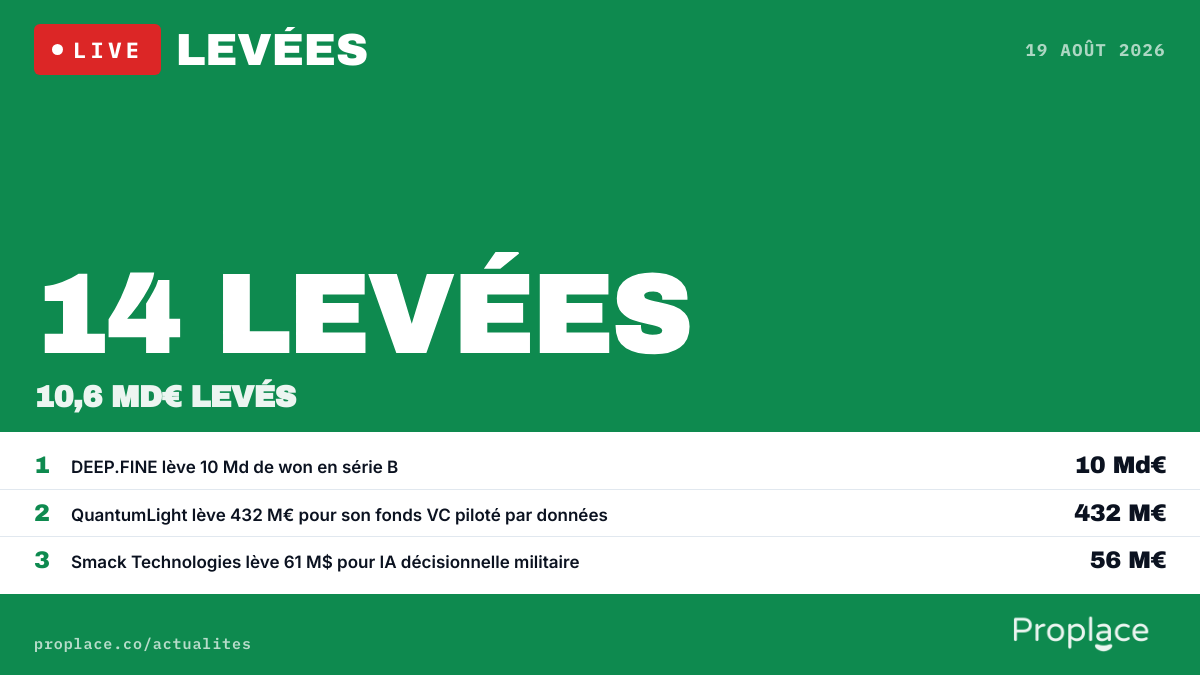
- DEEP.FINE — DEEP.FINE lève 10 Md KRW en financement de série B
Deep.Fine raises 10 billion won in Series B
LIVE10 Md€DEEP.FINEDeep TechRaiseDEEP.FINEDeep TechSeries BStadeCorée du SudPaysproplace.co/actualitesDeep.Fine (South Korea) raises 10 billion won in Series B (approximately €7 million). The sector is not specified in the available information.
Without details on the activity or investors, it's difficult to go beyond the observation: a modest-sized Korean Series B round, in a dynamic startup ecosystem whose operations remain poorly documented outside local sources.
- Grounded — Grounded lève 5 M€ pour customiser fourgons électriques
Grounded raises $5 million: van conversions for professionals
LIVE5 M€GroundedAménagement personnalisé de fourgonsRaiseGroundedAménagement personnalisé de fourgonsSeries AStadeÉtats-UnisPaysproplace.co/actualitesGrounded (Detroit) raises $5 million (€5 million) to customize electric and thermal vans for small businesses, after pivoting from consumer van-life to B2B.
The pivot is pragmatic: the recreational van-life market has contracted with rising costs, while small businesses have a structural need for fitted utility vehicles. A pivot from consumer to professional, with a higher average ticket and more predictable recurrence—the direction is good, the scale remains to be proven.
- Khartis Therapeutics — Khartis Therapeutics lance ses activités en biotech
- Lissun — Lissun lève 48 Cr Rs en série A pour la santé digitale
- LITILIT — LITILIT lève 8 M€ pour systèmes lasers femtosecondes modulaires
- NeoGeo — NeoGeo lève 20 M$ pour son logiciel géospatial
- Oceanloop — Oceanloop lève 38,5 M€ pour aquaculture terrestre innovante
- Quantexa — Quantexa envisage une IPO pour 3 Md$ de valorisation
- QuantumLight — QuantumLight lève 432 M€ pour son fonds VC data-driven
- Smack Technologies — Smack Technologies lève 61 M$ pour l'IA de décision militaire
Smack Technologies raises $61 million: the Pentagon as a business model
LIVE56 M€Smack TechnologiesLogiciels d'IA pour décisions militairesRaiseSmack TechnologiesLogiciels d'IA pour décisions militairesÉtats-UnisPaysproplace.co/actualitesSmack Technologies raises $61 million (€56 million) explicitly leveraging the Pentagon's urgency to deploy AI capabilities on the battlefield.
Smack develops AI tools for tactical military operations—decision support, field data processing, unit coordination. The company benefits from a favorable context: the Pentagon has accelerated its AI technology acquisition programs since 2022, with shorter contracting cycles than historically. US defense tech is one of the few markets where public demand is simultaneously solvent, urgent, and price-insensitive—which explains the valuations, but also the structural dependence on a single client.
Bending Spoons acquires Airtable: who is really losing money at $2.25 billion?
Italian company Bending Spoons is acquiring Airtable for $2.25 billion (€2.1 billion), an 81% discount compared to the $11.7 billion valuation reached in 2021.
The discount is spectacular but not uniformly distributed. Airtable had raised nearly $1.4 billion; a significant portion likely remains in cash. Preferred shareholders—who have priority liquidation rights—recover their investment before common shareholders. Employees who joined with stock options at high exercise prices post-2021 see their options underwater. Early-round investors (seed, Series A) who sold in secondary during the 2021 rounds have likely already cashed out.
The real lesson from Airtable is not the discount—it's the mechanics of who absorbs the loss: the employee and the late investor pay for the valuation that the early investor had already pocketed.
Bending Spoons, a specialist in acquiring mature software assets for operational optimization, is paying a reasonable price for a tool with a real installed base. For founders currently negotiating investment terms: the structure of liquidation preferences in a correction period can turn a "great exit" into a disappointment for 80% of stakeholders.
Alan raises €480 million: Prosus enters, valuation reaches €5.5 billion
Alan closes a €480 million round with Prosus, at a valuation of €5.5 billion—just three months after a €100 million financing, thus surpassing a cumulative €1 billion raised.
Prosus is a unique investor: a subsidiary of Naspers, it is one of the few funds capable of deploying several hundred million euros in a single European round without it being an extraordinary decision for them. Its entry into Alan's capital is not just a signal of size—it's a signal of international credibility.
Alan has built something rare in France: health insurance that reads like a tech product, with retention rates and satisfaction scores that rival the best consumer applications. The question this round raises is not about Alan's financial health—it's about what comes next. With a €5.5 billion valuation, Alan is clearly positioned for a medium-term IPO, or for aggressive European expansion that would justify this level of capital.
At this valuation, Alan is no longer a health startup—it's a bet on a tech player's ability to take a structural share of a market, supplementary health insurance, that traditional insurers have never truly managed to defend.
Skello raises €200 million: Bridgepoint makes it a European consolidator
Skello raises €200 million led by Bridgepoint, from a base of over €50 million in ARR.
Skello publishes team scheduling software for retail, restaurants, and hotels—a fragmented market, with local players in each European country, and customers who rarely change software once they've adopted one. This is exactly the hunting ground for a consolidator: low attrition, recurring revenue, reasonable acquisition multiples on medium-sized players.
The arrival of Bridgepoint—a European private equity fund, not a venture fund—signals that Skello is entering a build-up strategy rather than simple organic growth. The question is no longer "how does Skello grow?" but "how many local players can it absorb in two or three years?"
For mid-sized HR and scheduling software publishers in Europe, Skello becomes a potential buyer—and for their investors, a possible exit that didn't exist eighteen months ago.
Elixir Aircraft raises €45 million: the training aircraft as a Trojan horse
Elixir Aircraft (La Rochelle) raises €45 million led by Bpifrance's SPI fund, with Odyssée Venture and Innovacom via Turenne Groupe.
Elixir manufactures two-seater light aircraft made of composite materials, intended for pilot training. The light aviation market is modest in volume, but it is a certification market: each aircraft approved by EASA opens the door to variants, derivatives, larger versions—without starting from scratch on regulations. The training aircraft is not Elixir's final product; it's the entry ticket into a sector where regulatory barriers protect those who have overcome them.
Sapiom raises $35 million: the AI agent financial controller
Sapiom raises $35 million (€32 million) to build a financial control layer for AI agents.
The problem Sapiom addresses is concrete and growing: an autonomous AI agent can chain dozens of model calls, use external tools, purchase third-party services, restart an operation multiple times—without the company knowing precisely what each task cost. As AI budgets come under audit, the question "how much did this agent cost me to accomplish this mission?" becomes a matter of ordinary management control, not a technical question.
Sapiom positions itself exactly where AI spending ceases to be a global budget line and becomes a traceable unit cost—a necessary step for any company deploying agents at scale.
Comand AI raises €32 million: Saab enters capital, European defense enters a new era
Comand AI closes a €32 million Series A led by Blossom Capital, with the entry of Swedish group Saab into its capital—eighteen months after an initial round of €8.5 million.
Comand AI develops military command software: tools that allow a general staff to coordinate complex operations, integrate heterogeneous intelligence flows, and make decisions faster than the adversary. Saab's entry is not insignificant: it is a defense industrialist validating the technology and implicitly bringing a network of potential clients in the Scandinavian and European armies.
The article's title—"European defense no longer aims for sovereignty, but supremacy"—reflects a real shift. For years, the debate on European defense tech revolved around strategic autonomy: not depending on the Americans. This framework remains valid, but it is now coupled with an offensive ambition: to produce better command systems, not just independent ones.
For funds still hesitant about defense tech: Saab as an industrial co-investor is exactly the type of validation that reduces market risk—and signals that the window for early rounds is closing.
Flease raises €13 million: used car long-term leasing
Flease raises €13 million to offer long-term leasing of used vehicles to businesses, directly competing with traditional long-term leasing players who work almost exclusively with new vehicles.
The traditional long-term leasing model relies on new vehicles, long contracts, and predictable residual value. The rise of electric vehicles has blurred this equation: residual values are less clear, and renewal cycles are shortening. Flease bets that companies looking to reduce fleet costs are willing to accept a recent used vehicle if the contract is as simple as a classic long-term lease. This is a bet on the normalization of used vehicles in B2B—a market that large long-term leasing players have a structural interest in not developing, as it cannibalizes their new vehicle model.
Linc raises €8.5 million: AI tackles payroll
Linc raises €8.5 million to develop an AI-assisted payroll management tool for accounting firms.
Payroll is one of the most conservative software segments: high regulatory complexity, significant legal risk, clients reluctant to change solutions. It is precisely for this reason that established publishers (Silae, Cegid, ADP) have been able to maintain high prices and margins without massive innovation. Linc bets that AI can sufficiently reduce processing costs to offer a credible alternative to new firms or those wanting to automate more. The market is defensible—but it is precisely because entry barriers are real, and firms rarely change payroll software willingly.
HandleVisa digitizes travel formalities
HandleVisa raises an undisclosed amount to digitize support for travelers in their administrative procedures: visas, electronic authorizations, prior declarations.
The problem is real—travel formalities remain one of the most underserved areas of the tourist experience—but the market is narrow, and competition from major travel players (who could integrate this service) is a constant threat. Without an amount or investor disclosed, it's difficult to go further in the analysis.
Optimabio: AI in hospital prescribing
Optimabio receives funding (amount unspecified) supported by AP-HM, Hospices Civils de Lyon, CHU de Limoges, and startup Kiro, to improve the prescription of biology tests in public hospitals.
The project addresses a documented inefficiency: biological tests prescribed out of excessive caution or habit, without the doctor having contextual decision support. AI can play a filtering role here—suggesting, alerting, recalling protocols—without replacing the doctor. This is the most politically defensible hospital use case for medical AI: reducing waste, not replacing diagnosis.
Thrive Holdings raises $2 billion: OpenAI in the enterprise
Source: techcrunch.com → · Sector B2B Software & Cloud — 📬 subscribe to the B2B Software & Cloud newsletter
Thrive Holdings, backed by OpenAI, raises $2 billion (€1.8 billion) at a $12 billion valuation, from SoftBank, D1 Capital Partners, and Altimeter Capital.
Thrive Holdings positions itself on the deployment of AI in enterprise environments—integration, customization, supporting large organizations in adopting OpenAI's models. OpenAI's support is not neutral: it's a way for OpenAI to finance its own distribution channel without directly carrying it on its balance sheet. SoftBank, which already has massive commitments in the OpenAI ecosystem, continues to build a coherent position across the entire AI value chain.
Thrive Holdings is less an independent company than an OpenAI distribution vehicle disguised as a startup—which explains the valuation, and should encourage enterprise buyers to fully understand who they are really talking to when they sign.
Databricks and the $5 billion round: financing as a strategic position
Source: news.crunchbase.com → · Sector The Physical World — 📬 subscribe to the The Physical World newsletter
Databricks raises approximately $5 billion again (included in Crunchbase's weekly selection, €920 million representing a portion of all cited rounds), eight months after a previous round of the same size.
Databricks, a data and AI platform for businesses, is raising less to finance its growth than to consolidate its position before an IPO. At this stage of maturity, a $5 billion round is a signal sent to customers and competitors: Databricks will be here in ten years. This is financing as a tool for commercial credibility, not as operational fuel—a logic that large accounts understand and value in their platform purchasing decisions.
Lovable doubles its valuation with an additional $400 million
Lovable (generative AI application development platform) raises $400 million (€368 million) and doubles its valuation.
Lovable allows non-developers to create functional web applications by describing what they want in natural language. Growth has been remarkable—the company is one of the few AI tools to have achieved significant mainstream adoption. At this valuation level, the question is no longer traction but defensibility: Cursor (now in SpaceX), GitHub Copilot, Replit, and others are playing in adjacent fields. Lovable bets that the entry barrier is not technical—it's in user experience and community, two assets that money can accelerate but not create from scratch.
Higgsfield raises $400 million: AI video creation at $5.4 billion
Higgsfield, founded by former Snap executive Alex Mashrabov, raises $400 million (€368 million) in Series B, quadrupling its valuation in eight months to reach $5.4 billion.
Higgsfield allows users to create images and videos using AI. The quadrupling of valuation in eight months in a market where Runway, Sora (OpenAI), Veo (Google), and Kling (Kuaishou) are competing for the same ground says less about Higgsfield than about the general state of funding for creative generative AI. When valuations quadruple before the market has decided who wins, it often means investors are funding an option, not a certainty.
Groq raises $350 million: fast inference seeks its market
Groq raises $350 million (€322 million) in Series A at a $3.5 billion valuation.
Groq manufactures specialized inference chips (LPUs—Language Processing Units) designed to execute language models much faster than traditional GPUs. The promise is real—Groq is indeed significantly faster than Nvidia solutions for inference—but the question of market size remains open: how many applications truly need millisecond responses rather than seconds? Groq must convince that inference speed is a decisive purchasing criterion, not just a demonstration argument.
Wispr Flow raises $280 million: voice as a universal interface
Wispr Flow raises $280 million (€258 million) at a $2 billion valuation from Menlo Ventures, with India as its second largest market in terms of users and subscribers.
Wispr Flow is a dictation and voice composition tool that works across all applications—not a voice assistant within an app, but a layer that inserts itself between the keyboard and any software. The emergence of India as a second market is an interesting signal: in contexts where typing is less fluid (phonetic keyboards, languages with complex scripts) or where input speed is a hindrance, voice solves a real problem. Wispr Flow is testing whether voice can become a general-purpose interface, not just a niche use case for healthcare professionals or drivers.
Olix, Fractile, Etched: over $1.5 billion to challenge Nvidia on inference
Olix, Fractile, and Etched have collectively raised over $1.5 billion to accelerate token production, reduce energy bills, and challenge the architecture imposed by Nvidia in the inference market.
These three companies share a conviction: Nvidia's GPU architecture, designed for training, is suboptimal for inference—the stage where an already trained model responds to queries in production. Etched pushes this logic to the extreme with a hard-wired chip for a single type of model (transformer), which makes it much more efficient but also much less flexible. This is a bet on specialization versus generality—a bet that wins if model architectures stabilize, and loses if they continue to evolve rapidly.
WindBorne raises $37 million: weather balloons and AI
WindBorne Systems raises $37 million (€37 million) in Series B to deploy connected weather balloons coupled with AI forecasting models.
Weather forecasting relies on high-altitude data whose density is insufficient—WindBorne's balloons collect measurements where satellites have blind spots and where ground stations do not exist. This is literally physical data infrastructure: the value is not in the balloon, it's in the data it collects where no one else goes.
ClearJet raises $25 million: air cargo in unused capacity
Source: news.crunchbase.com → · Sector Construction & PropTech — 📬 subscribe to the Construction & PropTech newsletter
ClearJet raises $25 million (€23 million) in Series B led by Edison Partners to connect shippers to unused cargo capacity on commercial flights.
The holds of airliners already carry cargo, but coordination between airlines and shippers remains inefficient—capacity goes empty while shippers seek solutions. ClearJet acts as an aggregator and optimizer. This is a marketplace model for an underutilized physical asset—the type of efficiency that AI can truly improve, provided airlines agree to share their real-time capacity data.
Trunk Tools: a carpenter raises venture capital for AI in construction
Source: news.crunchbase.com → · Sector Construction & PropTech — 📬 subscribe to the Construction & PropTech newsletter
Trunk Tools (amount undisclosed) develops AI agents to help construction companies manage their projects, founded by Sarah Buchner, a former carpenter.
The Crunchbase article highlights the founder's atypical profile—"construction worker by background"—in a venture sector dominated by tech profiles. What matters here is not the anecdote but the thesis: construction is one of the least automated sectors of the economy, with low margins and chronic cost overruns. A founder who knows the field from the inside has a real advantage over a tech entrepreneur who is new to the sector—provided the product lives up to the understanding of the problem.
Scaleup Europe invests in ICEYE: the first deployment of a $5.7 billion fund
Scaleup Europe, a public-private fund with a $5.7 billion target, makes its first investment by acquiring a stake in ICEYE, a Finnish company specializing in radar observation satellites.
Scaleup Europe is a vehicle designed to bridge the funding gap for European scale-ups between Series B and IPO—the "valley of death" of European growth capital. The choice of ICEYE as the first investment is symbolic: it is a deeptech company, with dual civil-defense use, that needs patient capital to scale physical infrastructure (satellites). The real test of Scaleup Europe will not be its first investment but its ability to deploy the $5.7 billion without diluting the selection discipline suggested by this first choice.
Cognition in discussions to raise at $40 billion valuation
Cognition (publisher of the Devin coding agent) is reportedly in discussions to raise at a $40 billion valuation, just months after raising $1 billion at a $26 billion valuation.
A progression from $26 billion to $40 billion in a few months, for a company whose flagship product—Devin, presented as the first autonomous AI software engineer—has generated as much enthusiasm as skepticism about its real-world performance in production. When valuation grows faster than proof of use, it often means the market is funding the promise of a world where code writes itself—a promise whose value depends entirely on what flesh-and-blood engineers will do with it.
📩 Subscribe to our newsletter to follow daily M&A and fundraising news: https://proplace.co/newsletter
👔Appointments & new roles · 11 in the edition · 0 evaluable in the cockpit
📰Today's news · 4040 in the edition · 11 evaluable in the cockpit
- Agents IA — Agents IA : reprendre le contrôle pour retrouver la confiance
- ARR fever hits fintech — ARR fever hits fintech: ‘We are still relevant’
- DOJ — DOJ’s probe into Andreessen Horowitz over board seats baffles VCs
- Fortnox — Fortnox investit 4,5 M€ dans recherche sur succès entreprises
- Kelkun — Top Ten des Innovations : N°5, Kelkun, l’appli qui permet de trouver un artisan - Actu.fr
- Neko Health — Neko Health ouvre son premier bureau américain à New York
- NIS — Les 15 000 entreprises qui découvriront NIS 2 après le vote
- Perplexity — Perplexity’s free AI offer left it with millions more users in India
- Query fan out — Query fan out : pourquoi l’IA change la manière dont les moteurs explorent le Web
- The Latest — The Latest: Senate passes $70B immigration enforcement bill - KGW
- The race to superintelligence — The race to superintelligence: 7 AI labs to know in 2026 — TFN - Tech Funding News
The Exploration Company: towards a European space integrator
The Exploration Company does not disclose an amount for this operation, but the article describes the company's ambition to cover almost the entire space transport chain—orbital cargo, Earth return, satellite operations, lunar vehicle, high-thrust engine, astronaut transport.
In four years, the company has moved from a reusable capsule project to a vertical integration strategy reminiscent of SpaceX's trajectory on a European scale. The real question is not technological—it's institutional: does Europe have the capacity to finance and contract with a private player at this level of ambition, or will it continue to entrust to ESA what it could let players like The Exploration Company do?
📰Other news today — no identifiable company · 30outside the cockpit — explore via 🔎
- RLB Appoints Stormy Rasmussen as Chief Marketing Officer - The Manila Times
- /C O R R E C T I O N -- Smack Technologies/ - PR Newswire
- 10 European startups shaping our robotic future
- 10 European startups shaping our robotic future - EU-Startups
- 2026 film and high-end TV productions shooting in the UK and Ireland: latest updates - Screen Daily
- 7 Key AI Labs Leading the Superintelligence Race in 2026 - N24 Haber
- 98 % Strategie, 1 % Umsetzung | Die KI-Illusion: Warum fast alle deutschen Firmen eine Strategie haben – aber kaum jemand sie nutzt - Xpert.Digital - Konrad Wolfenstein
- Beyond Venture Capital: Why family offices are becoming AI’s most influential investors - The Next Web
- Brickanta Acquihires AI Startup Alysa to Boost Growth - N24 Haber
- Can Europe finance its sustainability ambitions?
- Crypto fundraising holds near $1.36B in July as deal activity narrows - Invezz
- Et si le vrai enjeu de l’innovation n’était plus d’aller vite ?
- Financement des Startups en Tunisie en 2026 : aides, fonds et dispositifs - radioexpressfm.com
- French Tech 120 2026 : à quoi ressemble l’économie française de la prochaine décennie ?
- How This 3-Year-Old AI Company Became One of Europe’s Most Valuable Start-ups
- Hyundai Motor exits Aurora stake as South Korea pivots to in-house autonomy - CHOSUNBIZ - Chosunbiz
- James Dacombe: building a new generation of AI chips with Olix - Dealroom
- Klarna loses two more senior executives
- Klarna reports Q2 2026 earnings with $1B revenue, guides for $4B full-year target - cryptobriefing.com
- La réglementation boomerang : ces lois qui manquent leur cible et pénalisent les entreprises européennes
- Le commerce conversationnel est déjà là : comment l’IA transforme l’expérience d’achat en ligne
- Legal AI will create more work, but not for lawyers
- Nel ASA's Order Book Surges, Yet the Market Remains Unconvinced - AD HOC NEWS
- Recrutement Tech : la leçon d'élasticité que les grands comptes devraient emprunter aux scale-ups
- Renewable energy firms up China’s status as Bangladesh’s top power investor - KrASIA
- Robots power European construction tech surge - ca.finance.yahoo.com
- The European Federation of Journalists calls for urgent oversight over the sale of the media to Alpac Capital - vijesti.me
- The Potential Impact of an AI Bubble Collapse and Market Correction on the European Healthcare Technology sector - healthcare.digital
- Top 10 Best AI Research Labs In Europe 2026 - nubiapage.com
- UK government under pressure to change non-compete rules
Today's intro
Artificial intelligence continues to draw in global capital, but what's happening today goes beyond the tech sector alone: large retailers are buying advertising data, a neobank is swallowing its accounting competitors, an industrial equipment manufacturer is paying eighteen times its revenue for a software publisher. It's not AI absorbing everything—it's each industry trying, in its own way, to take control of the link that has so far eluded it. Here's today's complete overview.
Set aside today · 150 (with reason)
- Databricks — already covered
- Trunk Tools — already covered
- ClearJet — already covered
- Sector Snapshot — already covered
- VC — already covered
- Lovable — already covered
- IA — already covered
- Prospection commerciale — already covered
- Au-delà du frein — already covered
- Rentrée 2026 — already covered
- SAPIOM — already covered
- PDP — already covered
- HandleVisa — already covered
- Airtable — already covered
- PIIEC IA — already covered
- Olix — already covered
- Hyper-croissance des ETI — already covered
- IT — already covered
- Ahead Health — already covered
- The Exploration Company — already covered
- Cybersécurité — already covered
- Start-ups à impact — already covered
- RSE — already covered
- GYS — already covered
- Self-stockage — already covered
- Alarme maison connectée — already covered
- ERP — already covered
- TEDx — already covered
- Proxima Fusion — already covered
- Cloud souverain — already covered
- Protection des mineurs — already covered
- Porelio — already covered
- Kiro — already covered
- NIS2 — already covered
- Skello — already covered
- Regate — already covered
- WE LOVE ENTREPRENEURS — already covered
- SMS — already covered
- Elixir Aircraft — already covered
- Acasi — already covered