
M&A and Fundraising Analysis for August 12, 2026
Defense, deep tech, and satellites attract capital at the start of the week — from the French nuclear aircraft carrier to British AI chips, a round-up for decision-makers and investors.
· Proplace
🌐 Translated from the French original by AI — the French version is authoritative.
🌡️ Sectors on the move — hover a sector to see its deals, click to open it
No deal recorded on August 12, 2026. The other editions are in the strip at the top of this page.
August 12 reveals two seemingly unrelated forces: on one hand, an industrial France betting on long cycles—nuclear, naval defense—and on the other, a European venture capital scene accelerating in AI chips and space imaging. The amounts and time horizons are vastly different, but they signal the same movement: capital is seeking positions that speed alone can no longer explain.
🤝 Mergers & acquisitions today · 0
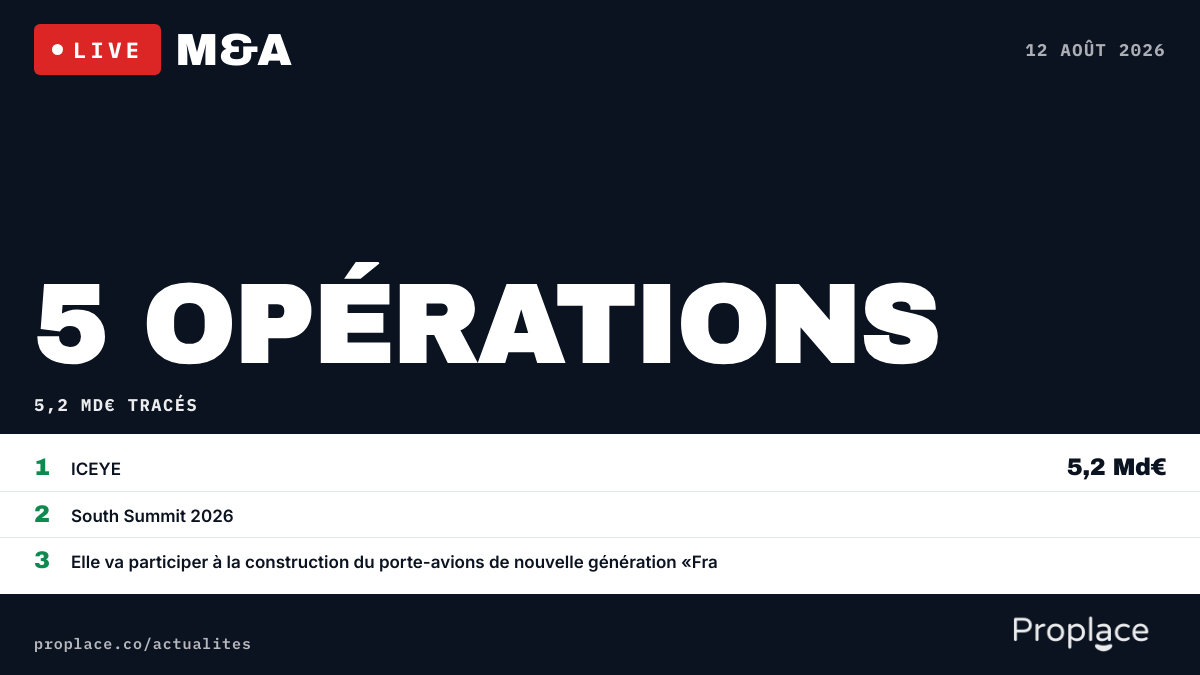
In focus — the deals we decoded
CLM Industrie: When a Nuclear SME Plays the Long Game
Source: x.com → · Sector Construction & PropTech — 📬 subscribe to the Construction & PropTech newsletter
CLM Industrie, a French SME specializing in boiler making and precision mechanics for the nuclear sector, has positioned itself for the next-generation aircraft carrier program "France Libre," the successor to the Charles-de-Gaulle, with delivery expected by the end of the 2030s.
The immediate takeaway: a great reference for an industrial SME, a secured order book for a decade, and the State as the ultimate client.
But what deserves attention is the positioning logic. In major nuclear armament programs, qualifying a supplier takes years—the requirements for traceability, certification, and control are such that once you're in the chain, you don't easily leave. CLM isn't just winning a contract; it's acquiring a status. In a sector where the barrier to entry is precisely the duration of the qualification effort, betting on the long term isn't a stance—it's the strategy itself.
For an investor or industrial acquirer looking at SMEs in the defense-nuclear supply chain: value isn't found in annual margins; it's found in the list of programs for which the supplier is qualified.
French Tech 2030: Applications Are Open
French Tech announces the opening of applications for the French Tech 2030 program, which aims to identify and support the next French technological champions—like Quobly (quantum), Exotrail (space propulsion), or Aqemia (computational chemistry).
No amount, no financial transaction per se: this is a public call for applications. What's worth noting is the list of examples cited—quantum, space, molecular AI—which reveals where the French State is placing its long-term bets, and therefore where public-private co-financing will concentrate in the coming months.
Maddyness: "What if the Real Challenge of Innovation Was No Longer About Going Fast?"
An editorial article from Maddyness questioning the primacy of speed in innovation. No associated financial operation, no amount, no transaction. To be noted as a fundamental signal: the rhetoric of urgency that has dominated startup discourse for the past ten years is starting to crack, including in the media that amplified it.
Scaleup Europe Acquires a Stake in ICEYE
Scaleup Europe, a public-private vehicle with a $5.7 billion target, has made its first investment by acquiring a stake in the Finnish company ICEYE, a specialist in synthetic aperture radar (SAR) satellite imaging.
The surface reading: a large European fund makes its debut investment in a deep tech asset with dual civil-defense use, very much in tune with current trends.
The more interesting reading concerns the nature of the vehicle itself. Scaleup Europe is a pan-European fund structured to bridge the "valley of death" between the accelerated growth phase and IPO or strategic consolidation—the segment where European capital has historically been most absent compared to American counterparts. Choosing ICEYE as its first investment is a deliberate signal: satellite radar imaging is one of the critical information infrastructures of the decade, with state clients (intelligence, crisis management, maritime surveillance) guaranteeing structural demand independent of consumption cycles.
This first ticket says less "we believe in ICEYE" than "we want to be identified as the capital that holds strategic European assets when no one else does." The reference position in a critical asset is, in the long run, worth much more than the return on the initial ticket.
For a French institutional investor: Scaleup Europe should be watched as a potential co-investor in sovereign deep tech assets—the fund will seek national partners for its next tickets.
South Summit 2026: Three Trends for European Tech
An article from Sifted from South Summit 2026 in Madrid, listing three major trends identified by participants for the future of European tech. No transaction, no amount. Useful as a barometer of European investor and founder sentiment this August, but without a transaction to decipher.
🚀 Fundraisings today · 0
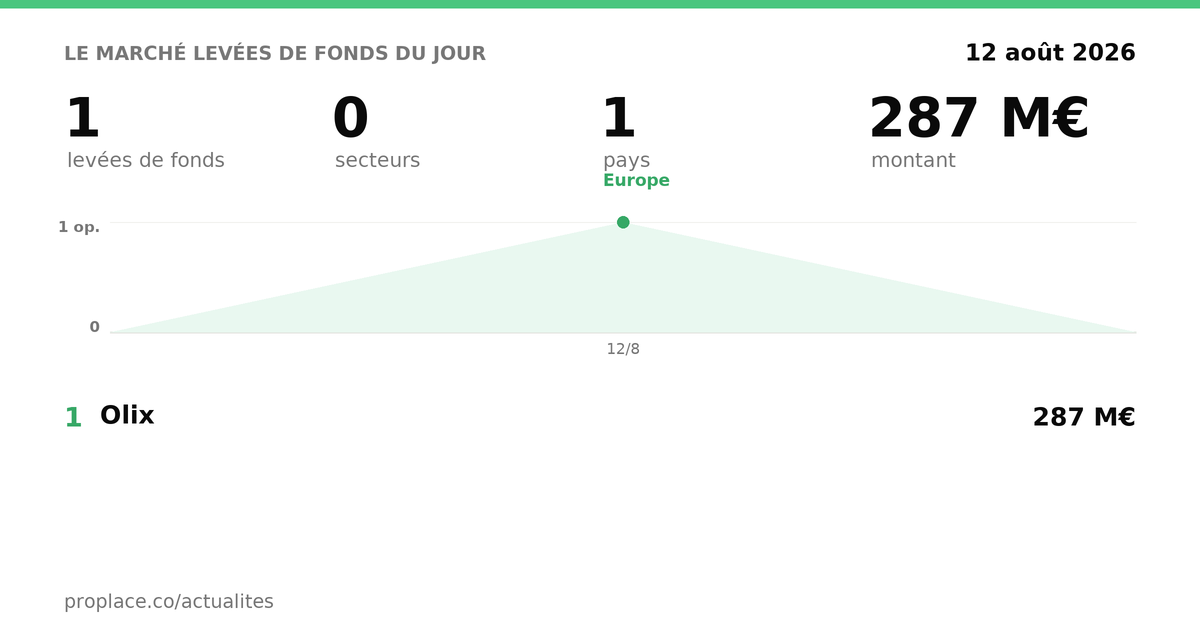
In focus — the deals we decoded
Olix Raises $312M in Series B: Two Years Old, $3.3B Valuation
Olix, a British AI chip startup founded two years ago, has just closed a $312 million Series B round at a $3.3 billion valuation. This is one of the ten largest fundraisings ever completed in the UK this year.
The immediate takeaway: another AI chip, another stratospheric valuation, another record-breaking funding round.
What deserves closer attention is the underlying arithmetic. Two years of existence, $3.3 billion valuation: this means investors are not paying for what Olix has produced, but for what they believe it will produce—and especially for the position it will occupy in a computing supply chain that currently relies on a near-monopoly. The AI chip has become the pivotal tool of the digital economy, in the same way that machine tools were for manufacturing industry: whoever controls it controls the pace of production for all others.
However, in this segment, almost all the money raised goes into silicon, design engineering, and energy—very little into traditional payroll. This is precisely what makes these valuations both defensible and fragile: defensible because the technological barrier is real and expensive to replicate; fragile because if computing demand slows down or a competing architecture emerges, there is no captive customer base, no contractual recurrence, no migration cost to cushion the shock.
Olix is a bet on the permanence of specialized computing scarcity—and on the fact that the UK can produce a semiconductor champion without Taiwan's industrial base or the US IRA subsidies. The bet is consistent; it is not without risk.
For a continental European investor: the concentration of British mega-rounds in AI and deep tech (Isomorphic Labs, Nscale, Wayve, Ineffable Labs—all above a billion this year) outlines an ecosystem that attracts global capital and widens the gap with Paris or Berlin in this specific segment. The question for a French fund is not to replicate this model, but to identify the building blocks of the chain—optimization software, cooling, connectivity—where a European player can take a position without directly competing on silicon itself.
📩 Subscribe to our newsletter to follow daily M&A and fundraising news: https://proplace.co/newsletter