
Analysis of the day
Analysis of M&A and Fundraising Operations as of July 15, 2026
Defense, AI, and Infrastructure: European Capital Chooses Its Battles While Pharma and Airline M&A Heats Up — Today's Overview for Decision-Makers and Investors.
· Proplace
🌐 Translated from the French original by AI — the French version is authoritative.
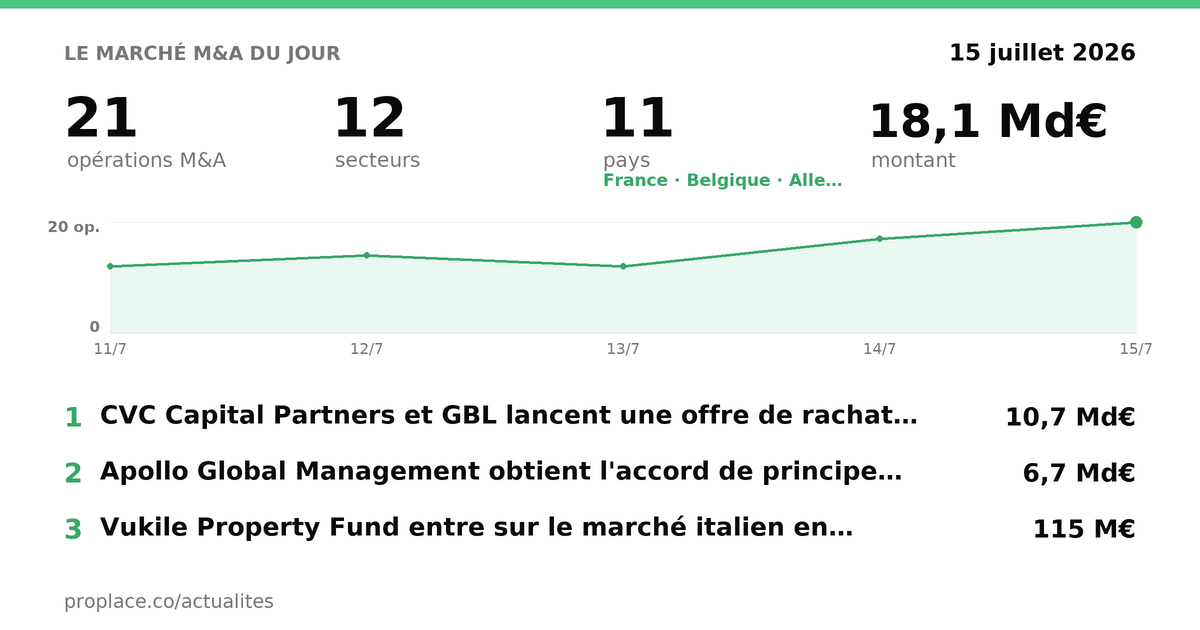
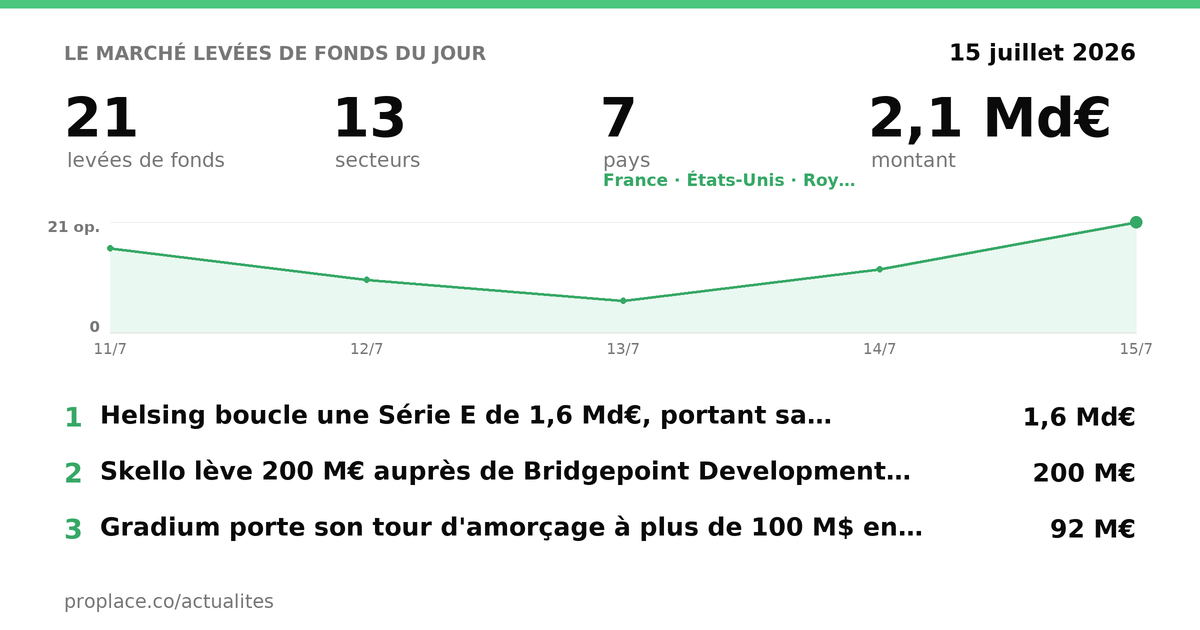
📊 Today's pulse — 42 deals · 21 M&A · 21 fundraisings · €20.2bn in play.
A busy day, with a clear theme emerging without needing to force it: critical infrastructure — compute, defense, field software — is concentrating the bulk of capital in Europe. In parallel, two significant transactions involving listed assets (Italian pharma, British airline) remind us that private equity sees public markets as reservoirs of underexploited value. And, in the background, some discreet bets on industrial sovereignty — from made-in-France underwear going public to a compiler aiming to break Nvidia's monopoly.
🤝 Mergers & acquisitions today · 21
In focus — the deals we decoded
CVC and GBL Acquire Recordati: When the Stock Market Becomes Too Small for a Cash Machine
Source: financierworldwide.com →
CVC Capital Partners and GBL are launching a delisting offer for Recordati, the Italian specialist in rare diseases and specialty medicines, for €10.7 billion — the largest privatization operation in Europe this month.
The immediate interpretation: a classic LBO on a defensive pharma company, with recurring revenues, exposure to rare diseases (high pricing power, limited competition), and predictable cash generation that supports acquisition debt.
What deserves attention is the direction of the movement: delisting a publicly traded company in 2026 is a bet that value is better created away from public markets than under their scrutiny. Recordati is not a company in distress — it is precisely because it performs well that its shareholders accept the premium. For French or European capital monitoring its listed assets, the signal is clear: specialty pharma assets with visible cash flow have become a systematic target for private equity, and the privatization premium is now very expensive.
Apollo Edges Out Castlelake on easyJet: A €6.7 Billion Counter-Offer That Says Something About the Price of Infrastructure
Apollo Global Management has secured easyJet's board's agreement in principle for a takeover offer of £5.7 billion (approximately €6.7 billion), at £7.15 per share, outbidding Castlelake's previous proposal (£6.90) by 3.6%, which the board has now withdrawn its support for.
The surface narrative: two American funds are vying for a European low-cost airline, Apollo wins by a few pence more.
But looking at who is buying sheds more light than the price. Apollo manages over $1 trillion in assets and operates largely through Athene, its retirement insurance arm, which needs real assets with predictable returns to back its long-term commitments. easyJet is not being bought as a company to be transformed: it is being bought as a mass mobility infrastructure, with airport slots, a captive customer base, and regular cash flows. The fact that Castlelake — a fund specializing in distressed assets — was the first in line, before Apollo prevailed, also says something: easyJet was perceived as a degraded asset, and Apollo, on the contrary, sees it as an undervalued asset. The divergence in analysis between two American funds is often more instructive than the final price.
Scaleway Absorbs Qarnot: Sovereign Cloud Gains a Thermal Engine
Scaleway (Iliad's cloud subsidiary) acquires Qarnot, a French specialist in distributed high-performance computing, to strengthen its European HPC offering. The amount was not disclosed.
Qarnot is a unique company: its computing servers recover up to 95% of the heat produced and reinject it into urban heating networks, swimming pools, and industrial facilities. It works for aerospace, automotive, energy, and finance — all sectors that need intense computing power without relying on American infrastructure.
The operation is more strategic than it appears. Scaleway positions itself as the sovereign European alternative to the AWS-Azure-GCP trio, and for that, it needs a credible HPC offering — intensive computing that engineers and researchers cannot entrust to just any cloud. By integrating Qarnot, Scaleway gains both technical capability and a rare environmental argument in the sector: data centers whose heat is not waste but a product. For large French companies subject to carbon footprint and data sovereignty requirements, this combination is hard to ignore.
Follow Health Joins Orisha: Healthcare Software Consolidation Continues
Source: presseagence.fr → · Sector HealthTech & Digital Health — 📬 subscribe to the HealthTech & Digital Health newsletter
Follow Health, a Rennes-based software publisher for surgeons and specialist doctors (4,500 professionals, 15 million patient records), joins the European group Orisha. Founded in 2015 by Roman Collin, the company was valued at approximately €20 million before the operation, with 42 employees and notable investors including Xavier Niel.
Orisha is a consolidator of vertical software for the healthcare, retail, and real estate sectors. The acquisition of Follow Health opens the door to specialist practitioners, a segment still largely undigitized and with high value.
For an acquirer in healthcare software, the real barrier to entry is not the code — it's the trust of practitioners and the depth of clinical data. With 300 doctor shareholders and 15 million records, Follow Health brings exactly what cannot be built quickly.
Equinox Takes Control of an Italian Plastics Recycler
Equinox acquires a majority stake in an Italian plastics recycler for an amount less than €200 million. Details about the target are not disclosed beyond its location and activity.
A private equity operation in the circular economy sector, which benefits from increasing European regulatory pressure on recycled content in packaging. No turnaround to force here — this is a clear investment thesis on a regulatory-protected industrial asset.
Vukile Enters Italy with Esperia Properties: Physical Retail as a Contrarian Bet
Source: propertyflash.co.za → · Sector Construction & PropTech — 📬 subscribe to the Construction & PropTech newsletter
Vukile Property Fund (a REIT listed in Johannesburg) acquires three Italian shopping centers — Le Due Valli in Turin, Le Centurie in Padua, Quarto Nuovo in Naples — for €115 million, with an initial yield of 10%, and creates Esperia Properties as a local holding vehicle. Two additional acquisitions representing approximately €200 million are reportedly underway.
Vukile has already built a solid Iberian platform (Castellana Properties in Spain, 99.7% owned) from its South African base, and is replicating the same model in Italy.
An initial yield of 10% on Italian shopping centers in 2026 simultaneously says two things: the market values these assets at a discount (e-commerce pressure has depressed prices), and an active operator convinced of its expertise can extract value where a generalist would hesitate. Vukile is not betting on commercial real estate in general — it is betting on its ability to manage better than the market thinks possible. For a French investor looking at commercial real estate, the price signal deserves attention.
Volex Buys Remaining 64% of Kepler SignalTek for €82 Million
Volex (critical cabling, AIM-listed) acquires the remaining 64.3% of Kepler SignalTek (KST) that it did not already own, for an amount up to $89.4 million (approximately €82 million), bringing its stake to 100%.
KST manufactures patient-connected products for the medical sector — cables, connectors, monitoring devices. Volex thus strengthens its exposure to the medical sector, one of the most defensive and demanding segments in terms of regulatory certification.
A classic minority buyout to consolidate an already operationally integrated asset. The logic is simple: once you manage a company, paying to own 100% is cheaper than sharing the value created with minorities.
VitalHub Acquires Buddy Healthcare: Digital Care Coordination Consolidates in Northern Europe
Source: investorsinhealthcare.com → · Sector HealthTech & Digital Health — 📬 subscribe to the HealthTech & Digital Health newsletter
VitalHub (healthcare software, listed in Canada) acquires Buddy Healthcare, a Finnish care coordination platform, for €8.6 million in initial payment (cash + shares), plus a potential earn-out of €4.5 million over two years.
Buddy Healthcare improves pre- and post-operative coordination between patients, caregivers, and institutions — a segment where digitalization remains partial in most European healthcare systems. A classic tuck-in acquisition for a consolidator of Nordic healthcare software.
Indutrade Makes Its 8th and 9th Acquisitions of the Year in Nordic Life Science
Source: uk.marketscreener.com → · Sector Industrial Tech & Manufacturing — 📬 subscribe to the Industrial Tech & Manufacturing newsletter
Indutrade (Swedish industrial conglomerate) acquires Dorte Egelund (Denmark) and Albiox (Finland), two life science distribution companies with combined revenues of approximately SEK 60 million (approximately €5 million). Both companies will be integrated into Labema in Finland.
These are Indutrade's 8th and 9th acquisitions in 2026 — a sustained pace of consolidation, consistent with the group's model of aggregating specialized industrial niches with defensible margins. Routine operations in a well-oiled M&A machine.
All of today's M&A, by sector
The full list for today — including the deals decoded above.
Mobility & Transportation · 4 →
- Berg Propulsion — Kongsberg Maritime rachète Berg Propulsion pour renforcer ses solutions maritimes
- Delivery Hero — Uber en négociations avancées pour racheter Delivery Hero
- Helen Oy — Plugit rachète le réseau de recharge EV de Helen en Finlande avec 199 stations
- easyJet — easyJet approuve l'offre d'Apollo Global Management pour une acquisition à 5,7 Md£
HealthTech & Digital Health · 3 →
- HMM Germany — Banyan Software rachète HMM Germany pour renforcer ses services eHealth numériques
- Buddy Healthcare — VitalHub rachète Buddy Healthcare, plateforme finlandaise de coordination des soins
- Follow Health — Follow Health rejoint le groupe européen Orisha (santé numérique)
Biotech & Pharma · 2 →
- Recordati — CVC et GBL lancent une OPA de 10,7 Md€ pour privatiser Recordati
- Indutrade rachète deux sociétés nordiques de sciences de la vie pour 60 M SEK
Climate & Energy Tech · 2 →
- Equinox acquiert une participation majoritaire dans un recycleur italien de plastiques
- Carbyon — Airhive rachète Carbyon pour former un leader européen de la capture directe du CO2
Construction & PropTech · 2 →
- Krata — Ryze rachète Krata, plateforme immobilière espagnole, septième acquisition en deux ans
- Esperia Properties — Vukile entre en Italie en acquérant Esperia Properties pour 115 M€
Developer & IT Infrastructure · 2 →
- Kepler SignalTek — Volex acquiert la participation restante dans Kepler SignalTek
- Qarnot — Scaleway rachète Qarnot pour renforcer sa plateforme HPC européenne
Data & Analytics · 1 →
- Solver — Sesa acquiert 19% de Solver, spécialiste espagnol de l'IA et du machine learning
FinTech · 1 →
- Orb — Adyen rachète Orb, plateforme de facturation, pour 335 M$
Food & AgTech · 1 →
- AMFresh — Paine Schwartz Partners acquiert une participation dans AMFresh valorisée jusqu'à 5 Md€
Future of Work & HR Tech · 1 →
- TOBA HR Solutions — ORTEC rachète TOBA HR Solutions pour renforcer la gestion RH santé en Belgique
MedTech & Devices · 1 →
- Primed — Inflexion rachète Primed, fournisseur allemand de consommables médicaux
Retail & E-commerce Tech · 1 →
- Burger King España — Mubadala rachète Burger King España à Cinven pour 2,1 Md€
🚀 Fundraisings today · 21
In focus — the deals we decoded
Helsing at €1.6 Billion: European Defense Finally Gets a Credible Unicorn
Source: munich-startup.de → · Sector The Physical World — 📬 subscribe to the The Physical World newsletter
Helsing, the Munich-based AI software startup for defense systems, closes a €1.6 billion Series E, valuing the company at €16 billion. The round includes Dragoneer, Lightspeed, Goldman Sachs Alternatives, JPMorgan Chase, CPP Investments (Canadian pension fund), General Catalyst, Iconiq, and others. Investor demand reportedly far exceeded the available volume.
Founded in 2021, Helsing develops AI software for drones, underwater reconnaissance, and an unmanned combat drone (co-developed with aircraft manufacturer Grob Aircraft, acquired in 2025). It already equips the Ukrainian armed forces.
The obvious interpretation: a tour de force in European defense tech, driven by the increase in military budgets on the continent.
What distinguishes Helsing from most defense tech companies is the nature of the product: not hardware, but AI software that integrates into existing systems. A missile costs once; software that pilots a drone sells as many times as there are platforms to equip. The €16 billion valuation — more than any other defense startup in Europe — reflects this multiplier. For a European institutional investor, Helsing is also a demonstration that defense sovereignty can be a business model, not just a political imperative. The fact that CPP Investments (Canada) and JPMorgan are participating indicates that this is no longer just a European geopolitical bet — it is a globally recognized financial asset.
Skello Raises €200 Million: Software for Invisible Workers Finds Its Moment
Source: beinsure.com → · Sector FinTech — 📬 subscribe to the FinTech newsletter
Skello, an HR platform for field teams (scheduling, compliance, operational performance), raises €200 million from Bridgepoint Development Capital V, which becomes a reference minority shareholder. Partech and XAnge reinvest. Management increases its stake.
Skello serves 25,000 companies and 600,000 daily users in France, Spain, Benelux, and Italy, and reportedly exceeded €50 million in ARR in 2026 after achieving profitability in 2025.
The 55% of the European workforce who are frontline workers — cashiers, waiters, caregivers, logistics agents — have long been overlooked in digital transformation. Large HR platforms were built for white-collar workers in open-plan offices, not for rotating teams across three sites. Skello built for them, and the profitability achieved before this fundraising validates that the model is not a bet on loss-making growth. For Bridgepoint, it is a defensive software asset: Skello's clients cannot do without scheduling their teams, regardless of the economic climate.
Gradium and Nvidia: When the Chip Supplier Becomes a Shareholder in Voice AI
Gradium, a Parisian voice AI startup from the Kyutai laboratory (supported by Xavier Niel), brings its seed round to over $100 million (approximately €92 million) by welcoming Nvidia as a new investor, which is leading an extension of at least $30 million, in addition to the $70 million raised in December 2025 from FirstMark Capital, Eurazeo, DST Global Partners, Eric Schmidt, and Xavier Niel.
Gradium develops cutting-edge voice language models, with the ambition of making them products used by developers and businesses worldwide.
Nvidia's entry into the capital of a French voice AI startup is worth noting. Nvidia does not invest out of philanthropy: when it invests in a startup, it ensures that the startup's models will run on its chips. This is the same mechanism observed on a large scale with OpenAI or xAI — the GPU manufacturer finances its own customers to guarantee future demand. For Gradium, Nvidia's money is validation and an accelerator; but it is also a link. The real question for Gradium's competitors and customers is whether this capital dependence will one day translate into architectural dependence. For now, it is the largest seed round ever for a French startup — and it comes in part from an infrastructure provider who has every interest in Gradium succeeding on its own rails.
TYLSemi Raises $43 Million for Core Components of Custom AI Chips
TYLSemi raises $43 million (approximately €40 million) to develop the fundamental components ("chiplets" and core IP) needed to manufacture custom AI chips. Investors are not detailed in available sources.
TYLSemi addresses an often-overlooked link: not the final chips, but the elementary building blocks that allow others to design their own. This is an infrastructure position in the semiconductor value chain — further upstream, less visible, but potentially more defensible if standards are established. In a context where every hyperscaler and every major industrial player wants its own in-house chip to free itself from Nvidia, providers of reusable generic components could capture a discreet but durable rent.
ZML Raises €17.5 Million to Break Nvidia's Software Lock
ZML, a Parisian startup founded in late 2023 by Steeve Morin, raises €17.5 million ($20 million) for its LLMD inference server, capable of running open-source language models on competing architectures: Nvidia (CUDA), AMD (ROCm), Google (TPU), Apple (Metal), and Intel.
The problem ZML addresses is real and costly: companies deploying AI in production are currently locked in by incompatible software layers between chip providers. Changing architecture means rewriting everything. ZML offers a universal compiler — written in Zig, relying on XLA and MLIR — that converts models into autonomous binaries, without Python dependency, executable on mixed chip fleets.
The amount is modest compared to the mega-rounds in the AI ecosystem, but the thesis is precisely anti-mega-round: ZML bets that sovereignty over computing infrastructure will come through the software layer, not through chip manufacturing. If it succeeds, it gives European compute buyers a real leverage point between providers — something Brussels has been calling for for years. For a CIO deploying AI in production, this is the promise of no longer being captive to a single silicon vendor.
Le Slip français Goes Public on July 14: A Symbol More Than a Round
Le Slip français raises €5 million in fresh capital during its listing on Euronext Growth, for a total of €13 million raised from 7,250 individual shareholders (including €8 million from the sale by historical shareholders). The share opened at €14.80, reached €15.90 during the session, and closed up 2% at €15.10. The company reported €21.1 million in revenue and €0.7 million in net profit in 2025.
The July 14 date is deliberate — founder Guillaume Gibault embraces the patriotic narrative. The company went through difficult years post-Covid (store closures, average price drop from €40 to €20) before turning things around.
The operation is modest — below the average for Euronext Growth IPOs — and the structure reveals its limitations: of the €13 million raised, €8 million goes into the pockets of exiting shareholders, not into development. The net €5 million for the company will have to finance an ambition to "reinvent the textile industry" against Shein and Temu. It's a brand bet more than a capital bet. What is real, however, is the base of 7,250 individual shareholders — customers who become co-owners, an original loyalty model in a sector where loyalty is difficult to build.
Helsing and Valarian: Defense Sovereignty, Two Interpretations
Valarian Raises $50 Million for Sovereign AI Infrastructure for States
Source: siliconangle.com → · Sector The Physical World — 📬 subscribe to the The Physical World newsletter
Valarian Technologies, a British startup founded by a former Palantir executive and a former US Army officer, raises $50 million (approximately €46 million) in a Series A, led by New Enterprise Associates (NEA's first investment in a European defense startup), with Lightbank, XTX Markets, Sequel, LitVC, and angels including Gokul Rajaram and Nikesh Arora.
Valarian develops a fundamental infrastructure layer that allows states and defense organizations to deploy AI systems while maintaining sovereign control over data, workloads, and access — without relying on an American cloud provider who can revoke access.
The thesis is simple and powerful: European states are massively increasing their defense budgets (over €392 billion in 2025 according to available sources), but they cannot deploy critical AI on AWS or Azure without accepting a structural dependence on companies subject to US law. Valarian sells the infrastructure that makes this independence possible. This is exactly the same logic as Scaleway-Qarnot in the civilian sector, applied to the military. For a European institutional investor, the convergence between rising defense budgets and the need for digital sovereignty creates a rare captive market.
Skalar Raises €12 Million to Reinvent the Accounting Firm with AI
Source: startbase.com → · Sector Horizontal & Productivity SaaS — 📬 subscribe to the Horizontal & Productivity SaaS newsletter
Skalar, a Munich-based startup founded in 2025 by Björn Goß (founder of Stocard, sold to Klarna) and four partners, raises €12 million in pre-seed and seed rounds, led by Headline, with QED Investors, futurepresent, Repeat, MS&AD, Foreword, and business angels.
Skalar is not building accounting software with an added AI layer — it is building an entire accounting firm, with its technology, entirely designed around AI agents that manage accounting, payroll, and tax advice in real-time. Human experts intervene in supervision, not execution.
The shortage of accountants and tax experts in Germany (and Europe) is structural: retirements are not being offset by new entrants to the profession. Skalar is not selling a tool to existing firms — it is directly competing with them by offering a cheaper and faster service. This is a thesis of sectoral disruption, not optimization. The participation of QED Investors (a recognized fintech specialist) lends credibility to the ambition.
Nopan Raises €7.2 Million: Former Netflix Executives Tackle Account-to-Account Payments
Source: eu-startups.com → · Sector FinTech — 📬 subscribe to the FinTech newsletter
Nopan, a startup founded by former Netflix payment executives, raises a total of €7.2 million for its account-to-account (A2A) payment performance platform in Europe. Investors are not detailed in available sources.
A2A payment — direct bank-to-bank transfer, without card intermediaries — has long been a technical reality, but its success rates remain lower than card payments, hindering its widespread adoption. Nopan focuses on optimizing this performance, a problem that Netflix teams are well familiar with, having experienced it across millions of recurring transactions.
Netflix's expertise here is a real asset: managing recurring subscriptions in dozens of countries with heterogeneous payment methods is exactly the problem European merchants are trying to solve with A2A. The founding team's credibility compensates for the modest size of the round.
Promptwatch Raises €6 Million for AI Search Optimization
Promptwatch raises €6 million to expand its end-to-end AI search optimization platform — sometimes referred to as "AI search optimization," the equivalent of SEO for generative search engines. Investors are not detailed in available sources.
With the rise of AI assistants as an entry point for information discovery, businesses need to understand and optimize their visibility in these new channels. Promptwatch addresses this nascent need. An early-stage funding round in a developing market.
📩 Subscribe to our newsletter to follow daily M&A and fundraising news: https://proplace.co/newsletter
All of today's fundraisings, by sector
The full list for today — including the deals decoded above.
FinTech · 4 →
- ARC Intelligence — ARC Intelligence lève 4 M€ en seed pour sa plateforme finance IA native
- Fondateur ayant vendu sa startup à Klarna pour 110 M€ lève 12 M€ pour un nouveau projet
- Nopan — Nopan lève 7,2 M€ pour son plateforme de paiements par compte et portefeuille
- M&A 2026, le retour des grandes manoeuvres en France - Capital Finance
Cybersecurity · 3 →
- Deals
- Valarian — Valarian lève 50 M$ pour son infrastructure IA souveraine de défense
- Project Q — Project Q lève 15 M€ en série A pour sa plateforme de défense open-source HYDRIS
Developer & IT Infrastructure · 3 →
- TYLSemi — TYLSemi lève 43 M$ pour développer des composants de puces IA sur mesure
- ZML — ZML lève 17,5 M€ pour son logiciel d'inférence IA multi-puces
- Gradium — Gradium lève 100 M$ pour son IA vocale avec Nvidia comme investisseur
Industrial Tech & Manufacturing · 2 →
- Helsing — Helsing lève 1,6 Md€ en série E pour sa tech de défense (Allemagne)
- NextGO Epi — NextGO Epi lève 2 M€ en pré-seed pour ses épitaxies en oxyde de gallium
Climate & Energy Tech · 1 →
- Gridcog — Gridcog lève 10 M$ avec ABB, Axpo, DNV et VERBUND pour la modélisation énergétique
Construction & PropTech · 1 →
- Prolo — Prolo lève 4,9 M€ pour son IA d'approvisionnement pour PME construction
D2C & Consumer Brands · 1 →
- Le Slip français — Le Slip français lève 5 M€ pour son introduction à la Bourse de Paris
Data & Analytics · 1 →
- Promptwatch — Promptwatch lève 6 M€ pour son plateforme d'optimisation de recherche IA
Future of Work & HR Tech · 1 →
- Skello — Skello lève 200 M€ pour son plateforme RH IA destinée aux équipes de première ligne
Health & Wellness · 1 →
- RAROG — RAROG lève 162 K€ pour transformer les appareils en balises de secours
Logistics & Supply Chain · 1 →
- Triton Depth — Triton Depth lève 1 M€ en pré-seed pour son réseau de capteurs acoustiques
RegTech & Compliance · 1 →
- Skalar — Skalar lève 12 M€ pour son IA de conseil fiscal (Allemagne)
Social & Creator Economy · 1 →
- Aida — Aida lève des fonds en seed pour sa plateforme marketing autonome collaborative