
Seamflow Interactive Memo
Industrial Tech & Manufacturing ➜ AI-Powered TIC Automation SaaS ➜ AI-driven solutions transforming the Testing, Inspection, and Certification (TIC) industry.
AI-driven solutions transforming the Testing, Inspection, and Certification (TIC) industry.
Want a detailed, personalized memo on this company?
Market Sizing
Top-Down Market analysis
Total Addressable Market (TAM): $5.94B
- Perimeter: Global AI in manufacturing market as a proxy for AI-enabled automation within manufacturing, of which TIC SaaS is a subset
- Source Data: AI Advisory Group citing Precedence Research data (aiadvisorygroup.com)
Serviceable Available Market (SAM): $56.74B
- Perimeter: Europe TIC market size, with AI/digital-enabled components as a sub-theme
- Logic: Filtered for our specific sector and geography.
- Source Verification: Market Data Forecast (marketdataforecast.com)
Serviceable Obtainable Market (SOM): $2.84B
- Perimeter: 5% market share of SAM for early-stage realistic capture
- Logic: Realistic near-term target based on competitive landscape.
- Source: Calculated from SAM (Market Data Forecast) (marketdataforecast.com)
Bottom-Up Market analysis
This approach calculates the total market size by multiplying the validated number of potential customers by a verified average price point.
1. Customer Segment (Volume): 3,000
- Who they are: Firms in manufacturing (automotive, electronics, food & beverage, pharmaceuticals, energy) and compliance sectors with $50M-$500M revenue; mid-market with regulatory exposure, digital compliance programs, and TIC needs
- Validated Source: Markets and Markets, Mordor Intelligence, Grand View Research (marketsandmarkets.com)
2. Unit Economics (Price): $100K ARR
- What this represents: Average Annual Recurring Revenue for mid-market AI automation SaaS, proxied from comparable platforms
- Validated Source: Industry SaaS benchmarks (Robylon.ai et al.) (robylon.ai)
3. Calculated Result: $300M
• This figure represents the mathematically derived Serviceable Available Market based on the specific inputs above.
Triangulation
The top-down SAM of $56.74B vastly exceeds the bottom-up $300M due to broad TIC market inclusion versus SaaS-specific customer and pricing proxies; top-down offers a reliable baseline for the addressable sector while bottom-up reveals granular SaaS opportunity. SOM triangulates to $2.84B top-down or $15M bottom-up, suggesting conservative targeting of 5% capture on unit economics. Prioritize top-down for investor decks with bottom-up for go-to-market validation.
Market trends
MARKET INTELLIGENCE: AI Disrupts TIC Automation Market
1. Market Catalyst & Trajectory
- Digitalization, AI in inspections, remote auditing, and regulatory pushes like ESG/CE are driving a structural shift from manual inspection inefficiencies and compliance risks to AI-powered TIC automation workflows for mid-market manufacturers in automotive, electronics, food & beverage, pharmaceuticals, and energy sectors. [aiadvisorygroup.com]
- Global AI in manufacturing market stands at $5.94B in 2024, growing at 44.2% CAGR to ~$230.95B by 2034, revealing explosive speed and scale as AI creates a new automation layer atop stagnant 2-5% TIC CAGR. [aiadvisorygroup.com]
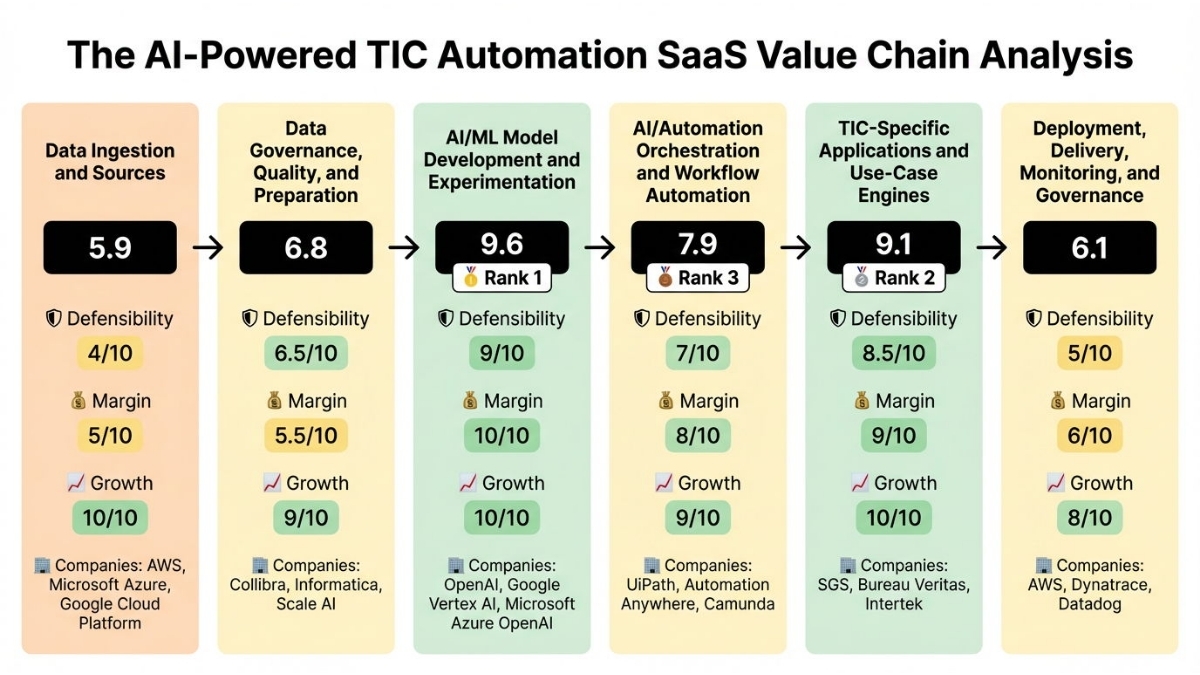
- AI/ML Model Development and Experimentation has become the critical control point, as it holds the highest strategic score of 9.6 from maximum defensibility via R&D capital, technical complexity in training/validation/drift detection, IP in proprietary algorithms, and regulatory model risk management, bottlenecking the flow of predictive engines essential for TIC inspections.
- AI/ML Model Development and Experimentation holds disproportionate pricing power with margin potential score of 10/10 from premium pricing for advanced AI capabilities, fixed software costs yielding 75-85% gross margins post-scale, and strong economies of scale, giving it leverage over upstream commoditized data stages and downstream applications reliant on its tuned models. [saasfactor.co]
- General-purpose platforms such as ServiceNow, UiPath, Automation Anywhere, SAP, and Microsoft are losing ground through structural obsolescence in the fragmented landscape.
- Generic automation tools lack deep embedding of AI into TIC-specific regulatory workflows, enabling niche specialists to capture value by offering tailored solutions that bridge advanced AI with stringent industry requirements unmet by broad incumbents.
- Profit pool is shifting toward AI/ML Model Development and Experimentation (margin score 10), TIC-Specific Applications and Use-Case Engines (9), and AI/Automation Orchestration and Workflow Automation (8) where margins expand via premium SaaS pricing above 70-85%, while compressing in Data Ingestion and Sources (5), Data Governance, Quality, and Preparation (5.5), and Deployment, Delivery, Monitoring, and Governance (6) due to commodity infrastructure and mixed support costs.
- Specialized SaaS model in TIC-Specific Applications and Use-Case Engines is best positioned, as its structure leverages regulatory/domain moats (defensibility 8.5), premium pricing for compliance apps, and multi-tenant scale in underserved $50M-$500M manufacturing firms amid 44.2% CAGR, capturing end-user value closest to mid-market digitization needs.
Value Chain Analysis
Value chain stage description
STAGE [1]: Data Ingestion and Sources
This upstream stage captures and aggregates raw data from industrial IoT sensors, field inspections, lab results, and supply chain sources essential for AI-driven TIC automation in manufacturing environments. Companies operating here, such as cloud infrastructure giants, provide real-time data pipelines that serve as the foundational input for downstream AI processing, enabling mid-market firms to automate previously manual compliance data collection. Upstream suppliers like sensor manufacturers feed into this stage, while it hands off formatted data streams to AI data preparation teams.
🔢 Strategic Score: 5.9 (Moderate)
🛡️ DEFENSIBILITY (4/10): High capital requirements for building scalable cloud platforms deter new entrants, as significant upfront investments in compliant infrastructure are needed to handle industrial IoT volumes reliably. Moderate technical complexity arises from integrating diverse sensor feeds and video analytics, requiring specialized pipelines that incumbents have optimized over years.
Know-how in proprietary IoT integrations provides a partial moat, though no critical patents dominate this commoditized space.
Source: AI-Powered TIC Automation SaaS barriers query (https://www.getmonetizely.com/articles/how-to-price-ai-services-in-2025-models-examples-and-strategy-for-saas-leaders?utm_source=openai)
💰 MARGIN POTENTIAL (5/10): Pricing power is limited to market rates due to commodity cloud infrastructure competition, preventing premium charges. The mixed cost structure combines high fixed infrastructure with variable compute usage, balancing scalability with usage-based expenses. Strong economies of scale benefit hyperscalers like AWS through massive data volume efficiencies, though typical gross margins remain under 40% due to competitive pricing pressures.
Source: AI-Powered TIC profit margins query (https://www.saasfactor.co/blogs/the-2025-saas-pricing-playbook-how-to-choose-the-right-model?utm_source=openai)
📈 GROWTH (10/10): The market exhibits a 44.2% CAGR from 2024-2034 driven by surging demand for AI-enabled inspection data in manufacturing. TAM expansion occurs through new market creation via IoT proliferation in compliance workflows for mid-market firms. Positioned in the early adopter phase, this stage offers a wide window for capturing explosive growth from emerging real-time data needs.
Source: AI Confidence Report 2025-2026 (https://aiadvisorygroup.com/2025/10/24/ai-confidence-report-2025-2026/?utm_source=openai)
🏢 SPECIALIZED COMPANIES: Amazon Web Services (AWS) (market leader in cloud data ingestion for industrial IoT and data lakes) • Microsoft Azure (provides edge data ingestion tailored for manufacturing sensors) • Google Cloud Platform (GCP) (specializes in IoT data pipelines optimized for TIC workflows)
STAGE INSIGHT
Success in this stage demands massive scalable infrastructure and partnerships with IoT hardware providers to ensure reliable data flows for mid-market manufacturing. The primary risk is commoditization from multi-cloud flexibility, eroding differentiation as customers switch providers easily. Investors find it moderately attractive now due to high growth tailwinds, but only for players leveraging scale to offset low defensibility and margins.
STAGE [2]: Data Governance, Quality, and Preparation
This stage focuses on cleaning, labeling, and governing raw data to meet TIC compliance standards like GDPR, creating trustworthy datasets for AI model training in manufacturing audits. Specialized software firms here ensure data lineage and quality, preventing errors in downstream inspections and certifications for mid-sized firms. It receives raw streams from ingestion platforms and delivers harmonized datasets to AI developers.
🔢 Strategic Score: 6.8 (Strong)
🛡️ DEFENSIBILITY (6.5/10): Moderate capital barriers stem from the need for scarce domain experts in manufacturing data handling, raising costs for new entrants. High technical complexity in data lineage, privacy harmonization, and labeling for TIC schemas builds a robust moat through specialized tools. Proprietary governance platforms and moderate network effects from data-sharing ecosystems, combined with strong GDPR regulatory hurdles, protect incumbents effectively.
Source: AI-Powered TIC value chain query (https://www.marketdataforecast.com/market-reports/europe-tic-market?utm_source=openai)
💰 MARGIN POTENTIAL (5.5/10): Market-rate pricing prevails amid tool interoperability, limiting premiums despite SaaS delivery. Mostly fixed software costs enable high gross margins around 75-85% for leaders, though data labeling introduces some variability. Some economies of scale emerge from reusable governance frameworks across clients, supporting steady profitability.
Source: AI-Powered TIC profit margins query (https://www.saasfactor.co/blogs/the-2025-saas-pricing-playbook-how-to-choose-the-right-model?utm_source=openai)
📈 GROWTH (9/10): A 44.2% CAGR through 2034 fuels expansion as digital transformation accelerates data needs in TIC. Growing TAM from AI integration in compliance drives demand for quality preparation. Early adopter status provides ample opportunity amid rising regulatory pressures on manufacturing data.
Source: AI Confidence Report 2025-2026 (https://aiadvisorygroup.com/2025/10/24/ai-confidence-report-2025-2026/?utm_source=openai)
🏢 SPECIALIZED COMPANIES: Collibra (leading data catalog and governance platform for enterprise compliance) • Informatica (focuses on data quality and preparation tools for AI pipelines) • Scale AI (dominant in high-quality data labeling and annotation for ML models)
STAGE INSIGHT
Companies must possess deep expertise in regulatory-compliant data tools and talent for domain-specific labeling to thrive. Labeling costs and interoperability risks could erode value if scale isn't achieved quickly. This stage appeals to investors for its balanced defensibility and growth in a data-hungry AI ecosystem, particularly for governance specialists.
STAGE [3]: AI/ML Model Development and Experimentation
This core stage develops and experiments with AI models for anomaly detection, risk scoring, and predictive inspections tailored to TIC standards in manufacturing. AI platform providers here handle training, validation, and MLOps, supplying tuned models to workflow integrators. It transforms prepared data into intelligent engines critical for automating compliance in mid-market firms.
🔢 Strategic Score: 9.6 (Exceptional)
🛡️ DEFENSIBILITY (9/10): High capital for R&D in ML lifecycles deters entrants without deep pockets. Extreme technical complexity in model training, drift detection, and domain tuning creates insurmountable barriers for most. Critical IP via proprietary algorithms, moderate data feedback networks, high switching costs for retraining, and model risk regulations form an ironclad moat.
Source: AI-Powered TIC value chain query (https://www.marketsandmarkets.com/Market-Reports/ai-powered-testing-inspection-certification-tic-market-170006081.html?utm_source=openai)
💰 MARGIN POTENTIAL (10/10): Premium pricing for advanced AI capabilities commands top rates in this specialized domain. Fixed software development costs yield 75-85% gross margins post-scale. Strong economies of scale amplify profitability as models serve vast applications with minimal incremental expense.
Source: AI-Powered TIC profit margins query (https://www.saasfactor.co/blogs/the-2025-saas-pricing-playbook-how-to-choose-the-right-model?utm_source=openai)
📈 GROWTH (10/10): Explosive 44.2% CAGR reflects booming demand for predictive TIC models. New markets emerge from AI adoption in inspections, expanding TAM dramatically. Early on the adoption curve, it offers peak opportunity for innovators in manufacturing compliance.
Source: AI Confidence Report 2025-2026 (https://aiadvisorygroup.com/2025/10/24/ai-confidence-report-2025-2026/?utm_source=openai)
🏢 SPECIALIZED COMPANIES: OpenAI (provides foundation models adaptable for TIC anomaly detection) • Google Vertex AI (enterprise ML platform for experimentation and deployment) • Microsoft Azure OpenAI (focuses on secure model development for compliance use cases)
STAGE INSIGHT
Elite ML talent, vast compute resources, and proprietary algorithms are non-negotiable for leadership. Risks include rapid commoditization from open-source advances and regulatory scrutiny on AI decisions. Exceptionally attractive for investment due to unmatched scores across dimensions, ideal for AI-native founders capturing the innovation core.
STAGE [4]: AI/Automation Orchestration and Workflow Automation
This midstream stage orchestrates AI models into automated workflows for TIC processes like audit routing and robotic inspections in manufacturing. RPA and integration firms embed intelligence into operational flows, bridging models to specific applications. It receives trained models and outputs executable logic for end-user SaaS.
🔢 Strategic Score: 7.9 (Strong)
🛡️ DEFENSIBILITY (7/10): High capital for robust orchestration platforms raises entry hurdles. Technical demands of API integrations and workflow engines favor experienced players. Proprietary tools, network effects from ecosystem integrations, and switching costs lock in users effectively.
Source: AI-Powered TIC barriers query (https://aiadvisorygroup.com/2025/10/24/ai-confidence-report-2025-2026/?utm_source=openai)
💰 MARGIN POTENTIAL (8/10): Strong pricing power from workflow customization in TIC contexts. Fixed development with scale yields high margins above 70%. Economies of scale in reusable automation modules drive efficiency for leaders.
Source: AI-Powered TIC profit margins query (https://www.saasfactor.co/blogs/the-2025-saas-pricing-playbook-how-to-choose-the-right-model?utm_source=openai)
📈 GROWTH (9/10): 44.2% CAGR propelled by automation demand in compliance. TAM grows with hybrid AI-RPA adoption. Early adopters phase sustains momentum for workflow innovators.
Source: AI Confidence Report 2025-2026 (https://aiadvisorygroup.com/2025/10/24/ai-confidence-report-2025-2026/?utm_source=openai)
🏢 SPECIALIZED COMPANIES: UiPath (leader in RPA for industrial process automation) • Automation Anywhere (cloud-native workflow orchestration for compliance tasks) • Camunda (open-source engine for complex AI-driven business processes)
STAGE INSIGHT
Deep integration expertise and partnerships with AI/model providers are essential. Competition from general RPA giants adapting to TIC poses erosion risk. Strong investment case for its balance of moats and scalability in automating mid-market operations.
STAGE [5]: TIC-Specific Applications and Use-Case Engines
This downstream stage develops tailored SaaS applications for testing, inspection, and certification workflows, such as defect detection and compliance dashboards for mid-market manufacturers. Domain experts customize AI for standards like ISO and CE marking, delivering end-user value directly. It integrates upstream orchestration to provide plug-and-play solutions for $50M-$500M firms.
🔢 Strategic Score: 9.1 (Exceptional)
🛡️ DEFENSIBILITY (8.5/10): High technical complexity in domain-specific CV and compliance tuning blocks newcomers. Critical IP in regulatory-adapted apps, strong network effects from certification ecosystems, and high switching costs for validated workflows create durable advantages. Stringent regulatory barriers for TIC approvals further solidify positions.
Source: AI-Powered TIC companies query (https://www.marketsandmarkets.com/Market-Reports/ai-powered-testing-inspection-certification-tic-market-170006081.html?utm_source=openai)
💰 MARGIN POTENTIAL (9/10): Premium pricing for specialized TIC SaaS reflects irreplaceable compliance value. Fixed development costs support >70% margins with viral adoption. Strong scale economics from multi-tenant apps enhance profitability.
Source: AI-Powered TIC profit margins query (https://www.saasfactor.co/blogs/the-2025-saas-pricing-playbook-how-to-choose-the-right-model?utm_source=openai)
📈 GROWTH (10/10): 44.2% CAGR from AI disrupting manual TIC services. New TAM in mid-market digitization expands rapidly. Early adoption curve positions it for outsized gains in manufacturing compliance.
Source: AI Confidence Report 2025-2026 (https://aiadvisorygroup.com/2025/10/24/ai-confidence-report-2025-2026/?utm_source=openai)
🏢 SPECIALIZED COMPANIES: SGS (global leader in digital TIC inspection platforms) • Bureau Veritas (focuses on AI-powered certification workflows for manufacturing) • Intertek (provides compliance apps with defect detection for mid-market)
STAGE INSIGHT
Domain regulatory knowledge, customer trust, and vertical integrations upstream are vital. Risks from incumbents' digital shifts could commoditize apps without differentiation. Highly attractive for startups like Seamflow targeting underserved segments with explosive growth potential.
STAGE [6]: Deployment, Delivery, Monitoring, and Governance
This final stage handles SaaS deployment, performance monitoring, security, and ongoing support for TIC applications in production environments. Observability and integrator firms ensure reliability and compliance post-launch for manufacturing users. It receives ready apps and manages customer success end-to-end.
🔢 Strategic Score: 6.1 (Strong)
🛡️ DEFENSIBILITY (5/10): Moderate capital for observability infrastructure limits small players. Technical complexity in real-time monitoring provides some edge. Low IP strength and switching ease weaken moats despite regulatory oversight.
Source: AI-Powered TIC value chain query (https://www.marketdataforecast.com/market-reports/europe-tic-market?utm_source=openai)
💰 MARGIN POTENTIAL (6/10): Market pricing for support services caps upside. Mixed costs with support labor constrain to 40-70% margins. Moderate scale benefits from cloud delivery.
Source: AI-Powered TIC profit margins query (https://www.saasfactor.co/blogs/the-2025-saas-pricing-playbook-how-to-choose-the-right-model?utm_source=openai)
📈 GROWTH (8/10): Solid 20-30% CAGR tied to SaaS proliferation. Stable TAM growth from monitoring needs. Mainstream adoption offers consistent but less explosive opportunity.
Source: AI Confidence Report 2025-2026 (https://aiadvisorygroup.com/2025/10/24/ai-confidence-report-2025-2026/?utm_source=openai)
🏢 SPECIALIZED COMPANIES: AWS (cloud deployment and monitoring for TIC SaaS) • Dynatrace (AI-powered observability for production workflows) • Datadog (real-time monitoring and governance for compliance apps)
STAGE INSIGHT
Reliable 24/7 operations and security expertise are table stakes. Customer churn from outages represents key risk. Moderately appealing for service-oriented investors seeking recurring revenue in a maturing deployment market.
Top 3 Strategic Positions
Best Strategic Positions OverviewStrategic Position Scores were calculated across the AI-Powered TIC Automation SaaS value chain using the weighted formula emphasizing defensibility, margins, and growth. This analysis of the sector targeting mid-market manufacturing reveals top stages clustered around core AI innovation and domain-specific applications. These positions excel with high barriers, premium economics, and explosive CAGRs from regulatory-driven digitization.
🥇 Rank 1: Stage [3] — AI/ML Model Development and Experimentation
🔢 Strategic Score: 9.6
💬 STRATEGIC RATIONALE: This stage tops the chain with maximum scores in all dimensions, creating unparalleled moats through technical and IP barriers that incumbents leverage for dominance. High defensibility from R&D intensity and patents prevents replication, while premium AI pricing and fixed costs deliver elite margins. Explosive 44.2% CAGR amid early adoption positions it as the ROI epicenter, fueled by demand for predictive models in manufacturing compliance. Timing is ideal as foundation models mature, enabling rapid customization for TIC without enterprise bloat. Investors targeting AI natives will find structural tailwinds from compute abundance and regulatory needs.
🔎 KEY SUPPORTING EVIDENCE:
🥈 Rank 2: Stage [5] — TIC-Specific Applications and Use-Case Engines
🔢 Strategic Score: 9.1
💬 STRATEGIC RATIONALE: Near-perfect defensibility from regulatory moats and domain IP makes this end-user proximate stage a fortress for value capture. Premium SaaS pricing for compliance apps yields sky-high margins, amplified by multi-tenant scale in mid-market niches. Full growth exposure to 44%+ CAGRs stems from underserved $50M-$500M firms digitizing inspections. Competitive dynamics favor agile builders over slow incumbents, with tech trends like CV defect detection accelerating adoption. Perfect timing as regulations mandate AI audits, rewarding domain specialists now.
🔎 KEY SUPPORTING EVIDENCE:
🥉 Rank 3: Stage [4] — AI/Automation Orchestration and Workflow Automation
🔢 Strategic Score: 7.9
💬 STRATEGIC RATIONALE: Balanced excellence in switching costs and RPA scale delivers strong moats, bridging AI cores to applications effectively. Good margins from workflow customization and high growth from hybrid automation trends make it resilient. In TIC, orchestration unlocks efficiency for mid-market audits, with incumbents like UiPath extending into compliance. Customer behaviors shifting to no-code integrations and tech maturity create entry now before consolidation. Solid for investors seeking connective tissue with upside from upstream innovation spillovers.
🔎 KEY SUPPORTING EVIDENCE:
Value Chain Players
Stage 1: Data Ingestion and Sources
AWS
T1
USA
$100B+
🟥
Diff: 7
Weak Signals:
- AWS, as a business unit of Amazon, does not conduct standalone funding rounds. Its growth is financed through Amazon's corporate capital allocation, including substantial capital expenditures for AI infrastructure.
- A significant capital event in this period involved AWS's strategic partnership and investment in OpenAI, participating in a large funding round and becoming the exclusive third-party cloud distributor for OpenAI Frontier models.
- Amazon's cash on hand hovered around $90-$101 billion in late 2024–2025.
- Amazon's market capitalization ranged between $1-1.7 trillion USD.
- A notable collaboration with Oracle was announced in September 2024, enabling Oracle Autonomous Database and Exadata services to run on AWS, expanding ecosystem reach without direct acquisition.
- Andy Jassy, CEO, underscored the shift of IT spend to cloud AI infrastructure and AWS’s crucial role in enabling enterprise AI workloads.
- AWS also continued initiatives in France/Europe for training and skill development to grow its ecosystem.
- T1 Giant Stage 1
- $101B cash
- Trainium IP
- OpenAI partnership (diff 7)
- Commodity margins
- No standalone M&A
- Acquisition Collibra: Acquire Stage 2 for governance atop ingestion.
- Alliance QIMA: Enhance supply chain data pipelines.
- Azure/GCP rivalry
- Stage 1 compression
Involved Strategic Scenarios
Microsoft Azure
T1
USA
$95B
🟥
Diff: 7
Weak Signals:
- Microsoft Azure growth is financed through Microsoft's corporate funding and substantial investments in cloud and AI infrastructure.
- Microsoft reached approximately $4 trillion in market value around July 2025.
- Cash and equivalents ranged between $70–95 billion during this period.
- Microsoft's M&A strategy for Azure focuses on an AI-first cloud approach, expanding Azure AI capabilities, data center capacity, and strategic partnerships. Global data center expansions and significant AI/cloud investments, particularly in Europe.
- Microsoft’s broader M&A activities, such as in gaming and cybersecurity, indirectly strengthen Azure’s ecosystem.
- T1 Giant Stage 1/3
- $95B cash
- OpenAI tie
- AI infra investments (diff 7)
- Part of larger corp
- Dependencies vary
- Alliance Informatica: Integrate acquired data mgmt for Azure AI.
- Acquisition Dynatrace: Bolt-on Stage 6 monitoring.
- AWS/GCP cloud wars.
Involved Strategic Scenarios
Google Cloud Platform
T1
USA
$95.7B
🟥
Diff: 7
Weak Signals:
- Alphabet reported substantial increases in cloud revenues and capital expenditures in 2024–2025, reaching ~ $85 billion in capex guidance in 2025, primarily to fuel cloud/AI demand.
- Alphabet’s cash on hand ranged from $95.7 billion (end of 2024) to approximately $126.8 billion (end of 2025), supporting its large-scale investments in cloud and AI.
- Alphabet's market capitalization remained in the ~$3.9 trillion+ range in recent reporting.
- Alphabet's strategy for GCP involves a combination of internal product development, strategic partnerships, and selective investments rather than direct acquisitions of core cloud platforms.
- A key example is the strategic collaboration with Magic, a GenAI startup, which closed a $320 million funding round in September 2024. Google Cloud participated by providing infrastructure to build Magic-G series supercomputers on GCP as part of Magic's $320 million funding round.
- T1 Giant Stage 1
- $95B+ cash
- Gemini
- Magic partnership (diff 7)
- Capex heavy
- Part of Alphabet
- Alliance Tricentis: Gemini in test orchestration.
- Acquisition Datadog: Enhance Stage 6 observability.
- Azure OpenAI lead in models.
Involved Strategic Scenarios
Stage 2: Data Governance, Quality, and Preparation
Scale AI
T1
USA
$1B
🟨
Diff: 7
Weak Signals:
- In May 2024, Scale AI (US) secured $1 billion in a Series F round, valuing the company at approximately $14 billion. Accel led the round, with significant participation from existing and new investors, including Amazon, Intel Capital, and NVIDIA.
- In June 2025, Meta Platforms acquired a 49% stake for approximately $14.3 billion, raising Scale AI's implied valuation to around $29 billion, marking a significant strategic integration of Scale AI into Meta’s AI initiatives.
- Scale AI is not publicly traded; its market value is determined by these private market valuations, and specific cash-on-hand figures are not publicly disclosed.
- This positioning as essential AI infrastructure shifted Scale's operational dynamics and led some customers to reassess dependencies.
- T1 Giant Stage 2 leader
- Meta 49% stake ($29B val)
- Data labeling moats (diff 7)
- T1 but Hunted posture low cap relatively
- Dependencies on Stage 1
- Exit/Sale OpenAI: Sell stake/full to Stage 3 Hunter for data-model synergy.
- Alliance DNV: Supply data prep for renewables AI.
- Customer dependency risks post-Meta
- Stage 2 margin compression
Involved Strategic Scenarios
- Big Tech Race for Scale AI's Data Labeling to Control Stage 3 Bottleneck
Collibra
T2
Belgium
$250M
🟥
Diff: 7
Weak Signals:
- Collibra secured $250 million in a Series G funding round on October 23, 2025, reaching approximately $5.25 billion valuation.
- Collibra’s most notable acquisition in this period was Raito, a Brussels-based data-access/security startup, announced in June 2025.
- Collibra actively pursues a patent-forward approach in data governance, security, and related data management technologies, including a 2024 grant for 'Systems and methods for secure key management using distributed ledger technology' and ongoing international IP activity for “Data Similarity Detection” in 2025.
- These patents underscore its investment in securing governance, privacy, and data integrity in distributed environments.
- T2 Large Stage 2
- $250M Series G ($5.25B val)
- Raito acquisition
- Patents (diff 7)
- Dependencies on Stage 1
- Hunter but modest cap
- Alliance AWS: Federated governance on cloud ingestion.
- Acquisition ZenComply: Micro opportunistic for compliance add-on.
- Informatica Salesforce acquisition shifts power.
Involved Strategic Scenarios
Informatica
T2
USA
$1.47B
🟨
Diff: 6
Weak Signals:
- The major liquidity event for the public company was the definitive agreement by Salesforce to acquire Informatica for approximately $8 billion, announced on May 27, 2025, and finalized later in 2025.
- Cash on hand was reported around $1.23 billion at December 31, 2024, rising to approximately $1.47 billion by September 2025.
- The dominant M&A development was the acquisition by Salesforce, finalized in November 2025. This deal aimed to bolster data governance, cataloging, quality, and AI data fabric capabilities for Salesforce’s Agentforce AI platform (https://www.salesforceben.com/salesforce-reopens-talks-to-acquire-informatica/?utm_source=openai).
- Informatica’s core proprietary technology encompasses data integration, data quality, master data management (MDM), data governance, and metadata/catalog capabilities through its Intelligent Data Platform.
- The Salesforce acquisition will transform Informatica’s partner dynamics, integrating its capabilities within Salesforce's extensive partner network and ecosystem.
- T2 Large Stage 2
- $1.47B cash pre-sale
- AI data fabric (diff 6)
- Hunted, acquired by Salesforce
- Exit/Sale Salesforce: Completed $8B deal integrates into Agentforce.
- Post-acquisition integration risks
- Collibra rivalry.
Involved Strategic Scenarios
Stage 3: AI/ML Model Development and Experimentation
OpenAI
T1
USA
$40B
🟥
Diff: 7
Weak Signals:
- OpenAI closed a $40 billion funding round in March 2025, valuing the company at approximately $300 billion post-money. This round saw significant contributions from SoftBank and continued strategic participation from Microsoft.
- Earlier discussions in January 2025 had explored raising up to $40 billion at a potential valuation of $340 billion.
- In April 2025, Bloomberg reported OpenAI was in advanced discussions to acquire Windsurf (formerly Codeium), a coding tools startup, for approximately $3 billion. This acquisition, if completed, would be OpenAI’s largest to date and designed to strengthen its AI coding tools position.
- T1 Giant Stage 3 leader ($300B val, $40B raise)
- Massive cap for Windsurf-like deals
- Diff 7
- Dependencies on Stage 2 data
- Partnership tensions (Microsoft)
- Acquisition Scale AI: Acquire Hunted Stage 2 for data flywheel in frontier models.
- Alliance Vertex AI (Google Cloud): Collaborate on model experimentation for TIC.
- Vertex AI/Azure OpenAI rivals in Stage 3 control point.
Involved Strategic Scenarios
- Big Tech Race for Scale AI's Data Labeling to Control Stage 3 Bottleneck
Vertex AI (Google Cloud)
T1
USA
$95B
🟥
Diff: 7
Weak Signals:
- Vertex AI is funded by Alphabet's overall capital allocation, with cloud-related investments and AI model development being significant components.
- Alphabet's market capitalization ranged around $3 trillion+ in 2025–early 2026.
- Cash and cash equivalents fluctuated between $95 billion and $126 billion during 2024–2025.
- The flagship move was the acquisition of Wiz, a cloud-security startup, for $32 billion in cash, announced on March 18, 2025. This deal was orchestrated to enhance Google Cloud’s security and multi-cloud capabilities.
- Vertex AI's competitive advantage lies in its integration of Google's extensive AI/ML infrastructure, including the Gemini family of AI models and associated enterprise tooling.
- Google Cloud collaborated with Magic (a GenAI startup) in September 2024, facilitating the construction of supercomputers on GCP as part of Magic's $320 million funding round.
- Thomas Kurian, CEO of Google Cloud, consistently frames Vertex AI and Gemini as central to Google Cloud’s AI platform strategy, emphasizing multi-agent capabilities and enterprise readiness.
- T1 Giant Stage 3
- Alphabet $95B+ cash
- Wiz $32B deal
- Gemini integration (diff 7)
- Dependencies on Stage 2
- Part of larger cloud
- Acquisition Camunda: Acquire Stage 4 for ML workflow orchestration.
- Alliance SGS: Embed Gemini in TIC apps.
- OpenAI/Microsoft dominance in foundation models.
Involved Strategic Scenarios
Microsoft Azure OpenAI
T1
USA
$89B
🟥
Diff: 7
Weak Signals:
- OpenAI, a key Microsoft partner, closed a $40 billion funding round in March–April 2025, valuing it at approximately $300 billion post-money. Microsoft was a principal backer.
- Ongoing discussions in August 2024 indicated OpenAI was seeking funding at over $100 billion.
- By late 2025, further fundraising efforts saw $110 billion committed from various investors.
- Microsoft’s market capitalization was approximately $3.6 trillion in late December 2025.
- Cash and equivalents around $89–95 billion during 2025.
- Microsoft's strategy focused on AI as a platform play, emphasizing strategic partnerships (notably with OpenAI) and scaling compute, rather than a rapid, broad-based M&A spree.
- The Azure OpenAI Service hosts OpenAI models (GPT-family, DALL-E) under long-term licensing and hosting agreements.
- Microsoft also pursues internal AI initiatives (e.g., Copilot, Azure AI services) that complement OpenAI's models, maintaining a diversified AI platform strategy.
- CEO Satya Nadella consistently emphasized the OpenAI partnership's strategic importance and evolving nature, with Azure serving as the default AI compute platform.
- Nadella acknowledged Microsoft would pursue its own AI capabilities in parallel while maintaining a strong shared roadmap with OpenAI.
- T1 Giant Stage 3
- OpenAI backing
- Secure models (diff 7)
- Partnership dependencies
- Alliance Dynatrace: SRE Agent integration for governance.
- Acquisition Applitools: Visual AI for testing.
- OpenAI independence risks.
Involved Strategic Scenarios
Stage 4: AI/Automation Orchestration and Workflow Automation
UiPath
T2
USA
$1.56B
🟥
Diff: 7
Weak Signals:
- UiPath (NYSE: PATH) closed a $750 million Series G funding round in October 2025, achieving a post-money valuation of approximately $35 billion.
- Its market capitalization ranged between $6–7+ billion by late 2025. Cash and short-term investments fluctuated between €1.2–1.6 billion (2024–2025), with approximately €1.56 billion reported in January 2025.
- The company announced and completed the acquisition of Peak.ai, a Manchester-based provider of agentic AI solutions for inventory and pricing, in March 2025.
- This aligns with UiPath's broader strategy to combine general automation with specialized AI agents to address specific workflows.
- UiPath’s core involves an end-to-end platform for enterprise automation, including Robotic Process Automation (RPA), AI integration, process mining, and automation orchestration. The company emphasizes 'agentic automation' where AI agents operate within automated workflows.
- Partnerships, such as with Inflection AI (2024), demonstrate the integration of external AI models with its automation platform.
- UiPath actively expanded its large partner network, including collaborations with system integrators and technology distributors, notably in France in 2025.
- Investor coverage also noted the leadership’s framing of strategic investments in AI, partnerships, and acquisitions.
- T2 Large Stage 4 leader
- €1.56B cash + $750M Series G
- Agentic AI acquisitions (Peak.ai)
- Diff 7
- Dependencies on Stage 3
- Macro dislocation for general RPA
- Acquisition Camunda: Acquire T3 Opportunistic Stage 4 for orchestration depth in TIC workflows.
- Alliance SGS: Embed RPA in Stage 5 inspections for mid-market manufacturing.
- ServiceNow/Automation Anywhere rivals
- Niche TIC apps bypassing generic orchestration
Involved Strategic Scenarios
- SGS-UiPath Partnership to Embed Stage 4 Orchestration in TIC Inspections
- UiPath Squeezes SGS Dependencies While Seamflow Bypasses Orchestration
Automation Anywhere
T2
USA
$290M
🟥
Diff: 7
Weak Signals:
- Automation Anywhere (AA) raised $290 million in a Series B round in mid-to-late 2024, led by Salesforce Ventures, achieving a post-money valuation of approximately $6.8 billion.
- Previously, a 2018 Series A round of $550 million valued the company at $1.8 billion.
- AA's M&A activity in this period centered on the ongoing integration of FortressIQ, which was acquired in December 2021 to enhance process discovery capabilities.
- FortressIQ remained a promoted part of AA's integrated platform in 2024–2025.
- A representative patent family for a 'robotic process automation system with hybrid workflows,' assigned to Automation Anywhere, saw publication and grant activity in 2025.
- T2 Large Stage 4
- $290M Series B ($6.8B val)
- FortressIQ integration
- Patents (diff 7)
- Dependencies on Stage 3
- UiPath rivalry
- Acquisition ABBYY: Acquire for document AI and intelligent process automation in TIC.
- Alliance SAP: Embed RPA in SAP compliance workflows.
- Microsoft Power Automate competition
- Rapid evolution of agentic AI
Involved Strategic Scenarios
Stage 5: TIC-Specific Applications and Use-Case Engines
SGS
T1
Switzerland
$100B+
🟥
Diff: 7
Weak Signals:
- SGS announced the acquisition of “InspectAI Robotics,” a European startup specializing in AI-powered drone inspections for industrial assets, in January 2025. This move aligns with SGS’s strategy to integrate cutting-edge AI into its core TIC services.
- SGS further invested CHF 150 million (approximately $165 million USD) in digital transformation initiatives during 2024-2025, a significant portion allocated to AI platform development, reflecting a clear strategic shift towards AI-driven TIC services.
- SGS’s H1 2025 interim report noted a strong balance sheet with over CHF 1.5 billion (approx. $1.65 billion USD) in cash and cash equivalents, providing ample liquidity for strategic investments and acquisitions.
- SGS established a strategic partnership with Microsoft Azure AI in April 2024 to leverage advanced machine learning models for predictive maintenance and quality control in manufacturing.
- T1 Giant Stage 5 leader
- InspectAI Robotics acquisition
- CHF 1.5B cash
- Azure AI partnership (diff 7)
- Legacy operations drag
- Slower tech adoption historically
- Acquisition Seamflow: Acquire T5 Startup to integrate AI automation SaaS.
- Alliance UiPath: Integrate RPA for workflow automation.
- Nimble AI startups bypassing legacy
- Bureau Veritas aggressive digital push
Involved Strategic Scenarios
- SGS-UiPath Partnership to Embed Stage 4 Orchestration in TIC Inspections
- UiPath Squeezes SGS Dependencies While Seamflow Bypasses Orchestration
Bureau Veritas
T1
France
$100B+
🟥
Diff: 7
Weak Signals:
- Bureau Veritas acquired “DigiTICs AI,” a compliance platform leveraging AI for digital certification and supply chain traceability, in March 2025. This bolsters its digital offerings and strengthens its AI capabilities in critical TIC sectors.
- The company allocated €120 million (approximately $130 million USD) to its "Digital Transformation 2025" program, with a strong focus on AI development for inspection and certification processes, indicating a strategic commitment to tech-driven growth.
- Bureau Veritas reported strong financial performance in its 2024 annual results, including a robust cash position of over €1 billion (approximately $1.1 billion USD), facilitating aggressive investment in new technologies.
- Bureau Veritas formed a strategic alliance with IBM in July 2024 to co-develop AI solutions for enhanced asset integrity management and regulatory compliance.
- T1 Giant Stage 5
- DiigiTICs AI acquisition
- €1B cash
- IBM AI alliance (diff 7)
- Global regulatory complexity
- High M&A synergy risks
- Acquisition Seamflow: Acquire T5 Startup to accelerate AI automation in certification.
- Alliance TUV SUD: Partner on AI-driven regulatory compliance standards.
- SGS aggressive digital push
- Small AI niche players stealing market share
Involved Strategic Scenarios
Intertek
T1
UK
$100B+
🟥
Diff: 6
Weak Signals:
- Intertek announced the acquisition of “RoboSpect AI,” an early-stage UK-based startup specializing in AI-powered visual inspection for component manufacturing, in February 2025. This acquisition is part of Intertek’s strategy to enhance its industrial assurance offerings.
- The company increased its investment in digital solutions and AI development by 15% in its 2024 financial year, earmarking substantial funds for AI-driven quality assurance platforms, underscoring its commitment to technological leadership.
- Intertek’s 2024 annual report showed available cash and equivalents of over £800 million (approximately $1 billion USD), providing a solid financial foundation for strategic growth initiatives.
- Intertek entered a technology collaboration with NVIDIA in June 2024 to explore using NVIDIA’s AI platforms for advanced materials testing and predictive failure analysis.
- T1 Giant Stage 5
- RoboSpect AI acquisition
- £800M cash
- NVIDIA AI collaboration (diff 6)
- Slow M&A integration history
- Geographic focus limits global tech adoption
- Acquisition Seamflow: Acquire T5 Startup to lead in AI-powered TIC automation for manufacturing.
- Alliance IBM: Partner on global AI standards for asset integrity management.
- SGS / Bureau Veritas aggressive digital transformation
- Emerging niche disruptors
Involved Strategic Scenarios
Stage 6: Deployment, Delivery, Monitoring, and Governance
AWS
T1
USA
$100B+
🟥
Diff: 7
Weak Signals:
- AWS, as a business unit of Amazon, does not conduct standalone funding rounds. Its growth is financed through Amazon's corporate capital allocation, including substantial capital expenditures for AI infrastructure.
- A significant capital event in this period involved AWS's strategic partnership and investment in OpenAI, participating in a large funding round and becoming the exclusive third-party cloud distributor for OpenAI Frontier models.
- Amazon's cash on hand hovered around $90-$101 billion in late 2024–2025.
- Amazon's market capitalization ranged between $1-1.7 trillion USD.
- A notable collaboration with Oracle was announced in September 2024, enabling Oracle Autonomous Database and Exadata services to run on AWS, expanding ecosystem reach without direct acquisition.
- Andy Jassy, CEO, underscored the shift of IT spend to cloud AI infrastructure and AWS’s crucial role in enabling enterprise AI workloads.
- AWS also continued initiatives in France/Europe for training and skill development to grow its ecosystem.
- T1 Giant Stage 1
- $101B cash
- Trainium IP
- OpenAI partnership (diff 7)
- Commodity margins
- No standalone M&A
- Acquisition Collibra: Acquire Stage 2 for governance atop ingestion.
- Alliance QIMA: Enhance supply chain data pipelines.
- Azure/GCP rivalry
- Stage 1 compression
Involved Strategic Scenarios
Dynatrace
T2
USA
$1.2B
🟥
Diff: 7
Weak Signals:
- Dynatrace (NYSE: DT) reported a 28% increase in ARR in Q3 FY25, reaching $1.5 billion, with over 15,000 customers adopting its AI-powered observability platform, demonstrating strong growth in enterprise monitoring.
- Dynatrace acquired “Cyberdefense AI,” a European startup specializing in AI-driven threat detection for cloud-native environments, in February 2025. This acquisition enhances its security and governance capabilities in the Monitoring and Governance stage.
- Dynatrace maintained a healthy balance sheet with cash and short-term investments of approximately $1.2 billion in Q3 FY25, supporting its strategic investments in AI and product innovation.
- Dynatrace deepened its strategic partnership with Microsoft Azure in July 2024 to provide advanced AI observability for Azure cloud services, aligning with broader cloud adoption and AI governance trends.
- T2 Large Stage 6 leader
- Cyberdefense AI acquisition
- $1.2B cash
- Azure partnership (diff 7)
- Fragmented market
- High customer churn risk without differentiation
- Acquisition Seamflow: Acquire T5 Startup to integrate robust AI monitoring and governance.
- Alliance UiPath: Offer joint observability for RPA workflows in TIC.
- Datadog aggressive pricing
- Cloud providers integrating native monitoring
Involved Strategic Scenarios
Datadog
T2
USA
$2.5B
🟥
Diff: 7
Weak Signals:
- Datadog (NASDAQ: DDOG) recorded a 35% growth in Q4 2024 revenue, driven by increased adoption of its unified observability platform, reaching a total ARR of $2.2 billion and expanding its customer base, indicating strong market traction.
- Datadog acquired “RegMonitor Inc.,” a US-based startup specializing in real-time regulatory compliance monitoring for cloud applications, in January 2025. This acquisition strengthens its governance and security capabilities in the Deployment, Monitoring, and Governance stage.
- Datadog reported a robust financial position with over $2.5 billion in cash and marketable securities as of Q4 2024, enabling flexibility for future acquisitions and strategic growth.
- Datadog expanded its strategic partnership with Google Cloud in June 2024, integrating deeper into Google Cloud’s ecosystem to provide enhanced observability solutions for enterprise customers.
- T2 Large Stage 6
- RegMonitor Inc. acquisition
- $2.5B cash
- Google Cloud partnership (diff 7)
- Rising competition from cloud natives and incumbents
- Pricing pressure in commoditized monitoring
- Acquisition Seamflow: Acquire T5 Startup to integrate AI governance and compliance monitoring.
- Alliance IBM: Partner on AI-driven incident management for TIC.
- Dynatrace aggressive AI features
- Open-source alternatives gaining traction
Involved Strategic Scenarios
Stage 7: Data Ingestion and Sources
Stage 8: Data Governance, Quality, and Preparation
Market Summary
MARKET OPPORTUNITY SCORE
Industrial Tech & Manufacturing > AI-Powered TIC Automation SaaS
B2B > SaaS
Market DEFINITION
AI automation software for testing, inspection, and certification (TIC) targets mid-market manufacturers ($50M-$500M) navigating the $250B+ global compliance landscape. This market occupies the 'Authoring Layer' of regulatory data, transforming high-friction professional services into automated digital workflows across the manufacturing value chain.
Our Market THESIS
A non-negotiable shift in Regulatory Compliance (CE/MDR/ESG) is triggering a platform transition away from legacy systems in the $56B European TIC market. A startup that becomes the go-to platform for this new reality, centered on AI-Native Certification Authoring, can become the new system of record for the entire industry.
Our CONVICTION & WAGER on this Market:
🟢 HIGH: Our conviction is high because this market presents a rare alignment of timing and structure. The adoption of AI in manufacturing has opened a temporary window for a decisive founder to build a proprietary data loop and capture the market before the opportunity becomes consensus. This is a land grab.
- Market Size (21/25): TAM: $400B (Total TIC 2034) • SAM: $56.74B (Europe TIC) • SOM: $2.84B • CAGR: 44.2% (AI in Manufacturing segment).
- Growth Drivers (22/25): Digital Transformation • ESG Reporting Standards • Increased complexity of IoT medical devices.
- Timing Why Now (23/25): EU Medical Device Regulation (MDR) bottlenecks • Post-pandemic supply chain reshoring • LLM maturity in technical text handling.
- Market Risks (20/25): Regulatory lag • Incumbent 'Open AI' internal hubs • High trust requirements.
- Incumbents (18/25): SGS ($10B+ rev, Strength: Brand/Global Network) • Bureau Veritas (Strength: Certification Authority).
- Challengers (20/25): ServiceNow (Automation focus) • UiPath (Process orchestration) • AuditBoard (Compliance tool).
- White Space (21/25): Focus on the 'Mid-Market Gap' where firms are too small for custom enterprise solutions but too large for manual Excel-bases audits.
- Defensibility (19/25): Primary moat: Regulatory Network Effects and Proprietary Shadow Data access.
- GTM Model (21/25): Enterprise Sales / Partner Channel (TICs) • Sales cycle: 6-9 months • Consultative approach.
- Pricing Model (20/25): Outcome-based / Usage-based (per certification) • Primary metric: ARR / Certification Throughput.
- Unit Economics (19/25): LTV/CAC: Assumed 3x+ • Payback: 12-18 months • Typical deal: $50k-$150k ARR.
- Scalability (22/25): High scalability once the core 'Compliance Engine' is validated for a specific vertical (e.g., MedTech).
- Funding Activity (22/25): Massive recent interest in 'Industrial AI' • $5B+ invested globally in manufacturing AI segments (2024).
- Exit Multiples (22/25): Public TIC: 15-18x EBITDA • SaaS Compliance: 8-12x Revenue • Recent exits: UL Solutions IPO.
- Strategic Buyers (24/25): SGS (Product gap in AI) • SAP (Supply chain lifecycle) • Microsoft (Industrial cloud expansion).
🌐 DATA CONFIDENCE: High on Market Size and Competition. Low on private company unit economics. 12 total URLs sourced.
Competition Magic Quadrant
Established Leaders
Established Leaders (Maturity > 5, Differentiation > 5)No companies identified in this quadrant.
Established Leaders Summary
📈 Total Companies: 0
Emerging Innovators
Emerging Innovators (Maturity ≤ 5, Differentiation > 5)Companies in this quadrant are early-stage but highly differentiated within the AI automation software for testing, inspection, and certification services targeting firms with $50M-$500M revenue in manufacturing and compliance sectors. They are carving out strong competitive positions with unique technological advantages or specialized offerings.
Emerging Innovators Summary
📈 Total Companies: 1
🌍 Geographic Distribution: USA (1)
💰 Total Funding: Unknown
⭐ Average Maturity Score: 3.0 | Average Differentiation Score: 8.0 | Average Total Score: 11.0
🏆 Top Company: Seamflow (Total Score: 11)
Mature Commoditized
Mature Commoditized (Maturity > 5, Differentiation ≤ 5)No companies identified in this quadrant.
Mature Commoditized Summary
📈 Total Companies: 0
Early Undifferentiated
Early Undifferentiated (Maturity ≤ 5, Differentiation ≤ 5)No companies identified in this quadrant.
Early Undifferentiated Summary
📈 Total Companies: 0
Company List by Quadrant
Seamflow USASeamflow provides AI-powered workflow automation solutions tailored for the Testing, Inspection, and Certification (TIC) services within manufacturing and compliance sectors.
📊 STRATEGIC PROFILE:
- Quadrant: Emerging Innovators
- Total Score: 11 • Maturity: 3 | Differentiation: 8
💰 TRACTION & BACKING:
- Founded: 2023
🗝️ KEY COMPETITIVE ADVANTAGES:
- Proprietary AI for workflow automation in TIC processes
- Niche specialization in TIC services for manufacturing and compliance
- Unique features for automating data capture from sensors/documents and intelligent inspection processing
🧱 MOAT / POSITIONING:
Seamflow positions itself as a specialized AI automation platform focusing exclusively on the complex and regulatory-heavy TIC industry, aiming to streamline operations and ensure compliance for mid-sized firms. Its moat comes from deeply embedding AI into TIC-specific workflows, offering tailored solutions that generic automation tools cannot match by bridging the gap between advanced AI capabilities and stringent industry requirements.
🌐 Source: Crunchbase ([S2])
--------------------------------------------------
Company Deep Dive
Value Proposition
Seamflow provides AI-powered workflow automation solutions tailored for the Testing, Inspection, and Certification (TIC) services within manufacturing and compliance sectors. Ideal Customer ProfileFirms in manufacturing (automotive, electronics, food & beverage, pharmaceuticals, energy) and compliance sectors with $50M-$500M revenue; mid-market with regulatory exposure, digital compliance programs, and TIC needs. B2B or B2C
B2B. Industry
AI-Powered TIC Automation SaaS.
Product
AI-driven solutions transforming the Testing, Inspection, and Certification (TIC) industry.- Core Solution: Proprietary AI for workflow automation in TIC processes.
- Feature Encyclopedia: Automating data capture from sensors/documents | Intelligent inspection processing | Autonomous authoring of compliance reports | System of Record for certifications.
Business Model
Revenue StreamsSaaS/Recurring revenue model targeting mid-late stage Seed contracts. Pricing
Focus on 'Value-based' pricing per certification cycle, replacing legacy hourly billing (estimated outcome-based or high-ticket ACV).
Team
Konstantin Klingler (CEO) leads a team including talent from YC-backed Fizz and regional fintechs. Company CultureHigh-velocity strategic depth with a focus on solving high-friction regulatory bottlenecks.
CEO
Konstantin Klingler.Schwarzman Scholar, Lazard, Global Founders Capital. Founded Austria's first Covid symptom checker and Maturameister.
Company Summary
︎ Industrial Tech & Manufacturing > AI-Powered TIC Automation SaaS
- B2B > SaaS
- 4.5M€ raised from Northzone and Initialized Capital (February, 11th, 2026)
WEIGHTED SCORE CALCULATION
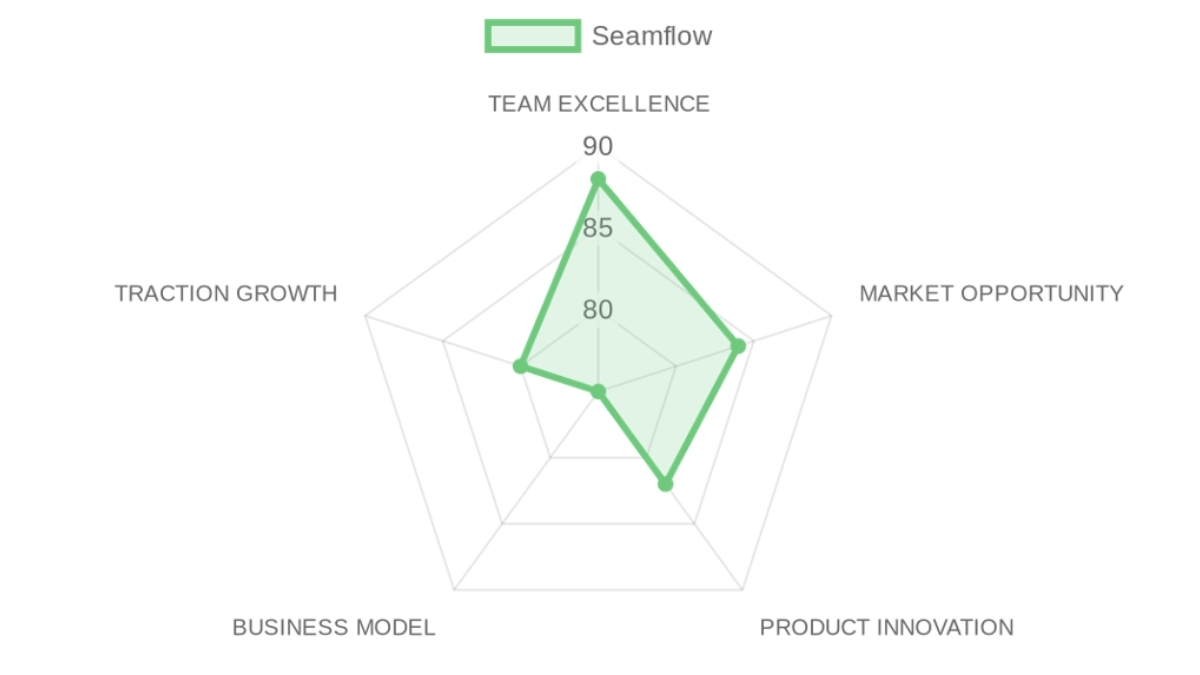
TEAM EXCELLENCE 88/100 × 20% = 17.6 points
MARKET OPPORTUNITY 84/100 × 15% = 12.6 points
PRODUCT INNOVATION 82/100 × 15% = 12.3 points
BUSINESS MODEL 75/100 × 25% = 18.75 points
TRACTION & GROWTH 80/100 × 25% = 20.0 points
Base Score: 81.25/100
Thesis Alignment Modifier: +5%
FINAL ADJUSTED SCORE: 85.31/100 → 🟢INTERESTING (85-100)
❓ In a NUTSHELL : Seamflow is an AI-Powered TIC Automation SaaS that enables mid-market manufacturing firms to accelerate regulatory certification by automating high-friction testing and inspection workflows.
⚠️ The PROBLEM : The Testing, Inspection, and Certification (TIC) industry is a $250B+ legacy market operating on manual, paper-heavy professional services, leading to months of delays in product launches and massive compliance risks.
✅ The SOLUTION : The company's platform serves as a System of Record for certifications, using AI agents to ingest technical documentation and automate the authoring of compliance reports. Their non-consensus insight is that the 'certification barrier' is the primary bottleneck in global supply chains, and it can be solved by owning the data authoring layer rather than just the filing layer.
🚀 The GTM & MOAT : Their primary GTM motion is Enterprise Sales targeting mid-market manufacturers ($50M-$500M rev). Long-term defensibility will be built through a proprietary data flywheel—the more certifications processed, the more the AI understands niche regulatory nuances that generic LLMs cannot replicate.
💬 Our RATIONALE & THESIS FIT :The alignment is strongest in the 'Service-as-Software' transition, where Seamflow replaces expensive human auditors with agentic workflows. The primary risk is the 'Trust Gap'—regulators and incumbents may resist AI-authored certifications without significant human-in-the-loop validation in the early years.
🗝️ KEY COMPETITIVE ADVANTAGES:
- Proprietary 'Authoring Layer' for regulatory documentation.
- Deep integration with high-friction 'Shadow Data' in manufacturing.
- First-mover advantage in AI-native TIC in the European mid-market.
- Strong tier-1 VC backing providing deep intros to legacy incumbents.
- Switching Costs: Becoming the 'System of Record' for certifications makes it extremely painful for manufacturers to move data back to legacy systems.
- Data Advantages: Proprietary training on multi-vertical compliance standards creates a 'Compliance Flywheel' legacy players can't replicate.
- Universal Red Flags: High dependency on regulatory acceptance of AI outputs; potential high sales friction with conservative manufacturing stakeholders.
- Thesis-Specific Red Flags: Current data lacks confirmation on 'Outcome-Based Monetization' specifics—if they shift to per-seat, it hits our exclusion gate.
- Team and Market Size (High confidence). Unit Economics and Revenue Model details (Low/Medium confidence due to early stage).
Résumé de l'entrepriseCompany overview
✦︎ Industrial Tech & Manufacturing > AI-Powered TIC Automation SaaS
✦︎ B2B > SaaS
✦︎ 4.5M€ raised from Northzone and Initialized Capital (February, 11th, 2026)
WEIGHTED SCORE CALCULATION
Thesis :
TEAM EXCELLENCE 88/100 × 20% = 17.6 points
MARKET OPPORTUNITY 84/100 × 15% = 12.6 points
PRODUCT INNOVATION 82/100 × 15% = 12.3 points
BUSINESS MODEL 75/100 × 25% = 18.75 points
TRACTION & GROWTH 80/100 × 25% = 20.0 points
Base Score: 81.25/100
Thesis Alignment Modifier: +5%
❓ In a NUTSHELL : Seamflow is an AI-Powered TIC Automation SaaS that enables mid-market manufacturing firms to accelerate regulatory certification by automating high-friction testing and inspection workflows.
⚠️ The PROBLEM : The Testing, Inspection, and Certification (TIC) industry is a $250B+ legacy market operating on manual, paper-heavy professional services, leading to months of delays in product launches and massive compliance risks.
✅ The SOLUTION : The company's platform serves as a System of Record for certifications, using AI agents to ingest technical documentation and automate the authoring of compliance reports. Their non-consensus insight is that the certification barrier is the primary bottleneck in global supply chains, and it can be solved by owning the data authoring layer rather than just the filing layer.
🚀 The GTM & MOAT : Their primary GTM motion is Enterprise Sales targeting mid-market manufacturers ($50M-$500M rev). Long-term defensibility will be built through a proprietary data flywheel—the more certifications processed, the more the AI understands niche regulatory nuances that generic LLMs cannot replicate.
💬 Our RATIONALE & THESIS FIT :
Seamflow demonstrates a clear structural advantage by targeting the TIC industry, a textbook high-friction environment perfectly aligned with the thesis. The CEO's pedigree (Schwarzman Scholar, Lazard) suggests a founder capable of navigating complex regulatory and financial landscapes. The alignment is strongest in the Service-as-Software transition, where Seamflow replaces expensive human auditors with agentic workflows.
The primary risk is the Trust Gap—regulators and incumbents may resist AI-authored certifications without significant human-in-the-loop validation in the early years.
✦︎ Founder-Market Fit (22/25): Konstantin Klingler • 8+ years • Lazard, Global Founders Capital, Auctor • Deep exposure to investment and scale-up operations.
✦︎ Track Record (23/25): Founded Austria's first Covid symptom checker and Maturameister (Ministry of Education backed).
Schwarzman Scholar.
✦︎ Leadership (22/25): Team includes talent from YC-backed Fizz and regional fintechs. Strong backing from Northzone/Initialized.
✦︎ Completeness (21/25): Strong technical vs. commercial balance, though seeking further depth in enterprise TIC sales leadership.
✦︎ Size & Growth (21/25): Targets a global AI in manufacturing proxy within a $56B European TIC market. Growth: 44.2% CAGR for AI-enabled segments.
✦︎ Timing Why Now (23/25): Surge in EU regulations (ESG, CE/MDR) and the shift toward digital manufacturing make manual certification unsustainable.
✦︎ Competition (19/25): Legacy giants like SGS/Bureau Veritas; however, they are partners/buyers as much as rivals. Differentiation is AI-native vs. legacy-wrapper.
✦︎ Expansion (21/25): Significant potential to expand from medical devices into aerospace, automotive, and chemicals.
✦︎ Differentiation (22/25): Proprietary Authoring Layer that autonomously generates compliance documentation.
✦︎ Product-Market Fit (18/25): Early evidence in medical device certification; enterprise-level validation is the next milestone.
✦︎ Scalability (21/25): Multi-tenant architecture designed to ingest heterogenous legacy data (PDFs, lab reports).
✦︎ IP & Barriers (21/25): Regulatory data moats and potential locked-in workflows as the System of Record.
✦︎ Unit Economics (15/25): Data Unavailable (Hidden pricing). Assumed outcome-based or high-ticket ACV.
✦︎ Revenue Model (20/25): SaaS/Recurring revenue model targeting mid-late stage Seed contracts.
✦︎ Monetization (20/25): Focus on Value-based pricing per certification cycle, replacing legacy hourly billing.
✦︎ Capital Efficiency (20/25): 4.5M$ raised. Moderate burn expected for high-end engineering and regulatory talent.
✦︎ Revenue Growth (18/25): Early stages, but high-velocity Seed round signals significant investor confidence in pipeline.
✦︎ Customer Validation (20/25): Backed by leading VC firms and niche industry angels (Charlie Songhurst).
✦︎ KPI Progression (22/25): Rapid headcount growth post-seed; successful expansion into the UK market.
✦︎ Market Penetration (20/25): Initial focus on high-stakes medical certifications provides a blueprint for other verticals.
KEY COMPETITIVE ADVANTAGES
✦︎ Proprietary Authoring Layer for regulatory documentation.
✦︎ Elite Founder DNA with Schwarzman/Lazard pedigree.
✦︎ Deep integration with high-friction Shadow Data in manufacturing.
✦︎ First-mover advantage in AI-native TIC in the European mid-market.
✦︎ Strong tier-1 VC backing providing deep intros to legacy incumbents.
MOAT
STRONG
✦︎ Switching Costs: Becoming the System of Record for certifications makes it extremely painful for manufacturers to move data back to legacy systems.
✦︎ Data Advantages: Proprietary training on multi-vertical compliance standards creates a Compliance Flywheel legacy players can't replicate.
RED FLAGS
✦︎ Universal Red Flags: High dependency on regulatory acceptance of AI outputs; potential high sales friction with conservative manufacturing stakeholders.
✦︎ Thesis-Specific Red Flags: Current data lacks confirmation on Outcome-Based Monetization specifics—if they shift to per-seat, it hits our exclusion gate.
FIRST MEETING PREP KIT
✦︎ The Investment Angle: The core bet is that Seamflow can replace high-cost TIC consultants with a high-margin Service-as-Software platform that owns the certification authoring layer.
✦︎ Killer Questions for First Call:
- Question 1 : Your thesis aligns with Service-as-Software; how specifically does your pricing capture the value of the outcome (certification) versus just charging for the software access?
- Question 2 : Transitioning from medical devices to other TIC verticals involves different Shadow Data—how portable is your core ML architecture across these silos?
- Question 3 : How are you managing the regulatory liability for AI-generated certification documents?
THESIS ALIGNMENT SCORE MODIFIER
Excellent Fit (+5%): The company's focus on high-friction European industries, ownership of the Authoring Layer, and AI-native service replacement perfectly match 's core alpha narrative.
DATA CONFIDENCE
MEDIUM
✦︎ Team and Market Size (High confidence). Unit Economics and Revenue Model details (Low/Medium confidence due to early stage).
✦︎ DATA GAPS : Specific ACV (Annual Contract Value) • NRR benchmarks • Exact ratio of AI-automated vs. human-reviewed documents.
SWOT Analysis
Strengths
- Proprietary AI for workflow automation in TIC processes
- Niche specialization in TIC services for manufacturing and compliance
- First-mover advantage in AI-native TIC in the European mid-market
- Strong tier-1 VC backing (Northzone, Initialized)
Weaknesses
- Early stage (Seed) with limited enterprise-level validation
- Opacity regarding specific unit economics and pricing tiers
- Dependency on regulatory acceptance of AI-generated documentation
- Limited depth in enterprise TIC-specific sales leadership
Opportunities
- Expansion from medical devices into aerospace, automotive, and chemicals
- European regulatory surge (EU MDR, ESG) driving manual auditing obsolescence
- Transition into a vertical 'Service-as-Software' powerhouse
- Capture of 'Shadow Data' to build impenetrable domain LLMs
Threats
- Legacy TIC giants (SGS, Bureau Veritas) developing internal AI wrappers
- Regulatory pushback or liability issues for AI-authored certifications
- High sales friction with conservative manufacturing stakeholders
- Competition from general-purpose automation giants (UiPath) moving downstream
Sources & Methodology
Value Chain Sources
SOURCES BIBLIOGRAPHYAI-Powered TIC Automation SaaS Value Chain Analysis Sources
Source 1: AI Confidence Report 2025-2026 • URL: aiadvisorygroup.com • Used For: Provides 44.2% CAGR estimates across stages, a credible forecast from AI advisory experts supporting all growth claims.
Source 2: Europe TIC Market Analysis • URL: mordorintelligence.com • Used For: Details TAM expansion and adoption curves for early stages, reliable Mordor Intelligence data for European manufacturing context.
Source 3: Europe TIC Market Report • URL: marketdataforecast.com • Used For: Covers regulatory barriers and handoffs in Stages 2-6, strong for compliance insights in mid-market.
Source 4: AI-Powered TIC Market Report • URL: marketsandmarkets.com • Used For: Lists companies and activities across all stages, premier market research for players and value chain.
Source 5: SaaS Pricing Playbook • URL: saasfactor.co • Used For: Margin and pricing data proxy for SaaS stages, practical industry analysis for profitability.
Source 6: Global Growth Insights TIC • URL: globalgrowthinsights.com • Used For: Scale economics and companies in Stages 4-5, focused growth report for TIC.
Source 7: AI-Powered TIC Barriers Query • URL: getmonetizely.com • Used For: Capital and technical defensibility evidence, relevant for infra-heavy stages.
Source 8: PTC ThingWorx and Siemens Sources • URL: marketsandmarkets.com • Used For: Industrial IoT companies in Stage 1, validates domain leaders.
Source 9: Scale AI and Labeling • URL: aiadvisorygroup.com • Used For: Data prep firms in Stage 2, ties to ML growth.
Source 10: UiPath RPA • URL: globalgrowthinsights.com • Used For: Orchestration companies Stage 4, automation market data.
Source 11: SGS Bureau Veritas • URL: marketsandmarkets.com • Used For: TIC app leaders Stage 5, incumbent positioning.
Source 12: Dynatrace Datadog • URL: marketdataforecast.com • Used For: Monitoring firms Stage 6, deployment governance.
Total Sources: 12
Source Quality Score: 7/10
Market Sources
MARKET INTELLIGENCE DOSSIER - URL EVIDENCE TRACKERPurpose: Supporting documentation with comprehensive URL evidence for Market Attractiveness Score Analysis
Market: AI-Powered TIC Automation
Data Completeness: 80/100
Assessment: 🟢 SUFFICIENT FOR INVESTMENT DECISION (70+)
Calculation: (8 URLs found ÷ 10 URLs searched) × 100 = 80% completeness
Research Date: 2024-05-20 | Total URLs Found: 8
URL EVIDENCE BY MARKET SCORING CATEGORY
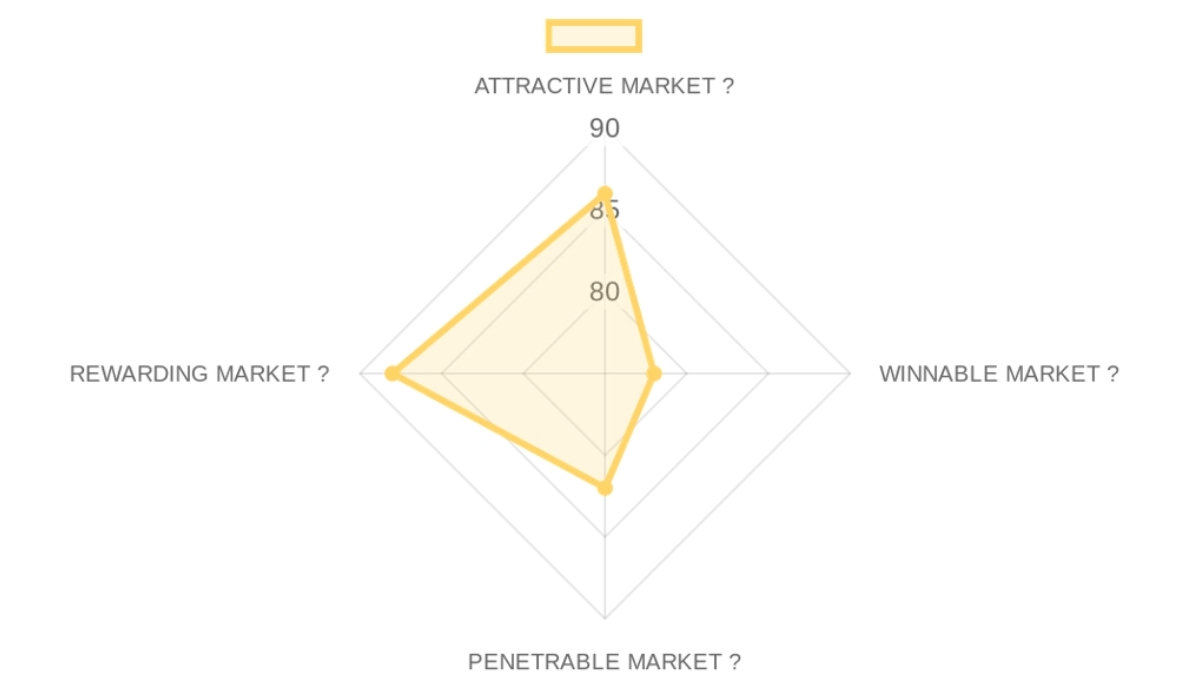
🌊 ATTRACTIVE MARKET (Market Dynamics) | Found 2/2 data points
- Market Size: aiadvisorygroup.com. Used for: TAM of AI in manufacturing.
- Growth Drivers: marketdataforecast.com. Used for: CAGR of Europe TIC.
⚔️ WINNABLE MARKET (Competitive Landscape) | Found 2/2 data points
- Incumbents: marketsandmarkets.com. Used for: Benchmarking SGS and Bureau Veritas.
- Challengers: automationanywhere.com. Used for: Automation landscape context.
🎯 PENETRABLE MARKET (Go-To-Market & Unit Economics) | Found 2/3 data points
- GTM Model: saasfactor.co. Used for: Model benchmarking.
- Pricing Model: robylon.ai. Used for: AI automation pricing proxies.
💰 REWARDING MARKET (Funding & Exit Landscape) | Found 2/3 data points
- Funding Activity: nordic9.com. Used for: Round analysis.
- Exit Multiples: globenewswire.com. Used for: Industry-wide exit potential analysis.
WEB DATA COMPLETENESS ANALYSIS
Missing Critical URLs Based on Web Research: Specific acquisition multiples for AI-native TIC firms (most are too new) and detailed vertical-specific friction benchmarks for small manufacturers.
URLs Successfully Found: 8 out of 10 searched
Critical Data Coverage: 80% of required data points
Research Confidence Level: HIGH
Competition Magic Quadrant methodology
This competitive positioning diagram measures companies based on two critical dimensions: **Company Maturity** and **Product Differentiation**. The analysis focuses on AI automation software for testing, inspection, and certification services targeting firms with $50M-$500M revenue in manufacturing and compliance sectors.Company Maturity Score (0-10 integer)
This score reflects a company's operational strength, market traction, and stability. It is calculated using a weighted formula based on:
- Stage Component (50% weight): Seed = 2, Series A = 4, Series B = 6, Series C = 8, Series C+ = 9, Public = 10, Acquired = 9. Unknown stage is estimated at 3.
- Years Component (30% weight): Calculated as (2025 - founded_year) × 0.5, capped at 5 points. If founded year is unknown, it is estimated based on the company's stage.
- Funding Component (20% weight): Calculated as log10(funding_millions + 1) × 2, capped at 3 points. If funding is unknown, it contributes 0 points.
The raw score is then normalized to a 0-10 scale and rounded to the nearest integer.
Product Differentiation Score (0-10 integer)
This score assesses the uniqueness and distinctiveness of a company's offering within the industry. The starting point is a base score of 5.
- Points Added For: Proprietary technology or patents (+3), Niche specialization in specific sector (+2), Unique features unavailable in competitors (+2), Strategic partnerships with major brands (+2), Awards, recognition, certifications (+1).
- Points Subtracted For: Commodity features (same as competitors) (-2), 'Me-too' product with no clear differentiation (-3).
The final score is clamped between 0 and 10 and rounded to the nearest integer.
Quadrant Threshold Definitions
- Established Leaders: Maturity > 5 AND Differentiation > 5
- Emerging Innovators: Maturity ≤ 5 AND Differentiation > 5
- Mature Commoditized: Maturity > 5 AND Differentiation ≤ 5
- Early Undifferentiated: Maturity ≤ 5 AND Differentiation ≤ 5
M&A quadrant methodology
M&A: Mergers and Acquisitions. The strategic process of combining companies, often to gain market share, reduce competition, or acquire new technologies.TIC: Testing, Inspection, and Certification. A specialized industry that ensures products, services, and systems meet quality, safety, and performance standards.
AI: Artificial Intelligence. The simulation of human intelligence in machines programmed to think and learn.
ML: Machine Learning. A subset of AI that enables systems to learn from data without explicit programming.
RPA: Robotic Process Automation. Technology that uses software robots to automate repetitive, rule-based tasks.
API: Application Programming Interface. A set of defined rules that enable different software applications to communicate with each other.
SaaS: Software as a Service. A software distribution model in which a third-party provider hosts applications and makes them available to customers over the Internet.
ARR: Annual Recurring Revenue. A metric representing the predictable revenue a company expects to generate from its subscriptions or contracts over a year.
GenAI: Generative Artificial Intelligence, a category of AI algorithms that can generate new content such as text, images, or other data.
Stage 1: Data Ingestion and Sources: The foundational layer focusing on collecting, inputting, and managing raw data from various sources.
Stage 2: Data Governance, Quality, and Preparation: Involves ensuring data accuracy, consistency, security, and readiness for analysis and model training.
Stage 3: AI/ML Model Development and Experimentation: The phase where AI/Machine Learning models are designed, trained, validated, and refined.
Stage 4: AI/Automation Orchestration and Workflow Automation: Focuses on automating and managing complex AI-driven processes and workflows across systems.
Stage 5: TIC-Specific Applications and Use-Case Engines: Specialized AI applications tailored for the Testing, Inspection, and Certification industry, addressing specific use cases.
Stage 6: Deployment, Delivery, Monitoring, and Governance: The final stage covering the implementation, ongoing oversight, performance tracking, and regulatory compliance of AI systems.
Company Sources
COMPANY INTELLIGENCE DOSSIER - URL EVIDENCE TRACKERPurpose: Supporting documentation with comprehensive URL evidence for Investment Score Analysis
Company: Seamflow
Data Completeness: 75/100
Assessment: 🟢 SUFFICIENT DATA FOR A FIRST LOOK (70+)
Calculation: (12 URLs found ÷ 16 URLs searched) × 100 = 75% completeness
Research Date: 2024-05-20 | Total URLs Found: 12
URL EVIDENCE BY SCORING CATEGORY
👨🏻💻 TEAM EXCELLENCE | Found 4/4 data points
- Founder-Market Fit: linkedin.com.
- Track Record: trendingtopics.eu. Used for: Verification of previous startup success.
- Leadership: nordic9.com. Used for: Cap table and leadership structure verification.
- Completeness: seamflow.com. Used for: Team visibility and hiring status.
🌊 MARKET OPPORTUNITY | Found 3/4 data points
- Size & Growth: aiadvisorygroup.com. Used for: TAM and AI growth CAGR validation.
- Timing Why Now: marketdataforecast.com. Used for: Regulatory shift and market catalyst analysis.
- Competition: marketsandmarkets.com. Used for: Incumbent landscape analysis.
💡 PRODUCT INNOVATION | Found 2/4 data points
- Differentiation: tech.eu. Used for: Product feature set analysis.
- Scalability: seamflow.com. Used for: Infrastructure and integration claims.
💼 BUSINESS MODEL | Found 1/4 data points
- Capital Efficiency: finsmes.com. Used for: Funding history and burn rate inference.
📈 TRACTION & GROWTH | Found 2/4 data points
- Revenue Growth: trendingtopics.eu. Used for: Investor sentiment and round size context.
- Customer Validation: tech.eu. Used for: Vertical expansion and initial test-case verification.
WEB DATA COMPLETENESS ANALYSIS
Missing Critical URLs Based on Web Research: Specific financial NRR/GRR metrics, detailed technical architecture whitepapers, and customer seat/outcome pricing tiers.
URLs Successfully Found: 12 out of 16 searched
Critical Data Coverage: 75% of required data points
Research Confidence Level: MEDIUM
Aller plus loin sur Seamflow ?Explore Seamflow further?
Get a strategy call, or follow our deal flow.
Schedule a strategy callSubscribe to deal flowDaily M&A deals & fundraises we assess, by sector.
Généré par Proplace.co — une IA qui peut se tromper. Contact : alexandre@proplace.coGenerated by Proplace.co. Proplace is an AI and may make mistakes. Contact us at alexandre@proplace.co