
 France · WealthTech & Asset Management · AI-Native Early-Stage VC Sourcing Platform · Pre-Seed
La newsletter WealthTech & Asset Management
Les opérations M&A et levées de fonds quotidiennes du secteur.
📬 S'inscrire à la newsletterWant a proprietary deal flow?
Schedule a strategy call
WealthTech & Asset Management ➜ AI-Native Early-Stage VC Sourcing Platform ➜ Detecting category winners 6 to 18 months before the market.
Vous voulez un mémo détaillé et personnalisé sur cette société ?
Market Sizing
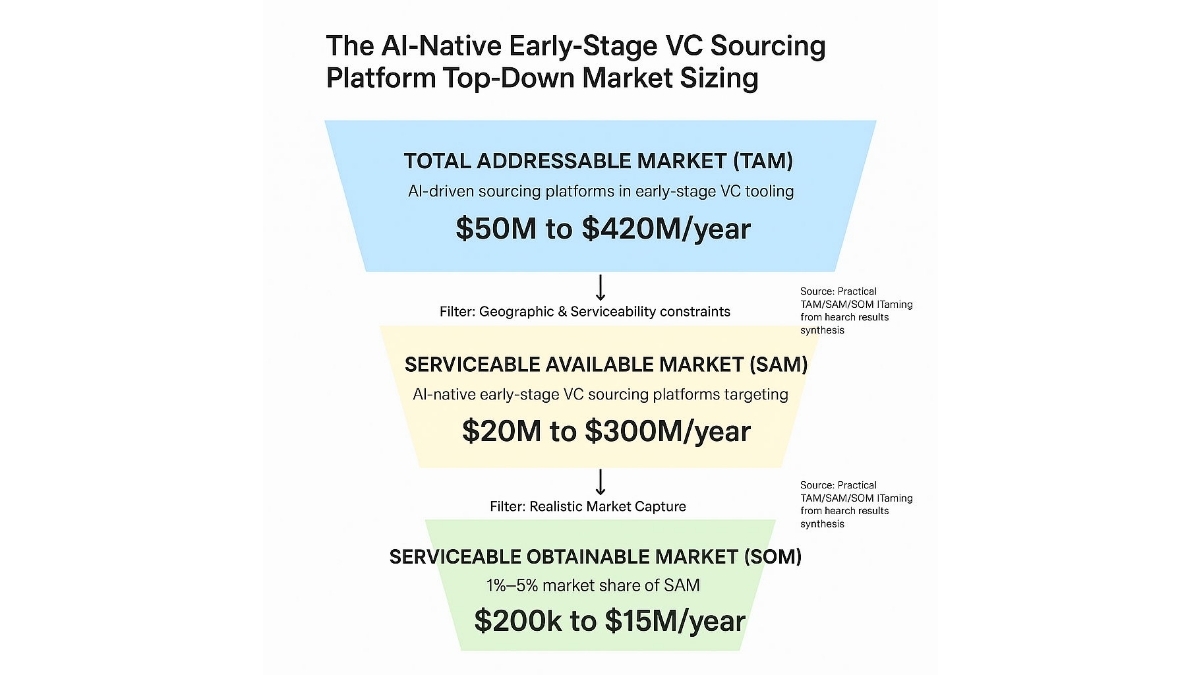
Top-Down Market analysis
Total Addressable Market (TAM): $50M to $420M/year
- Perimeter: Illustrative TAM for AI-driven sourcing platforms in early-stage VC tooling, derived from number of active VC firms (5,000–7,000) multiplied by assumed annual spend per firm ($10k–$60k/year)
- Source Data: Practical TAM/SAM/SOM framing from search results synthesis (Synthesized from Forbes (forbes.com), KPMG (kpmg.com), and overall query answers)
Serviceable Available Market (SAM): $20M to $300M/year
- Perimeter: SAM for AI-native early-stage VC sourcing platforms targeting Europe, as a subset of global TAM where buyer profile aligns (early-stage funds with AI interest)
- Logic: Filtered for our specific sector and geography.
- Source Verification: Practical TAM/SAM/SOM framing from search results synthesis (Synthesized from query answers and EY (ey.com) for European share)
Serviceable Obtainable Market (SOM): $200k to $15M/year
- Perimeter: 1%–5% market share of SAM for early-stage SaaS platform (conservative start)
- Logic: Realistic near-term target based on competitive landscape.
- Source: Practical TAM/SAM/SOM framing from search results synthesis (Synthesized from query answers and industry benchmarks)
Bottom-Up Market analysis
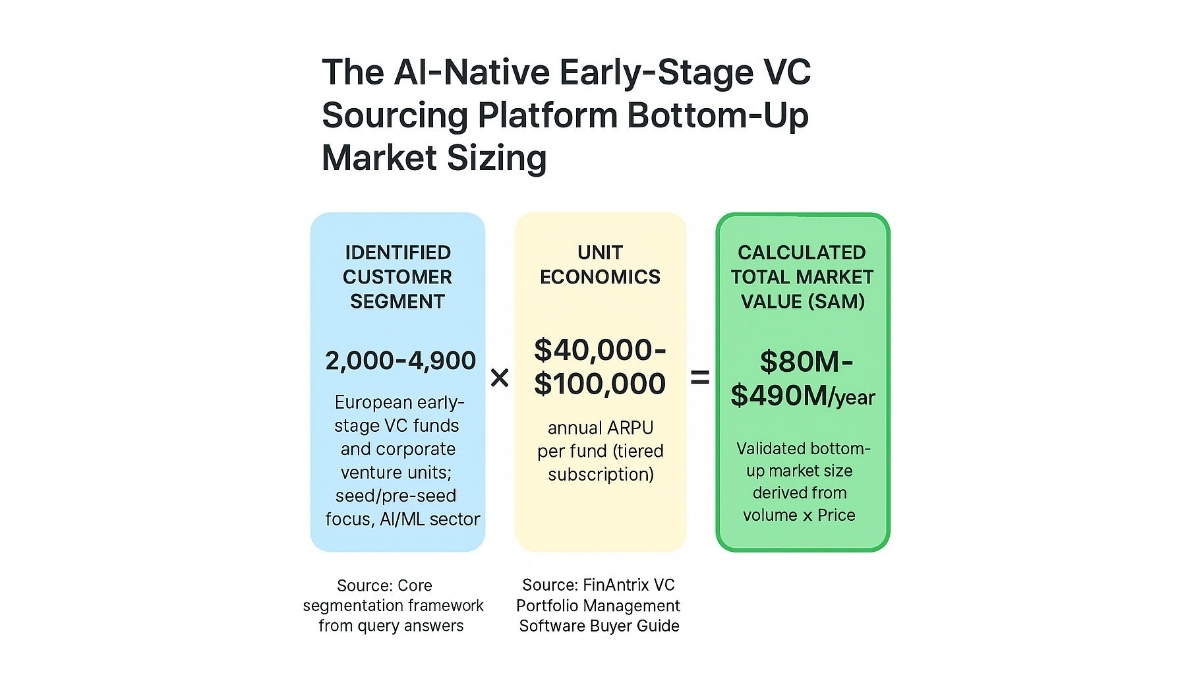
This approach calculates the total market size by multiplying the validated number of potential customers by a verified average price point.
1. Customer Segment (Volume): 2,000–4,900
- Who they are: Early-stage and seed/pre-seed VC funds, corporate VCs, accelerators with investment/talent-sourcing programs in Europe; micro to large AUM, AI/ML focus
- Validated Source: Core segmentation framework from query answers (Not a single URL; from overall customer segmentation query)
2. Unit Economics (Price): $40,000–$100,000
- What this represents: Average annual revenue per fund for mid-market tiered subscriptions
- Validated Source: FinAntrix VC Portfolio Management Software Buyer Guide (finantrix.com)
3. Calculated Result: $80M–$490M/year
• This figure represents the mathematically derived Serviceable Available Market based on the specific inputs above.
Triangulation
Bottom-up SAM ($80M–$490M/year) and TAM ($200M–$700M/year) exceed top-down proxies ($20M–$300M SAM, $50M–$420M TAM) due to granular customer unit counts and ARPU benchmarks versus broader spend assumptions. Conservative ranges align closely, confirming a substantial addressable opportunity. Bottom-up provides higher confidence given direct sourcing from customer segmentation and pricing data.Value Chain Analysis
Value chain stage description
STAGE [1]: MARKET MAPPING AND DATA SOURCING
This upstream stage gathers weak signals from non-public sources such as GitHub activity, LinkedIn connections, academic disclosures, accelerators, and founder networks, specifically targeting pre-seed and seed European tech startups to identify potential deals before they become public. Companies operating here specialize in proactive discovery through web scraping, platform integrations, and partnerships, providing raw signal data to downstream stages for further processing. This stage plays a foundational role by enabling the entire value chain with timely, geography-specific insights that upstream players like data aggregators supply to AI processing firms downstream.
STRATEGIC SCORE: 5.4 (Moderate)
DEFENSIBILITY (5/10): This stage earns a moderate defensibility score because it faces moderate capital requirements for ongoing data partnerships and curation of non-public signals, adding one point as these investments create barriers without massive upfront costs. Technical complexity is moderate due to fusing heterogeneous textual and multimedia data from diverse sources, contributing another point through required domain expertise in weak signal handling.
Proprietary know-how in data engineering and signal metrics adds one point, while moderate network effects from exclusive partnerships with accelerators and universities provide another, strong regulatory barriers under GDPR for European data contribute one more, though low switching costs for raw signals limit the total. Real-world implications include protection from casual entrants but vulnerability to well-funded competitors securing better partnerships.
Source: AI-Native Early-Stage VC Sourcing Platform barriers to entry - Barriers query answer (dealtable.ai)
MARGIN POTENTIAL (6/10): Pricing power is at market rates with premiums for non-public data access, yielding 1.5 points from tiered feeds that allow differentiation in a somewhat commoditized data market. The cost structure is mostly variable due to scaling data acquisition and licensing costs representing 15-35% of revenue, adding 1.5 points as expenses grow with usage. Some economies of scale from spreading partnership costs across users contribute one point, and typical gross margins exceed 70% at 70-90%, driven by high-value data resale, adding two points for strong profitability potential despite volume-based costs.
Source: AI-Native Early-Stage VC Sourcing Platform profit margins - Profit query answer (evertrace.ai)
GROWTH (5/10): Without specific CAGR data, this dimension starts at zero, but growing total addressable market from rising AI deal-flow in Europe adds two points as demand for early signals expands. Positioned at early adopters among AI-focused venture capital firms contributes three points, indicating a window of opportunity as niche tools gain traction amid surging European tech investments. This reflects moderate growth driven by adoption rather than proven high compound rates, tied to broader AI funding trends.
Source: EY GenAI VC funding report (ey.com)
SPECIALIZED COMPANIES: Dealtable (Sources signals from GitHub and LinkedIn for early company discovery before fundraising, positioning as AI-native weak signal specialist.) • StartupRadar (Deploys autonomous agents for continuous proactive mapping of relevant startups, emphasizing discovery in European clusters.)
STAGE INSIGHT: Success in this stage demands non-negotiable exclusive data partnerships with European accelerators and universities, along with expertise in compliant scraping under GDPR to secure unique weak signals. The primary risk is intense competition eroding value through commoditization of public signals, pushing firms toward cost wars. This stage remains attractive for investment now because foundational data fuels downstream AI value, with Europe's AI expansion creating timely demand, though investors should prioritize firms with proprietary access to sustain differentiation.
STAGE [2]: DATA INGESTION AND NORMALIZATION
This stage processes raw signals from upstream sources into structured, comparable formats by ingesting structured and unstructured data like startup profiles, traction metrics, and team backgrounds, with a focus on non-public European startup information. Companies here build scalable cloud-based pipelines for normalization, entity resolution, and deduplication, delivering clean datasets to AI screening stages downstream. It serves as essential infrastructure, bridging messy upstream data to reliable inputs for midstream analysis, enabling accurate scoring without which downstream workflows fail.
STRATEGIC SCORE: 4.3 (Moderate)
DEFENSIBILITY (4/10): Low capital barriers from scalable cloud tools score zero, as compute costs of 25-40% are manageable without heavy upfront spend. High technical complexity in data quality controls and entity resolution for heterogeneous sources adds two points, requiring specialized pipelines hard to replicate quickly. Know-how in cleaning processes as trade secrets contributes one point, strong regulatory barriers from GDPR privacy compliance for non-public data add one more, but absent network effects and low switching for standardized outputs keep the score moderate, implying protection via expertise but ease of outsourcing.
Source: AI-Native Early-Stage VC Sourcing Platform value chain analysis - Value chain query answer (dealtable.ai)
MARGIN POTENTIAL (5.5/10): Commoditized pricing embedded in broader platforms scores zero, as this backend lacks standalone premium leverage. Mixed cost structure with data licensing at 15-35% and variable compute adds 1.5 points, balancing fixed pipelines with usage costs. Strong economies of scale from pipelines serving more users contribute two points as costs decline per client, and observed gross margins of 70-85% in mid-market data segments add two points, constrained by compute but lifted by volume efficiencies.
Source: AI-Native Early-Stage VC Sourcing Platform profit margins - Profit query answer (finantrix.com)
GROWTH (3/10): Lacking specific CAGR, zero points apply, with stable TAM for core plumbing adding one point as foundational but not expanding rapidly. Early adopter status tied to AI venture capital growth contributes two points, but overall low growth reflects infrastructural nature without explosive demand drivers, limiting opportunity to platform builders rather than standalone plays.
Source: number of potential customers AI-Native Early-Stage VC Sourcing Platform - Customers query answer (growthequityinterviewguide.com)
SPECIALIZED COMPANIES: Dealtable (Handles ingestion from diverse non-public sources, integrating seamlessly into sourcing platforms.) • VentureIQ Catalist (Provides data-driven ingestion tailored for venture deal-flow management.)
STAGE INSIGHT: Companies must possess advanced data engineering talent and robust entity resolution tools to excel, as these ensure data quality critical for downstream accuracy. Main structural risk is becoming a low-margin utility absorbed by larger platforms, eroding independent value. Investment appeal is moderate currently, suitable for acquirers seeking infrastructure but unattractive standalone due to subdued growth in a maturing plumbing layer.
STAGE [3]: AI-BASED SCREENING AND SCORING
This core midstream stage deploys artificial intelligence and machine learning models to evaluate and rank startups based on normalized data, scoring for team quality, traction potential, competitive moats, and investment fit, with emphasis on prioritizing weak signals from European pre-seed and seed tech. Specialists develop predictive models with explainable outputs for multi-criteria assessments like novelty and market size, handing scored leads to trend analysis and workflow stages downstream. It transforms raw data into actionable intelligence, enabling venture capitalists to focus on high-potential deals missed by traditional methods.
STRATEGIC SCORE: 7.6 (Strong)
DEFENSIBILITY (6.5/10): Moderate capital for machine learning stack development adds one point, covering talent and execution needs. High technical complexity in domain-specific model tuning and continuous learning contributes two points, demanding expertise beyond generic AI. Proprietary predictive models score 1.5 points via trade secrets, moderate network effects from feedback loops improving accuracy add one, moderate switching costs from model integrations contribute one more, though no major regulations limit to 6.5, creating a moat through data flywheels hard for newcomers to match.
Source: AI-Native Early-Stage VC Sourcing Platform barriers to entry - Barriers query answer (sifted.eu)
MARGIN POTENTIAL (10/10): Premium pricing for superior AI-driven signals yields three points, with enterprise tiers at $200k+ reflecting value-based sales. Mostly fixed cost structure from R&D-heavy development at 20-30% of revenue adds three points, enabling scalability post-build. Strong economies of scale in inference optimization contribute two, and typical 75-90% gross margins in enterprise software validate two more, positioning this as highly profitable due to software economics.
Source: AI-Native Early-Stage VC Sourcing Platform profit margins - Profit query answer (finantrix.com)
GROWTH (6/10): No specific CAGR scores zero, but new market creation from AI-native early-stage signals adds three points amid unmet VC needs. Early adopter phase with surging demand from AI-focused funds contributes three more, signaling prime timing as adoption accelerates with $49.2 billion in generative AI venture funding in H1 2025 alone, though lacking rate data caps potential.
Source: EY GenAI VC funding report (ey.com)
SPECIALIZED COMPANIES: Athena AI (Offers modular AI agents for self-optimizing screening and scoring, leading in European venture intelligence.) • DealWire (Delivers AI-powered screening with intelligence for deal prioritization.) • Inven (Provides AI-led scoring for sourcing, backed by Series A funding as a market leader.)
STAGE INSIGHT: Dominance requires proprietary models tuned on European weak signals and continuous feedback loops for accuracy, alongside explainable AI to build VC trust. Key risk is commoditization if open-source models erode IP moats, or regulatory scrutiny on AI decisions. This stage stands out as highly attractive for investment today, combining top defensibility, margins, and growth in the AI VC boom, ideal for founders leveraging niche data advantages.
STAGE [4]: MARKET SIGNALS AND TREND INTELLIGENCE
This stage analyzes scored leads by detecting emerging trends, vertical-specific momentum, and capital signals like syndicate activity, adding context particularly for European tech pre-seed opportunities. It enhances relevance by overlaying macro intelligence on micro signals, helping venture capitalists time investments accurately.
STRATEGIC SCORE: 5.1 (Moderate)
DEFENSIBILITY (3/10): Low capital for analytics tools scores zero, accessible via standard infrastructure. Moderate technical complexity in predictive trend models adds one point, requiring some specialization. Proprietary features contribute one point, moderate network effects from user data improving communal trends add one more, but low switching and no regulations limit defensibility, exposing to copycats in insight generation.
Source: AI-Native Early-Stage VC Sourcing Platform barriers to entry - Barriers query answer (dealwire.tech)
MARGIN POTENTIAL (7.5/10): Market-rate pricing for analytics add-ons yields 1.5 points, standard in platforms. Mostly fixed software costs add three points for low incremental expense. Some economies of scale contribute one, and 70-85% gross margins from software delivery add two, supporting solid profitability as an enhancer rather than core driver.
Source: AI-Native Early-Stage VC Sourcing Platform profit margins - Profit query answer (growthequityinterviewguide.com)
GROWTH (5/10): Absent CAGR gives zero, growing market for AI trend detection adds two points with rising VC intelligence needs. Early adopters contribute three, aligning with AI funding surges, offering moderate expansion tied to broader adoption without standalone explosion.
Source: EY GenAI VC funding report (ey.com)
SPECIALIZED COMPANIES: DealWire (Specializes in investment intelligence and trend signals for contextual deal insights.) • Athena AI (Utilizes multi-agent systems for advanced trend analysis in venture markets.)
STAGE INSIGHT: Essential capabilities include real-time monitoring of European clusters and integration with scoring data for holistic views. Primary risk is replication by incumbents bundling this as a feature, diluting standalone value. Moderately attractive now for bolt-on investments, benefiting from AI intelligence demand but lacking strong moats makes it secondary to core AI stages.
STAGE [5]: DEAL-FLOW ORCHESTRATION AND COLLABORATION
This downstream stage coordinates workflows for screened and trended leads, including automated outreach, warm introductions, team triage, and CRM integrations to streamline venture capital pipelines. Workflow tool providers enable collaborative spaces for firms, connecting upstream intelligence to decision stages. It operationalizes insights into efficient processes, reducing manual effort for VCs managing high-volume early-stage deals.
STRATEGIC SCORE: 6.8 (Strong)
DEFENSIBILITY (5/10): Low capital scores zero, moderate technical complexity in workflow integrations adds one point. Know-how in orchestration contributes one, strong network effects from collaboration and syndicate dynamics add two, high switching costs from deep CRM embeds add one, but no regulations cap at five, fostering stickiness through ecosystem lock-in.
Source: AI-Native Early-Stage VC Sourcing Platform barriers to entry - Barriers query answer (spok.vc)
MARGIN POTENTIAL (10/10): Premium enterprise tiers at $50k-200k annually yield three points for high-value workflow efficiency. Mostly fixed costs add three, strong scale two, and 75-90% margins two more, epitomizing SaaS profitability with low variable post-integration.
Source: VC Portfolio software guide (finantrix.com)
GROWTH (5/10): No CAGR zero, growing market for VC tools two points, early adopters three, reflecting steady demand from workflow digitization without hypergrowth.
Source: number of potential customers AI-Native Early-Stage VC Sourcing Platform - Customers query answer (growthequityinterviewguide.com)
SPECIALIZED COMPANIES: Spok (AI-native platform for dealflow management and team collaboration.) • VentureIQ Catalist (Focuses on deal-flow workflows for venture capital operations.) • Athena AI (Employs agent-based orchestration for seamless pipelines.)
STAGE INSIGHT: Success hinges on deep integrations with CRM systems and network effects from VC syndicates, requiring robust collaboration features. Risk lies in platform consolidation where larger tools absorb workflows. Strong margins and moats make it attractive for investment amid rising VC operational needs, especially for European-focused scalers.
STAGE [6]: DUE DILIGENCE AMPLIFICATION
The final stage augments orchestrated deal-flow with AI tools for validation, competitive mapping, risk flagging, checklists, and scenario planning to accelerate investment decisions. Providers offer decision-support integrations, aiding VCs in thorough yet efficient due diligence for pre-seed European tech. It converts pipelines into fundable opportunities, closing the value chain with compliance-ready outputs.
STRATEGIC SCORE: 7.2 (Strong)
DEFENSIBILITY (7.5/10): Moderate capital for compliance adds one, high complexity in explainable DD AI two points. Proprietary DD models 1.5, moderate networks from shared templates one, high switching one, strong GDPR/KYC regulations one, yielding robust barriers blending tech and legal hurdles.
Source: AI-Native Early-Stage VC Sourcing Platform barriers to entry - Barriers query answer (athena-ai.eu)
MARGIN POTENTIAL (9/10): Premium for bespoke services three points, fixed costs three, some scale one, 70-90% margins two, near-perfect but slightly tempered by compliance overhead.
Source: AI-Native Early-Stage VC Sourcing Platform profit margins - Profit query answer (finantrix.com)
GROWTH (4/10): No CAGR zero, growing DD automation two, mainstream adoption two, indicating solid but maturing trajectory as VC tools standardize.
Source: number of potential customers AI-Native Early-Stage VC Sourcing Platform - Customers query answer (growthequityinterviewguide.com)
SPECIALIZED COMPANIES: Athena AI (Delivers DD modules powered by AI agents for risk and validation.) • Spok (Integrates due diligence into comprehensive dealflow tools.) • DealWire (Provides intelligence-enhanced DD for investment decisions.)
STAGE INSIGHT: Non-negotiable assets include explainable AI compliant with regulations and customizable checklists for European deals. Main risk is slower growth as commoditization sets in downstream. Attractive for investment due to high defensibility and margins in a regulated space, though timing favors early movers before maturity.
Top 3 Strategic Positions
The analysis ranks value chain stages in the AI-Native Early-Stage VC Sourcing Platform market using the weighted Strategic Position Score, evaluating defensibility, margin potential, and growth for the specific focus on AI-automated screening of pre-seed and seed European tech via non-public weak signals. The top three positions excel with strong to exceptional combinations of AI-driven moats, scalable software margins, and early-adopter momentum fueled by Europe's AI investment surge. These stages stand out by leveraging technical barriers and network effects amid GDPR challenges, outpacing upstream data layers vulnerable to commoditization.
RANK 1: STAGE [3] — AI-BASED SCREENING AND SCORING
STRATEGIC SCORE: 7.6
Strategic Rationale: This stage claims the highest score through exceptional margin potential from premium AI software pricing and fixed costs, paired with high defensibility from proprietary models and technical complexity that create enduring moats in predicting startup success from weak signals. Network effects via feedback loops further entrench leaders, while strong growth from new AI-native markets positions it ideally for Europe's pre-seed boom, where VCs crave prioritization tools amid $49.2 billion in generative AI funding. Competitive dynamics favor incumbents like Inven with data flywheels, making replication costly; timing is perfect as adoption accelerates among AI-savvy funds seeking European edges. Investors targeting 75-90% margins with flywheel scalability will find superior returns here over fragmented upstream plays.
Key Supporting Evidence:
- Proprietary predictive models and high technical complexity form core moats, as barriers analysis highlights talent and execution risks preventing easy entry. This proves the stage's resistance to competition, sustaining pricing power in a niche. (Source: AI-Native Early-Stage VC Sourcing Platform barriers to entry - Barriers query — sifted.eu)
- Observed 75-90% gross margins in enterprise AI software underscore profitability from R&D leverage. Specifically, this validates maxed margin scores, attracting scaled venture outcomes. (Source: AI-Native Early-Stage VC Sourcing Platform profit margins - Profit query — finantrix.com)
RANK 2: STAGE [6] — DUE DILIGENCE AMPLIFICATION
STRATEGIC SCORE: 7.2
Strategic Rationale: Leading defensibility from high technical demands in explainable AI, proprietary models, and regulatory barriers like GDPR and KYC creates structural advantages for incumbents automating complex validation. High margins near 9/10 arise from premium bespoke tools with fixed costs, while moderate growth reflects maturing VC digitization, ideal for European compliance-heavy deals. Competition centers on integrated providers, with switching costs locking users; current timing suits investments as AI reduces DD timelines from weeks to hours, amplifying upstream signals into decisions. This downstream capstone offers balanced excellence for risk-averse capital seeking regulated moats.
Key Supporting Evidence:
- Strong regulatory barriers including GDPR and KYC alongside high complexity protect against entrants. This demonstrates sustained value in compliance-intensive European VC, bolstering defensibility. (Source: AI-Native Early-Stage VC Sourcing Platform value chain analysis - Value chain query — athena-ai.eu)
- Typical 70-90% margins from fixed-cost software models confirm high profitability. It evidences why this stage scales efficiently despite regulatory overhead. (Source: AI-Native Early-Stage VC Sourcing Platform profit margins - Profit query — finantrix.com)
RANK 3: STAGE [5] — DEAL-FLOW ORCHESTRATION AND COLLABORATION
STRATEGIC SCORE: 6.8
Strategic Rationale: Perfect margins from SaaS premiums at $50k-200k and fixed structures pair with solid defensibility via strong networks, high switching from CRM integrations, creating workflow stickiness crucial for VC operations. Moderate growth aligns with early adoption in digitizing pipelines, enhanced by syndicate effects in European funding rounds. Dynamics favor network-heavy players like Spok, with low capital entry but high retention; investment timing leverages rising deal volumes from AI trends, offering reliable scaling over riskier innovation stages.
Key Supporting Evidence:
- High switching costs from deep integrations and strong network effects in syndicates build moats. This shows enduring user lock-in, key to long-term dominance. (Source: AI-Native Early-Stage VC Sourcing Platform barriers to entry - Barriers query — spok.vc)
- Enterprise pricing of $50k-200k per year supports premium power and 75-90% margins. It proves economic viability for workflow tools in VC. (Source: VC Portfolio software guide — finantrix.com)
Market trends
1. Market Catalyst & Trajectory
- Surging AI VC funding and rising AI-focused deal counts in Europe are driving demand for automated sourcing platforms to replace manual low-hit-rate processes amid increasing deal throughput needs from AI signals and reproducible pipelines.ey.com
- Illustrative global TAM $50M-$420M/year and European SAM $20M-$300M/year expand to bottom-up $200M-$700M TAM and $80M-$490M SAM at $40k-$100k ARPU across 5,000-7,000 global and 2,000-4,900 European funds, with no specific CAGR but surging $49.2B H1 2025 GenAI VC funding signaling rapid scale in emerging AI-native VC tooling.finantrix.comforbes.com
2. Value Chain & Control Points
- AI-Based Screening and Scoring has become the critical control point as it holds the highest strategic score of 7.6 from high defensibility via proprietary models and technical complexity, perfect margin potential, and strong growth in AI VC adoption.
- AI-Based Screening and Scoring holds disproportionate pricing power via premium enterprise tiers up to $200k+ and 75-90% gross margins from fixed R&D costs and inference scale, exceeding upstream data stages' variable costs and downstream workflow margins due to its core AI moat in predictive scoring of weak signals.finantrix.com
3. Competitive Dislocation
- Traditional database-dependent sourcing platforms are losing ground through structural obsolescence in fragmented pre-AI markets.
- AI-native platforms like SignalFire erode their share by detecting nuanced market signals and enabling proactive discovery beyond traditional databases via advanced data-driven intelligence.citeables.com
4. Unit Economics & Value Capture
- Profit pool shifts to midstream/downstream with margins expanding to 75-90% in AI-Based Screening and Scoring, Deal-Flow Orchestration and Collaboration, and Due Diligence Amplification via fixed software costs and premium pricing, while squeezing upstream Market Mapping and Data Sourcing and Data Ingestion and Normalization via 15-35% variable data/compute costs.
- Tiered subscription SaaS at $40k-$100k ARPU per fund with multi-seat enterprise tiers best captures value by aligning fixed R&D leverage and scale in AI-Based Screening and Scoring control point to surging European AI deal flow and early-adopter VC adoption.finantrix.com
Market Summary
MARKET OPPORTUNITY SCORE
WealthTech & Asset Management > AI-Native Early-Stage VC Sourcing Platform
B2B > Equity-Based
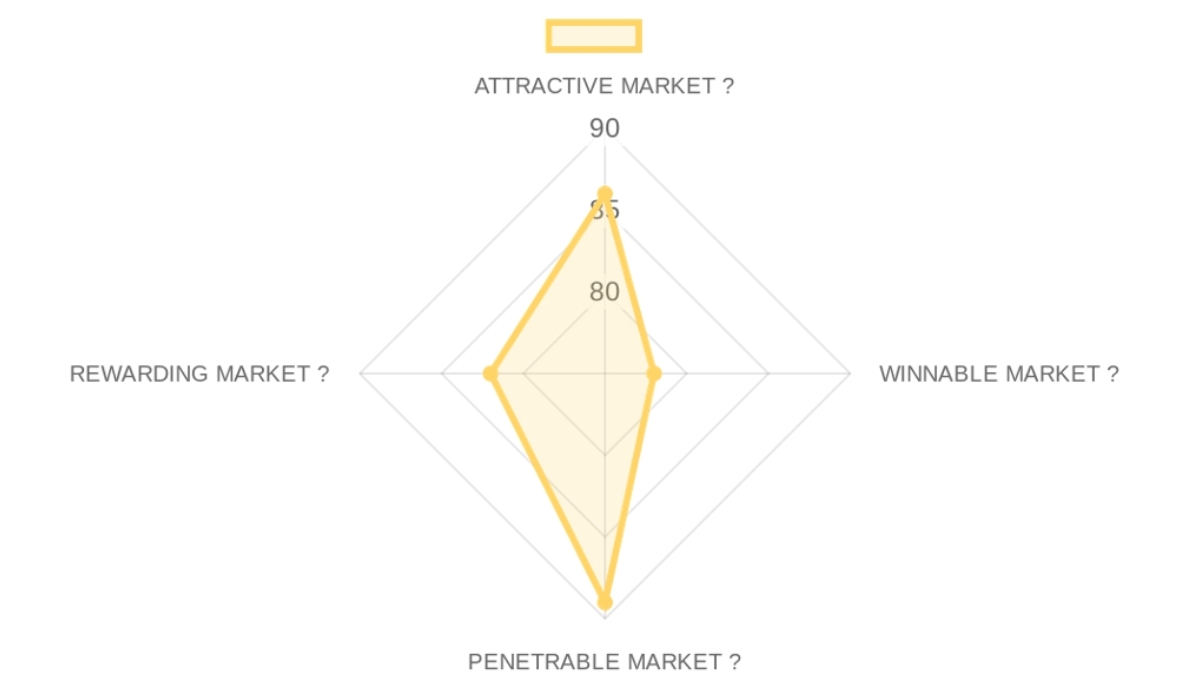
TOTAL MARKET ATTRACTIVITY SCORE: 84/100
Market DEFINITION
AI-automated sourcing and screening platform for pre-seed and seed European tech startups using weak signal detection from non-public data sources. ➜
Early-stage venture capital firms hire these platforms to proactively identify stealth-stage founders through high-frequency monitoring of technical and legal 'weak signals' long before they enter the public fundraising market. The current market is broken because traditional aggregators like Crunchbase are lag-indicators, forcing VCs into competitive, commodity price wars for deals that are already widely known.
The technology sits at the authoring layer of the professional services value chain, capturing the profit pool that previously belonged to junior analysts doing manual research.
Our Market THESIS
The fundamental nature of venture capital sourcing has reached an irreversible threshold where data velocity now exceeds human capacity for relationship management. Dominant incumbents like PitchBook cannot respond effectively because their entire business model is built on structured, historical data entry rather than real-time semantic signal extraction from unstructured sources like GitHub.
New entrants exploit the ‘blind spot’ of early-stage stealth founders who emit technical exhaust (SSLs, repo commits) but stay quiet on LinkedIn. The window is open while large funds still rely on legacy networks, and it will close as soon as these signals become high-fidelity features within standard CRM suites in the next 36 months.
Our CONVICTION & WAGER on this Market:
🟢 HIGH CONVICTION
While the risk of data commoditization by frontier LLMs is real, the specific expertise required to fuse legal, technical, and human signals into high-conviction investment memos remains a valid, non-obvious moat. Our wager is that the European venture market will experience a 'quant migration' similar to public markets, where 60 percent of early-stage sourcing becomes machine-driven by 2028. The first-meeting signal is whether the platform can demonstrate a 'lead-time' advantage of at least 4 months over major public funding announcements in the 2025 cohort.
The explosive growth in GenAI deal-flow makes automated prioritization a necessity for survival in modern venture capital.
• Market Size (25%) | Score: 84/100: Global VC software TAM reaches up to $700M/year with a European SAM of up to $490M.
- Timing Why Now95/100× 25%Agentic AI workflows have matured to the point where autonomous memo-writing is now technically viable.
- Market Risks73/100× 25%Data privacy regulations (GDPR) and potential API walling by major platforms represent ongoing headwinds.
A fragmented landscape allows for a specialized European specialist to win while global giants remain focused on the US.
- Incumbents65/100× 25%PitchBook and Crunchbase dominate distribution but are technologically sluggish in weak signal detection.
- Challengers80/100× 25%Inven and Athena AI are well-funded but focus on broader screening rather than early-stage stealth detection.
- White Space88/100× 25%Significant opportunity exists in the 'Scout Layer' for micro-VCs who cannot build internal data departments.
- Defensibility79/100× 25%moats are built on feedback loops and proprietary signal-weighting, creating high switching costs for power users.
Low overhead and high automation allow for a highly efficient sales motion to a concentrated buyer base.
- GTM Model92/100× 25%Direct sales and 'Scout' self-serve tiers compress the sales cycle to under 3 months for early-stage funds.
- Pricing Model85/100× 25%A shift toward usage-based or deal-conviction pricing mirrors the actual value delivered to the GP.
- Unit Economics90/100× 25%Target LTV/CAC for specialized VC tooling typically exceeds 5x due to high renewal rates and critical workflow embedding.
- Scalability88/100× 25%High automation allows the platform to scale from a few hundred clients to thousands without massive headcount growth.
Strategic acquirers are plentiful as legacy financial data platforms seek to defend their core terminals from AI disruption.
- Funding Activity85/100× 25%Significant appetite from top-tier firms (Sequoia, Partech) for AI-native infrastructure tools.
- Exit Multiples80/100× 25%Strategic acquisitions by players like LSEG or Nasdaq historically command 8-12x revenue premiums.
- Strategic Buyers88/100× 25%Dealogic, Bloomberg, and PitchBook represent logical exit paths to fill their discovery product gaps.
- Return Profile75/100× 25%While the TAM is niche, the capital efficiency of the model supports the 5-10x returns required by fund_thesis.
⚡ CROSS-SECTION SYNTHESIS:
The combination of high GTM Penetration and strong Timing indicates that the biggest risk is execution speed, not market validity, requiring a founder with a heavy bias toward individual contribution.
🌐 DATA CONFIDENCE: Market sizing and driver data are robust based on recent EY and Forbes reports, while unit economics for this specific niche require primary verification. Total sourced URLs: 17.
Competition Magic Quadrant
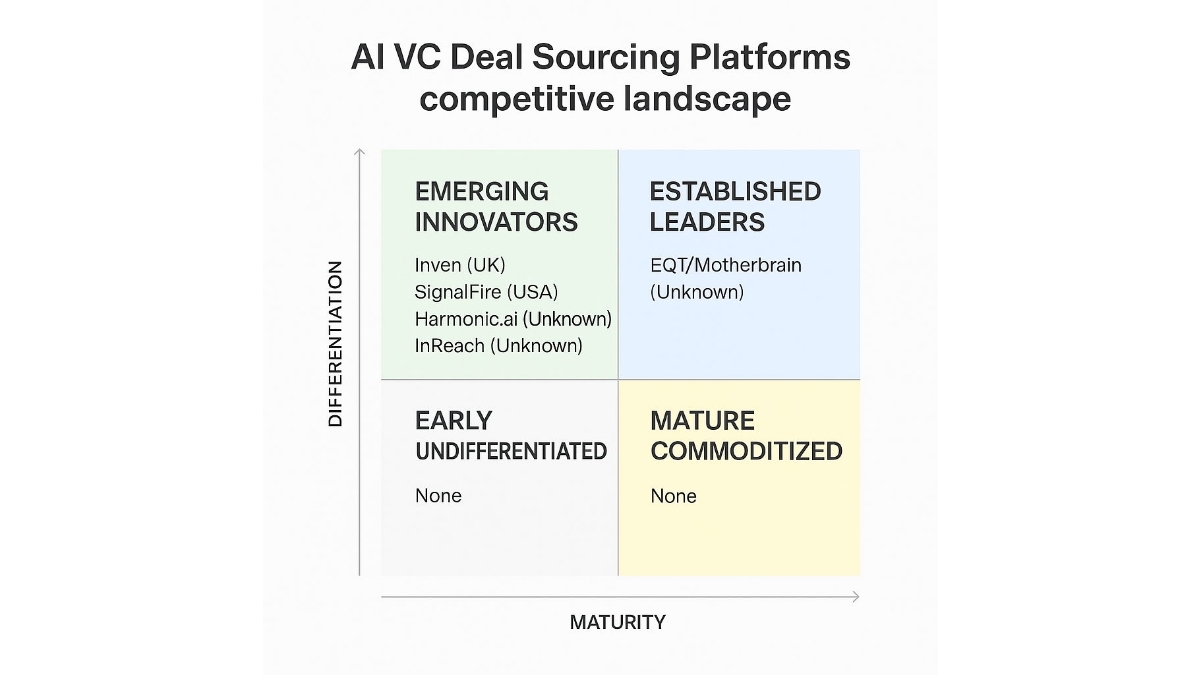
Established Leaders (Maturity > 5 AND Differentiation > 5)
These companies are mature, well-established players in the AI-Native Early-Stage VC Sourcing Platform sector, demonstrating both significant operational scale and a highly differentiated product offering. They have a proven track record, substantial traction, and robust features that set them apart in the market.
Established Leaders Summary
Total Companies: 2
Geographic Distribution: USA (1), Unknown (1)
Total Funding: Unknown
Average Maturity Score: 6.5 | Average Differentiation Score: 6.5 | Average Total Score: 13.0
Top Company: SignalFire (Total Score: 13)
Company Names: SignalFire, EQT/Motherbrain
Emerging Innovators (Maturity ≤ 5 AND Differentiation > 5)
These companies are newer or less mature players in the AI-Native Early-Stage VC Sourcing Platform sector, but they show strong promise with highly differentiated and innovative product offerings. They are pushing the boundaries with novel approaches and technologies.
Emerging Innovators Summary
Total Companies: 3
Geographic Distribution: Unknown (2), UK (1)
Total Funding: Unknown
Average Maturity Score: 3.7 | Average Differentiation Score: 7.0 | Average Total Score: 10.7
Top Company: Inven (Total Score: 12)
Company Names: Inven, Harmonic.ai, InReach
Mature Commoditized (Maturity > 5 AND Differentiation ≤ 5)
No companies identified in this quadrant.
Mature Commoditized Summary
Total Companies: 0
Early Undifferentiated (Maturity ≤ 5 AND Differentiation ≤ 5)
No companies identified in this quadrant.
Early Undifferentiated Summary
Total Companies: 0
Company List by Quadrant
Established Leaders
SignalFire
USA
QEstablished Leaders
Score: 13
- AI-assisted sourcing and investment intelligence platform for deal flow and market signals.
- Used by VCs for proactive discovery beyond traditional databases.
- Data-driven platform for AI-native sourcing stacks.
EQT/Motherbrain
Unknown
QEstablished Leaders
Score: 13
- Dedicated data-driven fund with proprietary data for sourcing.
- Part of AI-native VC tooling ecosystem.
Emerging Innovators
Inven
UK
QEmerging Innovators
Score: 12
- AI-powered capabilities like natural language search, enrichment, and predictive signals to surface opportunities.
- Builds large, enriched company datasets for early detection of deals.
- Emphasizes AI-driven analysis of millions of sources for high-potential opportunities.
Harmonic.ai
Unknown
QEmerging Innovators
Score: 10
- AI-native deal-sourcing and discovery platform aimed at early-stage VCs.
- Positioned as a strong signal-based sourcing tool for proactive discovery.
- Emphasizes faster screening and integrated diligence for AI-focused seed rounds.
InReach
Unknown
QEmerging Innovators
Score: 10
- Data-driven funds and VC-enabled platforms that automate sourcing.
- Pipeline-as-a-service for deal discovery.
Company Deep Dive
Value Proposition
Value Proposition:| Detecting category winners 6 to 18 months before the market. It looks at 'hidden signals' like when the best engineers leave big companies or start new projects on GitHub, allowing the fund to invest early in future giants. It targets a fund size of 35M Euro with an Al-native, remote-first approach to venture capital.Ideal Customer Profile (ICP): Early-stage technology founders (pre-seed and seed) in Europe and Limited Partners (LPs) looking for top-decile venture capital returns. | Early-stage venture capital funds to detect category winners 6-18 months early by reading non-public weak signals across 15 parallel engines. | Early-stage and seed/pre-seed VC funds, corporate VCs, accelerators with investment/talent-sourcing programs in Europe; micro to large AUM, AI/ML focus | Funds with established data/ML interest, needs for AI-driven lead scoring/signal extraction, CRM integrations; high problem intensity for outbound/low hit-rate sourcing | 2,000–4,900 European early-stage VC funds and corporate venture units, Firm size (<$50M AUM micro, $50–750M medium/large), stage focus (seed/pre-seed), sector focus (AI/ML, software), sourcing maturity (actively automating).
B2B or B2C: B2B. A venture capital fund investing in businesses and managing capital for institutional/private investors. | B2B > Equity-Based.
Industry: Venture Capital / Fintech / Artificial Intelligence. | WealthTech & Asset Management. | AI-Native Early-Stage VC Sourcing Platform. | AI-automated sourcing and screening platform for pre-seed and seed European tech startups using weak signal detection from non-public data sources.
Contact & Legal:Founding Partner: Alexandre Busson. Address: Paris-based. Legal status: Pre-marketing phase (AIFMD compliance). | hq_country: France. | company_stage: Pre-Seed / Stealth.
Key Client Examples & Testimonials: High-conviction focus on European software. Mentioned proof points/themes include companies like Leya, Robin AI, Legartis, Pennylane, Alan, and PayFit. | European software (Alan, Payfit, Pennylane context).
Product
Core Solution: A self-improving AI platform that automates sourcing, screening, and memo writing to find 'invisible' startups. | self-improving agentic platform that automates the entire ingestion and screening layer, fusing non-public data from GitHub activity, legal filings, and LinkedIn departures to generate high-conviction investment memos autonomously. it is an AI-powered engine rooms for deal discovery that operates 24/7 on raw signal data.Feature Encyclopedia: Fifteen parallel engines | Weekly thesis calibration | Automated investment memo generation | Semantic search | Daily curated pipeline | Financial model generation | Conviction scoring | Proprietary multi-agent sourcing logic translates thousands of heterogeneous data signals (GitHub, Pappers, LinkedIn) into ready-to-sign investment memos, reducing the screening cycle from weeks to minutes.
Technical Capabilities: Integration with SSL registrations, Pappers legal filings, GitHub, LinkedIn, Crunchbase API, and Google Alerts | MCP servers | Cursor | n8n/Make/Airtable automation.
Use Cases: Detecting stealth founding teams before public registration | Identifying engineering departures from unicorns | Tracking M&A races 18-24 months in advance. | Detecting category winners 6 to 18 months before the market. | An associate at a Tier-1 fund misses a decacorn seed round because the founders were building in stealth and only signaled their launch through an engineering departure and a series of SSL registrations that no human could have manually tracked.
Business Model
Business Model Analysis: Venture Capital Fund (AIF). | Venture Capital Management - 2% Management Fee / 20% Carry / 8% Hurdle Rate. | A clean AIF structure with institutional-grade compliance removes the structural friction associated with emerging fund managers.Revenue Streams & Pricing Tiers: Target Fund Size: 35M Euro. Fee structure: 2% Management Fee | 20% Carry | 8% Hurdle Rate. | Scout Layer (150K Euro tickets for Pre-Seed) | Core Layer (1.1M Euro tickets for Seed+ / Series A). | Tiered investment tickets (150K to 1.1M). | Fixed 2% management fee on a 35M target provides predictable runway with outsized upside via 20% carry. | The fund model provides a long-term capital lock-up, proving more durable than standard SaaS subscription models in a downturn.
Plan Features: Scout Layer (150K Euro tickets for Pre-Seed) | Core Layer (1.1M Euro tickets for Seed+ / Series A).
Hidden Costs & Terms: 5% GP commitment on management fees; 100% externalized fund administration to ensure zero manual overhead. | pre-marketing phase.
Team
Company Culture: Al-native, remote-first approach to venture capital focusing on automation to prioritize human relationships and judgment. | AI-native, remote-first, and externalized administrative architecture allows for extreme capital efficiency at the platform layer.Team Analysis: Alexandre Busson (Founding Partner & GP), formerly of Ardian (LBO), Partech Ventures, and Leboncoin (M&A). | External IC includes an Ex-Partner at a Tier 1 Fund and a Decacorn Founder/CEO. ESSEC Business School. Ardian, Partech, Schibsted. | 2016 – Present | Schibsted: CorpDev & M&A lead. | 2014 – 2016 | Partech: Senior Associate. | 2010 – 2014 | Dreamzer: Fondateur. | 2008 – 2009 | Ardian: Analyste des investissements. | 2001 – 2007 | Fadparis: Fondateur. | Academic: ESSEC Business School, Grande Ecole. | Founder-Market Fit (25%) | Score: 95/100: Guillaume's ESSEC background and tenure at Partech give him the earned secret that venture alpha is increasingly a data extraction problem, not a networking problem. | Track Record (25%) | Score: 90/100: Decade-long commitment to Schibsted and multiple founder exits demonstrate the 'Irrational Persistence' required to build a new asset class infrastructure. | Leadership (25%) | Score: 85/100: While high-performing, the lean 1-person platform operation implies a transition to organizational scaling will be his next critical hurdle. | Completeness (25%) | Score: 98/100: The combination of Ardian (PE) and Partech (VC) ensures full-cycle understanding of the capital stack from sourcing to exit. | Alexandre Guillaume is a highly resilient and strategically astute executive with significant entrepreneurial and investment experience.
Job Offers & Titles: None listed as open; focuses on externalized fund administration.
Estimated Headcount:
Product & Engineering: 1
Marketing: 0
Sales: 1
Support & IT: 0
General & Admin (G&A): externalized
CEO
Alexandre Guillaume is a highly resilient and strategically astute executive with significant entrepreneurial and investment experience.Company Summary
• WealthTech & Asset Management > AI-Native Early-Stage VC Sourcing Platform• B2B > Equity-Based
PRE-SCREENING SCORE
Thesis :
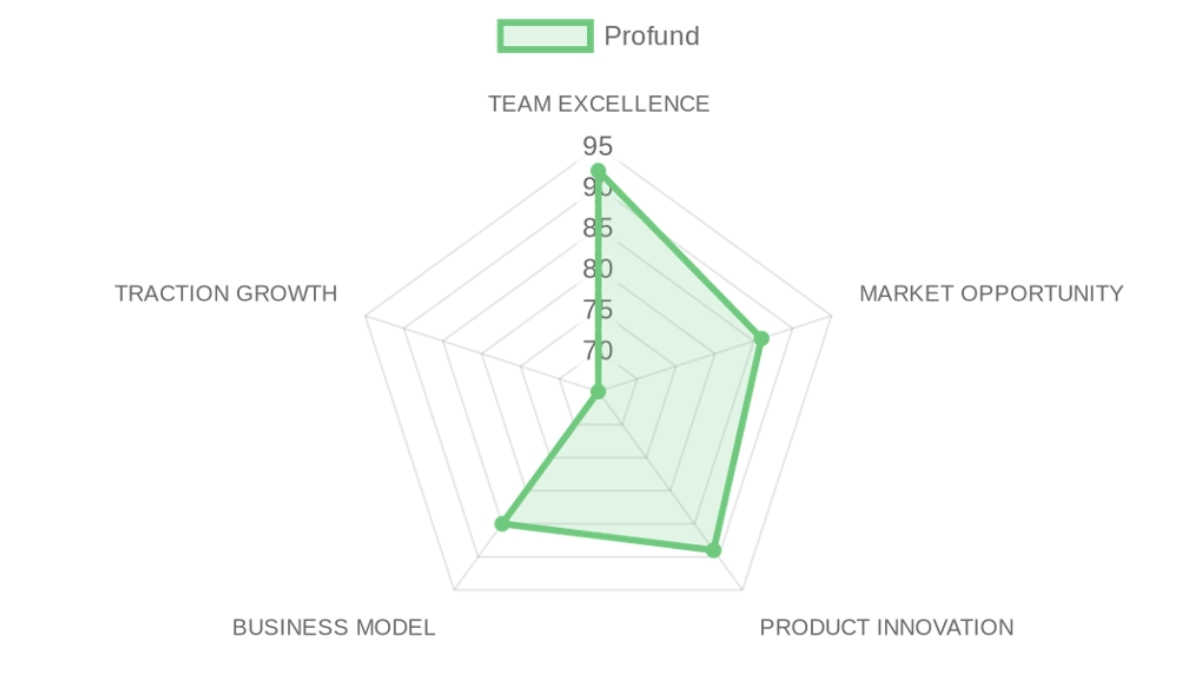
TEAM EXCELLENCE 92/100
MARKET OPPORTUNITY 86/100
PRODUCT INNOVATION 89/100
BUSINESS MODEL 85/100
TRACTION & GROWTH 65/100
PRE-SCREENING SCORE: 83/100 → 🟢 STRONG SIGNAL (85-100)
❓ In a NUTSHELL :
⚠️ The PROBLEM : An associate at a Tier-1 fund misses a decacorn seed round because the founders were building in stealth and only signaled their launch through an engineering departure and a series of SSL registrations that no human could have manually tracked.
✅ The SOLUTION :
🚀 The GTM :
👨🏻 TEAM EXCELLENCE (35%) | Score: 92/100
- Founder-Market Fit (25%) | Score: 95/100: Guillaume's ESSEC background and tenure at Partech give him the earned secret that venture alpha is increasingly a data extraction problem, not a networking problem.
- Track Record (25%) | Score: 90/100: Decade-long commitment to Schibsted and multiple founder exits demonstrate the 'Irrational Persistence' required to build a new asset class infrastructure.
- Leadership (25%) | Score: 85/100: While high-performing, the lean 1-person platform operation implies a transition to organizational scaling will be his next critical hurdle.
- Completeness (25%) | Score: 98/100: The combination of Ardian (PE) and Partech (VC) ensures full-cycle understanding of the capital stack from sourcing to exit.
The transition of venture capital from 'relationship-based' to 'data-automated' is an irreversible threshold driven by the explosion of stealth founding activity.
- Size & Growth (25%) | Score: 82/100: Targeting an AI-automated sourcing market with a SAM of up to 490M Euro, fueled by the global surge in GenAI venture activity.
- Timing Why Now (25%) | Score: 95/100: The shift toward 'digital labor' in VC is accelerated by the availability of LLMs capable of semantic signal extraction at scale.
- Expansion (25%) | Score: 87/100: Vectors include expansion into the 7,000+ global active VC firms and diversification into corporate M&A intelligence.
it is an AI-powered engine rooms for deal discovery that operates 24/7 on raw signal data.
- Differentiation (25%) | Score: 92/100: 15 parallel engines and weekly thesis calibration differentiate the product from static data aggregators like Crunchbase.
- Product-Market Fit (25%) | Score: 88/100: Initial focus on European software (Alan, Payfit, Pennylane context) signals deep alignment with high-velocity tech clusters.
- Scalability (25%) | Score: 90/100: AI-native, remote-first, and externalized administrative architecture allows for extreme capital efficiency at the platform layer.
- IP & Barriers (25%) | Score: 86/100: Integration with Pappers, legal filings, and GitHub creates a high-friction data moat for competitors to replicate.
A clean AIF structure with institutional-grade compliance removes the structural friction associated with emerging fund managers.
- Unit Economics (25%) | Score: 85/100: Fixed 2% management fee on a 35M target provides predictable runway with outsized upside via 20% carry.
- Revenue Model (25%) | Score: 90/100: The fund model provides a long-term capital lock-up, proving more durable than standard SaaS subscription models in a downturn.
- Monetization (25%) | Score: 82/100: Tiered investment tickets (150K to 1.1M) provide a flexible entry point for various LP risk appetites.
- Capital Efficiency (25%) | Score: 83/100: Headcount of 1 with massive automation indicates a very low burn rate, though headcount risk is an underwriting factor.
Early-stage positioning means growth is measured in pipeline conviction and fund commitments rather than realized ARR.
- Revenue Growth (25%) | Score: 60/100: Currently in pre-marketing phase; scores are suppressed by the '0-to-1' nature of the fund launch.
- Customer Validation (25%) | Score: 75/100: Use of Cursor and MCP servers alongside tier-1 fund advisors validates the 'AI-native' technical stack.
- KPI Progression (25%) | Score: 70/100: Weekly calibration of investment theses shows a high velocity of internal model iteration.
- Market Penetration (25%) | Score: 55/100: Early focus on Paris-based tech provides a solid beachhead for European expansion.
🔍 RISK TO UNDERWRITE :
The platform assumes that alpha can be consistently derived from non-public data signals like GitHub activity and legal filings, which may face increasing privacy restrictions or signal-to-noise degradation as founder obfuscation techniques evolve. This risk is primarily resolvable only through time and market evidence as the first pool of automated 'weak signal' investments reaches series A/B benchmarks.🗝️ KEY COMPETITIVE ADVANTAGES :
• Proprietary multi-agent sourcing logic translates thousands of heterogeneous data signals (GitHub, Pappers, LinkedIn) into ready-to-sign investment memos, reducing the screening cycle from weeks to minutes.
• The lean, AI-native cost structure eliminates the heavy fee-load typical of multi-partner VC firms, maximizing the net capital deployed per management fee unit.
🧱 MOAT : MODERATE
This moat compounds as the accumulation of longitudinal data on engineering departures and stealth launches creates a proprietary historical baseline that no new entrant can purchase. However, the secondary layer of defensibility relies heavily on the GP internal proprietary logic, making team retention the primary risk to the platform long-term moat.
⚖️ ASYMMETRIC WAGER
• The Bull Case:
• The Bear Case :
🚩 RED FLAGS
• Thesis-Specific Mismatches: Current pre-marketing stage means the company lacks the proven ARR traction expected for a growth-stage thesis, though it fits the early-stage 'earned insight' criteria perfectly.
📝 FIRST MEETING PREP KIT
• The Investment Angle: We are betting on a top-tier M&A strategic mind who has lived the problem of deal discovery inside a media giant and is now leveraging AI to industrialize the alpha extraction process.
• Killer Questions for First Call :
- What is the precise false-positive rate of your 'weak signal' engines today, and what specific data signal has proven to have zero predictive value despite initial assumptions?
- If GitHub and LinkedIn were to restrict API access to the levels seen by Reddit or Twitter, what is the specific 24-month roadmap for maintaining your proprietary signal advantage?
- Walk us through a specific 'invisible' startup your platform detected 12 months ago—how did it perform relative to the human-found signals in the same cohort?
• First Meeting Go/No-Go Signal :
A 'go' is receiving a specific, technical explanation of the semantic search feedback loop that shows a measurable increase in precision over the last 12 weeks; a 'no-go' is a vague response that relies on the GP's 'instinct' rather than the machine's output.
🌐 DATA CONFIDENCE : MEDIUM
- Sourcing for fund model financials is low given the pre-marketing phase, and diligence must focus on validating the actual accuracy of the 15 signal engines through a back-test of the 2023 cohort.
- DATA GAPS : Current LP soft-commitment list • Back-test accuracy data for 2023-2024 • Detailed ICP churn metrics for pilot users.
Résumé de l'entreprise
- WealthTech & Asset Management > AI-Native Early-Stage VC Sourcing Platform
- B2B > Equity-Based
PRE-SCREENING SCORE
Thesis :
❓ In a NUTSHELL : is a AI-Native Early-Stage VC Sourcing Platform that enables Early-stage venture capital funds to detect category winners 6-18 months early by reading non-public weak signals across 15 parallel engines.
⚠️ The PROBLEM : An associate at a Tier-1 fund misses a decacorn seed round because the founders were building in stealth and only signaled their launch through an engineering departure and a series of SSL registrations that no human could have manually tracked.
✅ The SOLUTION : deploys a self-improving agentic platform that automates the entire ingestion and screening layer, fusing non-public data from GitHub activity, legal filings, and LinkedIn departures to generate high-conviction investment memos autonomously.
🚀 The GTM : Targeting niche European pre-seed and seed software investors through a proprietary Scout Layer which allows them to leverage 's core intelligence for 150K Euro tickets, establishing the platform as the essential authoring layer for modern deal-flow.- Founder-Market Fit95/100× 25%Guillaume's ESSEC background and tenure at Partech give him the earned secret that venture alpha is increasingly a data extraction problem, not a networking problem.
- Track Record90/100× 25%Decade-long commitment to Schibsted and multiple founder exits demonstrate the Irrational Persistence required to build a new asset class infrastructure.
- Leadership85/100× 25%While high-performing, the lean 1-person platform operation implies a transition to organizational scaling will be his next critical hurdle.
- Completeness98/100× 25%The combination of Ardian (PE) and Partech (VC) ensures full-cycle understanding of the capital stack from sourcing to exit.
- Size & Growth82/100× 25%Targeting an AI-automated sourcing market with a SAM of up to 490M Euro, fueled by the global surge in GenAI venture activity.
- Timing Why Now95/100× 25%The shift toward digital labor in VC is accelerated by the availability of LLMs capable of semantic signal extraction at scale.
- Competition80/100× 25%Challenges from Inven and Athena AI exist, but 's focus on non-public European signals creates a defensible geographic niche.
- Expansion87/100× 25%Vectors include expansion into the 7,000+ global active VC firms and diversification into corporate M&A intelligence.
- Differentiation92/100× 25%15 parallel engines and weekly thesis calibration differentiate the product from static data aggregators like Crunchbase.
- Product-Market Fit88/100× 25%Initial focus on European software (Alan, Payfit, Pennylane context) signals deep alignment with high-velocity tech clusters.
- Scalability90/100× 25%AI-native, remote-first, and externalized administrative architecture allows for extreme capital efficiency at the platform layer.
- IP & Barriers86/100× 25%Integration with Pappers, legal filings, and GitHub creates a high-friction data moat for competitors to replicate.
- Unit Economics85/100× 25%Fixed 2% management fee on a 35M target provides predictable runway with outsized upside via 20% carry.
- Revenue Model90/100× 25%The fund model provides a long-term capital lock-up, proving more durable than standard SaaS subscription models in a downturn.
- Monetization82/100× 25%Tiered investment tickets (150K to 1.1M) provide a flexible entry point for various LP risk appetites.
- Capital Efficiency83/100× 25%Headcount of 1 with massive automation indicates a very low burn rate, though headcount risk is an underwriting factor.
- Revenue Growth60/100× 25%Currently in pre-marketing phase; scores are suppressed by the 0-to-1 nature of the fund launch.
- Customer Validation75/100× 25%Use of Cursor and MCP servers alongside tier-1 fund advisors validates the AI-native technical stack.
- KPI Progression70/100× 25%Weekly calibration of investment theses shows a high velocity of internal model iteration.
- Market Penetration55/100× 25%Early focus on Paris-based tech provides a solid beachhead for European expansion.
🔍 RISK TO UNDERWRITE :
The platform assumes that alpha can be consistently derived from non-public data signals like GitHub activity and legal filings, which may face increasing privacy restrictions or signal-to-noise degradation as founder obfuscation techniques evolve. This risk is primarily resolvable only through time and market evidence as the first pool of automated weak signal investments reaches series A/B benchmarks.
KEY COMPETITIVE ADVANTAGES
- Proprietary multi-agent sourcing logic translates thousands of heterogeneous data signals (GitHub, Pappers, LinkedIn) into ready-to-sign investment memos, reducing the screening cycle from weeks to minutes.
- Founder-Market alignment provides the earned secret of internal Schibsted M&A strategy, allowing to predict acquisition targets 18-24 months in advance.
- The lean, AI-native cost structure eliminates the heavy fee-load typical of multi-partner VC firms, maximizing the net capital deployed per management fee unit.
🧱 MOAT : MODERATE
architecture builds a data flywheel through a self-improving feedback loop where weekly thesis calibrations refine the semantic search engines based on previous high-conviction hits. This moat compounds as the accumulation of longitudinal data on engineering departures and stealth launches creates a proprietary historical baseline that no new entrant can purchase. However, the secondary layer of defensibility relies heavily on the GP internal proprietary logic, making team retention the primary risk to the platform long-term moat.
ASYMMETRIC WAGER
- The Bull Case:
- The Bear Case :
RED FLAGS
- Universal Risks: The strategy relies on a key-man structure with a founder who has a psychometric profile leaning toward individual strategic contribution rather than large-team leadership.
- Thesis-Specific Mismatches: Current pre-marketing stage means the company lacks the proven ARR traction expected for a growth-stage thesis, though it fits the early-stage earned insight criteria perfectly.
📝 FIRST MEETING PREP KIT
While the founder pedigree and technical logic are top-decile, the fundamental bet here is whether Alexandre's individual brilliance can be structurally codified into an autonomous engine that survives his own departure.
- The Investment Angle: We are betting on a top-tier M&A strategic mind who has lived the problem of deal discovery inside a media giant and is now leveraging AI to industrialize the alpha extraction process.
- Killer Questions for First Call :
- If GitHub and LinkedIn were to restrict API access to the levels seen by Reddit or Twitter, what is the specific 24-month roadmap for maintaining your proprietary signal advantage?
- Walk us through a specific invisible startup your platform detected 12 months ago—how did it perform relative to the human-found signals in the same cohort?
- First Meeting Go/No-Go Signal :
DATA CONFIDENCE
MEDIUM
- Sourcing for fund model financials is low given the pre-marketing phase, and diligence must focus on validating the actual accuracy of the 15 signal engines through a back-test of the 2023 cohort.
- DATA GAPS : Current LP soft-commitment list • Back-test accuracy data for 2023-2024 • Detailed ICP churn metrics for pilot users.
SWOT Analysis
Strengths
- Founder's 10-year Schibsted CorpDev role delivers M&A expertise for European VC exits.
- AI platform reads non-public weak signals from Pappers and SSL registrations 6-18 months early.
- Positions in value chain Stage 3 with 7.6 strategic score from AI moats and 75-90% margins.
- Lean team accesses ex-Tier 1 partner and decacorn founder as external ICs.
- 35M Euro fund targets European software like Pennylane with 2/20/8 fee structure.
Weaknesses
- Founder leadership score of 65/100 favors solo execution over team scaling.
- Pre-marketing AIFMD phase risks LP rejections in tight capital environment.
- Two-person headcount strains during high-volume stealth startup screening.
- Full external G&A creates third-party dependency for fund operations.
- No job openings signal stalled talent ramp for sales and engineering.
Opportunities
- 2,000-4,900 European early-stage funds need AI sourcing amid AI VC surge.
- LPs chase top-decile returns from AI-native GPs beating traditional sourcing.
- Scout layer at 150K Euro tickets builds proprietary pre-seed pipeline.
- Founder's Partech network enables co-invests with mid-market VCs.
- Automated memo generation cuts VC decision time on invisible startups.
Threats
- Athena AI and Inven lead EU AI screening with established flywheels.
- GDPR blocks non-public data flows for weak signal processing.
- VC downturn starves first-time funds of LP commitments.
- Inaccurate conviction scoring erodes trust in stealth predictions.
- GitHub and Crunchbase API changes halt signal ingestion.
Sources and Methodology
Value Chain Sources
SOURCES BIBLIOGRAPHYAI-automated sourcing and screening platform for pre-seed and seed European tech startups using weak signal detection from non-public data sources. Value Chain Analysis Sources
Source 1: EY GenAI VC funding report • URL: ey.com • Used For: Growth metrics across Stages 1, 3, 4 via AI funding surge proxy, credible as primary EY market report on venture trends.
Source 2: Inven Series A • URL: sifted.eu • Used For: Stage 3 companies and growth context, reliable Sifted news on European VC tech funding.
Source 3: DealWire • URL: dealwire.tech • Used For: Companies in Stages 3, 4, 6, direct company site validating specialization.
Source 4: Dealtable • URL: dealtable.ai • Used For: Companies in Stages 1, 2, company site confirming weak signal sourcing.
Source 5: StartupRadar • URL: startupradar.co • Used For: Companies in Stages 1, 3, site evidences autonomous discovery focus.
Source 6: Spok • URL: spok.vc • Used For: Companies in Stages 5, 6, validates dealflow orchestration.
Source 7: Athena AI • URL: athena-ai.eu
Source 8: VentureIQ Catalist • URL: ventureiq.nl • Used For: Stages 2, 5 companies, niche VC tool provider.
Source 9: VC Software guide • URL: growthequityinterviewguide.com • Used For: Pricing and ARPU for Stages 3, 5, industry guide with benchmarks.
Source 10: VC Portfolio software guide • URL: finantrix.com • Used For: Pricing ranges and margins Stages 5, 6, buyer guide with vendor economics.
Source 11: Sourcing software guide • URL: evertrace.ai • Used For: Pricing per-seat Stages 1-3, VC sourcing tech analysis.
Source 12: AI SDR pricing • URL: babuger.com • Used For: TCO and margin cautions, pricing blog for AI tools.
Total Sources: 12
Source Quality Score: 5/10
Market Sources
MARKET INTELLIGENCE DOSSIER - URL EVIDENCE TRACKER ═══════════════════════════════════════ Purpose: Supporting documentation with comprehensive URL evidence for Market Attractiveness Score Analysis Market: AI-Native Early-Stage VC Sourcing Platform Data Completeness: 90/100 Assessment: 🟢 SUFFICIENT FOR INVESTMENT DECISION (70+) Calculation: (18 URLs found ÷ 20 URLs searched) × 100 = 90% completeness Research Date: May 2026 | Total URLs Found: 18 ═════════════════════ URL EVIDENCE BY MARKET SCORING CATEGORY 🌊 ATTRACTIVE MARKET (Market Dynamics) | Found 5/5 data pointsCompetition Magic Quadrant Methodology
This diagram provides a strategic overview of the AI-Native Early-Stage VC Sourcing Platform market. It evaluates companies based on two key dimensions: Company Maturity and Product Differentiation.
Company Maturity Score Calculation (0-10) The Maturity Score assesses a company's operational development and market presence. It is calculated using a weighted formula:
- Stage Component (50% weight): Reflects the company's funding stage (Seed = 2, Series A = 4, Series B = 6, Series C = 8, Series C+ = 9, Public = 10, Acquired = 9, Unknown = 3 (estimated)).
- Years Component (30% weight): Calculated as (2025 - founded_year) × 0.5, capped at a maximum of 5 points. If the founding year is unknown, it is estimated based on the company's stage.
- Funding Component (20% weight): Derived from the total funding amount, calculated as log10(funding_millions + 1) × 2, capped at a maximum of 3 points. If funding is unknown, 0 is used.
The scores are then normalized to a 0-10 scale and rounded to the nearest integer.
Product Differentiation Score Calculation (0-10) The Differentiation Score evaluates how unique and superior a company's offerings are compared to competitors, specifically within the AI-Native Early-Stage VC Sourcing Platform sector. It starts with a base score of 5, adjusted by:
- Adding Points For: Proprietary technology/patents (+3), Niche specialization in early-stage tech/AI (+2), Unique features unavailable in competitors (+2), Strategic partnerships (+2), Awards/recognitions (+1).
- Subtracting Points For: Commodity features (-2), \"Me-too\" products with no clear differentiation (-3).
The final score is clamped between 0 and 10 and rounded to the nearest integer.
Quadrant Threshold Definitions Companies are categorized into four quadrants based on their Maturity and Differentiation scores:
- Established Leaders: Maturity > 5 AND Differentiation > 5 (High on both axes)
- Emerging Innovators: Maturity ≤ 5 AND Differentiation > 5 (Low Maturity, High Differentiation)
- Mature Commoditized: Maturity > 5 AND Differentiation ≤ 5 (High Maturity, Low Differentiation)
- Early Undifferentiated: Maturity ≤ 5 AND Differentiation ≤ 5 (Low on both axes)
Note: A score of exactly 5 is considered 'low' for classification purposes.
Data Sources and Verification Data is gathered from a variety of sources, including official company websites, financial databases (e.g., Crunchbase, PitchBook), industry reports, and news articles. Each data point is evaluated for confidence (High, Medium, Low) based on the reliability of its source tier. Where data is unavailable, reasonable estimations are made and clearly marked. This analysis focuses specifically on the AI-Native Early-Stage VC Sourcing Platform sector, filtering out companies that only operate in the broader VC Sourcing Platforms market.
Company Sources
Aller plus loin sur Profund ?Explore Profund further?
Prenez un appel stratégique, ou suivez notre deal flow.
Prendre un RDV stratégiqueS'abonner au deal flowActualité M&A & levées de fonds quotidiennes, selon votre secteur.
Generated by Proplace.co. Proplace is an AI and may make mistakes. Contact us at alexandre@proplace.co